
腹膜间皮瘤患者端粒酶逆转录酶(TERT)mRNA水平与临床病理特征分析
Analysis of TERT mRNA Levels and Clinicopathological Features in Patients with Peritoneal Mesothelioma.
作者信息
d'Amati Antonio, Serio Gabriella, Quaranta Andrea, Vimercati Luigi, De Giorgis Michelina, Lorusso Loredana, Errede Mariella, Longo Vito, Marzullo Andrea, Ribatti Domenico, Annese Tiziana
机构信息
Department of Medicine and Surgery, LUM University, Casamassima, 70010 Bari, Italy.
Department of Translational Biomedicine and Neuroscience, University of Bari Medical School, 70124 Bari, Italy.
出版信息
Cancers (Basel). 2025 Jan 14;17(2):252. doi: 10.3390/cancers17020252.
BACKGROUND/OBJECTIVES: Telomerase reverse transcriptase (TERT) is the catalytic subunit of the telomerase enzyme responsible for telomere length maintenance and is an important cancer hallmark. Our study aimed to clarify the mRNA expression of TERT in peritoneal mesothelioma (PeM), and to explore the relationship between its expression and the clinicopathological parameters and prognosis of patients with PeM.
METHODS
In a cohort of 13 MpeM patients, we evaluated histotype, nuclear grade, mitotic count, necrosis, inflammation, Ki67, BAP1, MTAP and p16 expression by immunohistochemistry, / status by FISH and TERT mRNA expression by RNAscope.
RESULTS
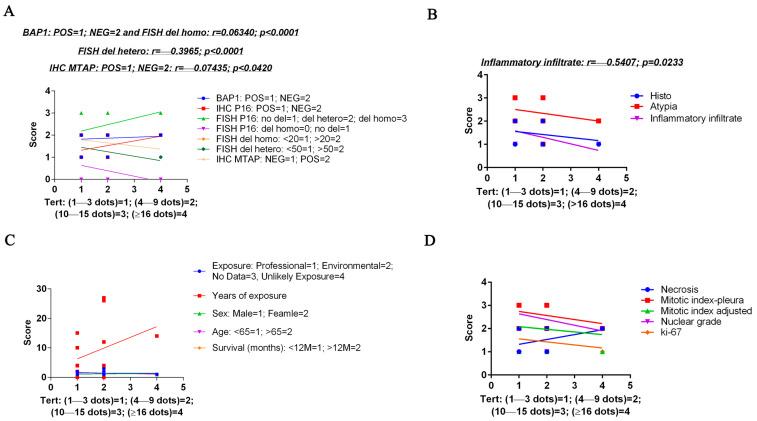
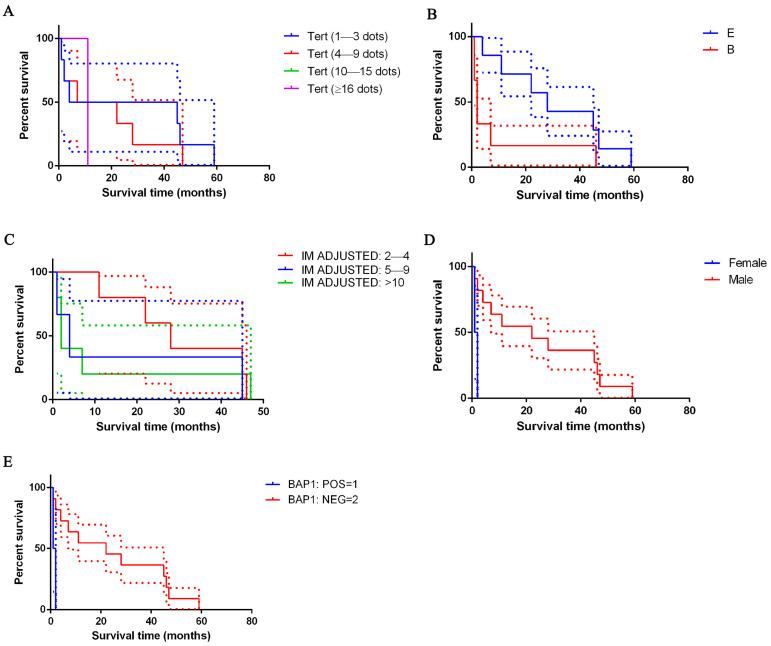
Our results showed several statistical correlations between TERT mRNA-score and other investigated features: (i) a poor positive correlation with BAP1 score ( = 0.06340; ≤ 0.0001); (ii) a moderate positive correlation with FISH del homo ( = 0.6340; ≤ 0.0001); (iii) a fair negative correlation with FISH del hetero ( = -0.3965; ≤ 0.0001); a negative poor correlation with MTAP ( = -0.2443; ≤ 0.0001); and (iv) a negative fair correlation with inflammatory infiltrate (r = -0.5407; = 0.0233). Moreover, patients survive for a significantly longer time if they have a low mitotic index adjusted (2-4 mitotic figures per 2 mm) ( ≤ 0.0001), are male ( = 0.0152), lose BAP1 ( = 0.0152), are p16 positive and present no deletion or heterozygous for ( ≤ 0.01).
CONCLUSIONS
TERT is highly expressed in PeM, but it is not one of the crucial factors in evaluating the prognosis of patients. Nevertheless, the results validate the prognostic significance of the mitotic index, BAP1 loss and /CDKN2A status.
背景/目的:端粒酶逆转录酶(TERT)是端粒酶的催化亚基,负责维持端粒长度,是一个重要的癌症标志。我们的研究旨在阐明TERT在腹膜间皮瘤(PeM)中的mRNA表达,并探讨其表达与PeM患者临床病理参数及预后之间的关系。
方法
在一组13例PeM患者中,我们通过免疫组织化学评估组织学类型、核分级、有丝分裂计数、坏死、炎症、Ki67、BAP1、MTAP和p16表达,通过荧光原位杂交(FISH)评估/状态,通过RNAscope评估TERT mRNA表达。
结果
我们的结果显示TERT mRNA评分与其他研究特征之间存在若干统计学相关性:(i)与BAP1评分呈弱正相关(=0.06340;≤0.0001);(ii)与FISH del homo呈中度正相关(=0.6340;≤0.0001);(iii)与FISH del hetero呈中等负相关(=-0.3965;≤0.0001);与MTAP呈弱负相关(=-0.2443;≤0.0001);(iv)与炎症浸润呈中等负相关(r=-0.5407;=0.0233)。此外,如果患者的有丝分裂指数调整后较低(每2mm有2 - 4个有丝分裂象)(≤0.0001)、为男性(=0.0152)、缺失BAP1(=0.0152)、p16阳性且不存在/缺失或杂合(≤0.01),则患者存活时间显著更长。
结论
TERT在PeM中高表达,但它不是评估患者预后的关键因素之一。然而,这些结果验证了有丝分裂指数、BAP1缺失和/CDKN2A状态的预后意义。


 Zotero 插件