
肝细胞癌中的细胞衰老:通过机器学习和体外实验洞察免疫微环境
Cellular Senescence in Hepatocellular Carcinoma: Immune Microenvironment Insights via Machine Learning and In Vitro Experiments.
作者信息
Lu Xinhe, Luo Yuhang, Huang Yun, Zhu Zhiqiang, Yin Hongyan, Xu Shunqing
机构信息
School of Life and Health Sciences, Hainan University, Haikou 570228, China.
School of Public Health, Tongji Medical College, Huazhong University of Science and Technology, Wuhan 430030, China.
出版信息
Int J Mol Sci. 2025 Jan 17;26(2):773. doi: 10.3390/ijms26020773.
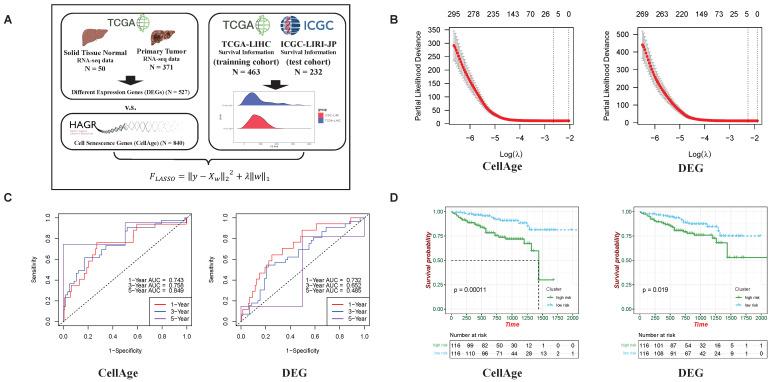
Hepatocellular carcinoma (HCC), a leading liver tumor globally, is influenced by diverse risk factors. Cellular senescence, marked by permanent cell cycle arrest, plays a crucial role in cancer biology, but its markers and roles in the HCC immune microenvironment remain unclear. Three machine learning methods, namely k nearest neighbor (KNN), support vector machine (SVM), and random forest (RF), are utilized to identify eight key HCC cell senescence markers (HCC-CSMs). Consensus clustering revealed molecular subtypes. The single-cell analysis explored the tumor microenvironment, immune checkpoints, and immunotherapy responses. In vitro, RNA interference mediated knockdown, and co-culture experiments assessed its impact. Cellular senescence-related genes predicted HCC survival information better than differential expression genes (DEGs). Eight key HCC-CSMs were identified, which revealed two distinct clusters with different clinical characteristics and mutation patterns. By single-cell RNA-seq data, we investigated the immunological microenvironment and observed that increasing immune cells allow hepatocytes to regain population dominance. This phenomenon may be associated with the HCC-CSMs identified in our study. By combining bulk RNA sequencing and single-cell RNA sequencing data, we identified the key gene and the natural killer (NK) cells that express at the highest levels. knockdown increased NK cell proliferation but reduced function, potentially aiding tumor survival. These findings provide insights into senescence-driven HCC progression and potential therapeutic targets.
肝细胞癌(HCC)是全球主要的肝脏肿瘤,受多种风险因素影响。以永久性细胞周期停滞为特征的细胞衰老在癌症生物学中起着关键作用,但其标志物及其在HCC免疫微环境中的作用仍不清楚。利用三种机器学习方法,即k近邻(KNN)、支持向量机(SVM)和随机森林(RF),来识别八个关键的HCC细胞衰老标志物(HCC-CSMs)。共识聚类揭示了分子亚型。单细胞分析探索了肿瘤微环境、免疫检查点和免疫治疗反应。在体外,通过RNA干扰介导的敲低和共培养实验评估其影响。细胞衰老相关基因比差异表达基因(DEGs)能更好地预测HCC生存信息。鉴定出八个关键的HCC-CSMs,其揭示了具有不同临床特征和突变模式的两个不同聚类。通过单细胞RNA测序数据,我们研究了免疫微环境,并观察到免疫细胞增加使肝细胞重新获得群体优势。这种现象可能与我们研究中鉴定出的HCC-CSMs有关。通过整合批量RNA测序和单细胞RNA测序数据,我们鉴定出关键基因以及表达水平最高的自然杀伤(NK)细胞。敲低该基因增加了NK细胞增殖但降低了其功能,这可能有助于肿瘤存活。这些发现为衰老驱动的HCC进展及潜在治疗靶点提供了见解。



 Zotero 插件