
英国真实世界糖尿病性黄斑水肿患者抗VEGF治疗前两年的视力结果及影响因素
Visual Acuity Outcomes and Influencing Factors in a Cohort of UK Real-World Diabetic Macular Oedema Patients During the First Two Years of Anti-VEGF Treatment.
作者信息
Wen Qing, Karcher Helene, Wright David M, Sinha Samriddhi Buxy, Chakravarthy Usha, Santos Catarina, Igwe Franklin, Salongcay Recivall, Curran Katie, Peto Tunde
机构信息
Centre for Public Health, Institute of Clinical Sciences, School of Medicine, Queen's University Belfast, Belfast BT7 1NN, UK.
Department of Non-Communicable Disease Epidemiology, Faculty of Epidemiology and Population Health, London School of Hygiene and Tropical Medicine, London WC1E 7HT, UK.
出版信息
Pharmaceutics. 2025 Jan 13;17(1):99. doi: 10.3390/pharmaceutics17010099.
BACKGROUND/OBJECTIVES: The visual acuity (VA) outcomes after the first and second years of anti-vascular endothelial growth factor (anti-VEGF) treatment in patients with diabetic macular oedema (DMO) were evaluated, and the factors associated with treatment success were investigated.
METHODS
Using Medisoft electronic medical records (UK), this retrospective cohort study analysed VA outcomes, changes, and determinants in DMO patients at year 1 and year 2 after initial anti-VEGF injection. Descriptive analysis examined baseline demographics and clinical characteristics, while regression models were used to assess associations between these factors and changes in VA.
RESULTS
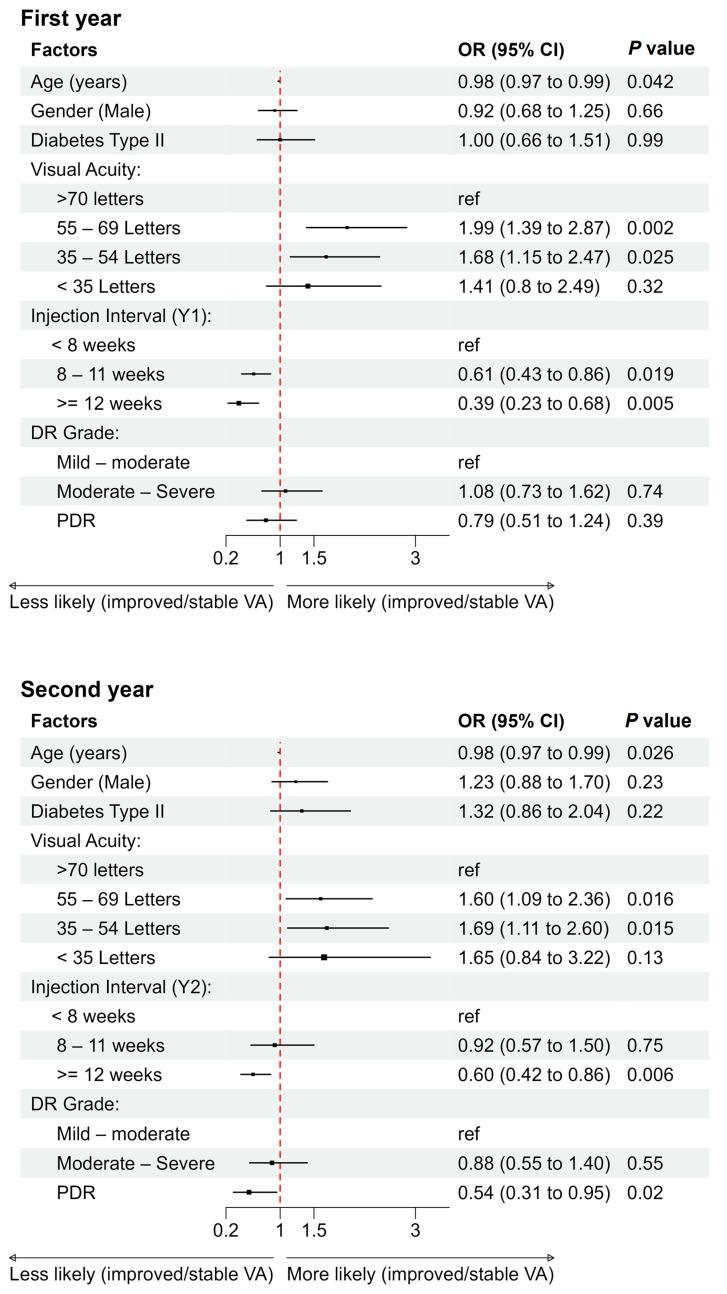
728 DMO patients (1035 eyes) treated with anti-VEGFs (ranibizumab, aflibercept, or bevacizumab) at the Northern Ireland Mater Macular Clinic from 2008 to 2021 were evaluated. The mean age was 64.5 (SD 12.8) years, and 59.6% were male. In the first year, the median annual injection number and interval were 6.0 (IQR 5.0-8.0) and 6.1 weeks (IQR 5.4-7.8), respectively, and in the second year, they were 3.0 (IQR 2.0-5.0) and 10.0 weeks (IQR 6.5-20.1). In the first two treatment years, 83.4% and 79.8% of eyes had improved/stable VA (ISVA) respectively. The injection number, interval, baseline VA, age, and proliferative diabetic retinopathy (PDR) significantly impacted VA outcomes.
CONCLUSIONS
Our study confirms the effectiveness of anti-VEGF treatments in improving or maintaining vision for DMO patients, consistent with previous real-world clinical data. An elder age, a better baseline VA, low annual injection numbers (<5), and less frequent injection intervals (≥12 weeks) were negatively associated with ISVA success in the first two years. These findings have implications for managing patient expectations, allocating resources, and understanding DMO clinical management.
背景/目的:评估糖尿病性黄斑水肿(DMO)患者接受抗血管内皮生长因子(anti-VEGF)治疗第一年和第二年的视力(VA)结果,并调查与治疗成功相关的因素。
方法
利用Medisoft电子病历(英国),这项回顾性队列研究分析了初次抗VEGF注射后第1年和第2年DMO患者的VA结果、变化及决定因素。描述性分析检查了基线人口统计学和临床特征,同时使用回归模型评估这些因素与VA变化之间的关联。
结果
对2008年至2021年在北爱尔兰马特黄斑诊所接受抗VEGF药物(雷珠单抗、阿柏西普或贝伐单抗)治疗的728例DMO患者(1035只眼)进行了评估。平均年龄为64.5(标准差12.8)岁,男性占59.6%。第一年,年注射次数中位数和间隔分别为6.0(四分位间距5.0 - 8.0)和6.1周(四分位间距5.4 - 7.8),第二年分别为3.0(四分位间距2.0 - 5.0)和10.0周(四分位间距6.5 - 20.1)。在治疗的前两年,分别有83.4%和79.8%的患眼视力改善/稳定(ISVA)。注射次数、间隔、基线视力、年龄和增殖性糖尿病视网膜病变(PDR)对VA结果有显著影响。
结论
我们的研究证实了抗VEGF治疗对改善或维持DMO患者视力的有效性,与之前的真实世界临床数据一致。年龄较大、基线视力较好、年注射次数少(<5次)和注射间隔时间长(≥12周)与前两年ISVA成功呈负相关。这些发现对管理患者期望、分配资源以及理解DMO临床管理具有启示意义。


 Zotero 插件