
靶向EBV附加体用于抗癌治疗:新兴策略与挑战
Targeting EBV Episome for Anti-Cancer Therapy: Emerging Strategies and Challenges.
作者信息
Sugiokto Febri Gunawan, Li Renfeng
机构信息
Program in Microbiology and Immunology, University of Pittsburgh, Pittsburgh, PA 15219, USA.
Cancer Virology Program, Hillman Cancer Center, University of Pittsburgh Medical Center, Pittsburgh, PA 15232, USA.
出版信息
Viruses. 2025 Jan 15;17(1):110. doi: 10.3390/v17010110.
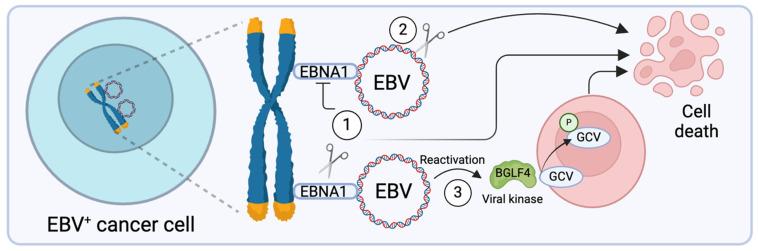
As a ubiquitous human pathogen, the Epstein-Barr virus (EBV) has established lifelong persistent infection in about 95% of the adult population. The EBV infection is associated with approximately 200,000 human cancer cases and 140,000 deaths per year. The presence of EBV in tumor cells provides a unique advantage in targeting the viral genome (also known as episome), to develop anti-cancer therapeutics. In this review, we summarize current strategies targeting the viral episome in cancer cells. We also highlight emerging technologies, such as clustered regularly interspersed short palindromic repeat (CRISPR)-based gene editing or activation, which offer promising avenues for selective targeting of the EBV episome for anti-cancer therapy. We discuss the challenges, limitations, and future perspectives associated with these strategies, including potential off-target effects, anti-cancer efficacy and safety.
作为一种普遍存在的人类病原体,爱泼斯坦-巴尔病毒(EBV)已在约95%的成年人口中建立了终身持续性感染。EBV感染每年与约20万例人类癌症病例和14万例死亡相关。肿瘤细胞中EBV的存在为靶向病毒基因组(也称为附加体)开发抗癌治疗方法提供了独特优势。在本综述中,我们总结了目前针对癌细胞中病毒附加体的策略。我们还强调了新兴技术,如基于成簇规律间隔短回文重复序列(CRISPR)的基因编辑或激活技术,这些技术为选择性靶向EBV附加体进行抗癌治疗提供了有前景的途径。我们讨论了与这些策略相关的挑战、局限性和未来前景,包括潜在的脱靶效应、抗癌疗效和安全性。
 Zotero 插件