
快速眼动睡眠潜伏期与阿尔茨海默病多模态生物标志物的关联。
Association of rapid eye movement sleep latency with multimodal biomarkers of Alzheimer's disease.
作者信息
Jin Jiangli, Chen Jiong, Cavaillès Clémence, Yaffe Kristine, Winer Joseph, Stankeviciute Laura, Lucey Brendan P, Zhou Xiao, Gao Song, Peng Dantao, Leng Yue
机构信息
Clinical Trial Research Center, China-Japan Friendship Hospital, Beijing, China.
Peking University China-Japan Friendship School of Clinical Medicine, Beijing, China.
出版信息
Alzheimers Dement. 2025 Feb;21(2):e14495. doi: 10.1002/alz.14495. Epub 2025 Jan 27.
INTRODUCTION
Sleep disturbances are associated with Alzheimer's disease (AD) and Alzheimer's disease and related dementias (ADRD), but the relationship between sleep architecture, particularly rapid eye movement (REM) sleep, and AD/ADRD biomarkers remains unclear.
METHODS
We enrolled 128 adults (64 with Alzheimer's disease, 41 with mild cognitive impairment [MCI], and 23 with normal cognition [NC]), mean age 70.8 ± 9.6 years, 56.9% female, from a tertiary hospital in China. Participants underwent overnight polysomnography (PSG), amyloid β (Aβ) positron emission tomography (PET), and plasma biomarker analysis: phosphorylated tau at threonine 181 (p-tau181), neurofilament light (NfL), and brain-derived neurotrophic factor (BDNF).
RESULTS
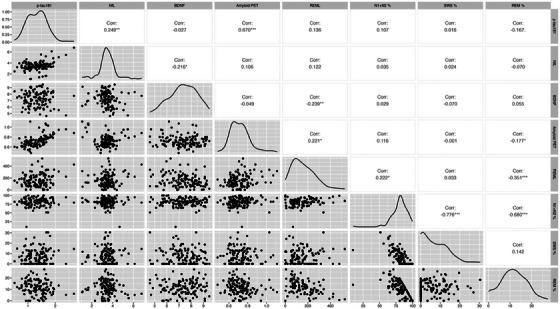
After adjusting for demographics, apolipoprotein E (APOE) ε4 status, cognition, and comorbidities, the highest tertile of REM latency was associated with higher Aβ burden (β = 0.08, 95% confidence interval [CI]: 0.03 to 0.13, p = 0.002), elevated p-tau181 (β = 0.19, 95% CI: 0.02 to 0.13, p = 0.002), and reduced BDNF levels (β = -0.47, 95% CI: -0.68 to -0.13, p = 0.013), compared to the lowest tertile.
DISCUSSION
Prolonged REM latency may serve as a novel marker or risk factor for AD/ADRD pathogenesis.
HIGHLIGHTS
Rapid eye movement latency (REML) may be a potential marker for Alzheimer's disease and Alzheimer's disease and related dementias (AD/ADRD) pathogenesis. Prolonged REML was associated with higher amyloid beta (Aβ) burden, phosphorylated tau-181 (p-tau181), and lower brain-derived neurotrophic factor (BDNF) levels. Intervention trial is needed to determine if targeting REML can modify AD/ADRD risk. Slow-wave sleep was not associated with AD/ADRD biomarkers.
引言
睡眠障碍与阿尔茨海默病(AD)以及阿尔茨海默病和相关痴呆症(ADRD)有关,但睡眠结构,尤其是快速眼动(REM)睡眠与AD/ADRD生物标志物之间的关系仍不清楚。
方法
我们从中国一家三级医院招募了128名成年人(64名患有阿尔茨海默病,41名患有轻度认知障碍[MCI],23名认知正常[NC]),平均年龄70.8±9.6岁,女性占56.9%。参与者接受了夜间多导睡眠图(PSG)检查、淀粉样β蛋白(Aβ)正电子发射断层扫描(PET)以及血浆生物标志物分析:苏氨酸181位点的磷酸化tau蛋白(p-tau181)、神经丝轻链(NfL)和脑源性神经营养因子(BDNF)。
结果
在对人口统计学、载脂蛋白E(APOE)ε4状态、认知和合并症进行调整后,与最低三分位数相比,REM潜伏期的最高三分位数与更高的Aβ负荷(β=0.08,95%置信区间[CI]:0.03至0.13,p=0.002)、升高的p-tau181(β=0.19,95%CI:0.02至0.13,p=0.002)以及降低的BDNF水平(β=-0.47,95%CI:-0.68至-0.13,p=0.013)相关。
讨论
延长的REM潜伏期可能是AD/ADRD发病机制的一种新标志物或危险因素。
要点
快速眼动潜伏期(REML)可能是阿尔茨海默病和阿尔茨海默病及相关痴呆症(AD/ADRD)发病机制的潜在标志物。延长的REML与更高的淀粉样β蛋白(Aβ)负荷、磷酸化tau-181(p-tau181)以及更低的脑源性神经营养因子(BDNF)水平相关。需要进行干预试验以确定针对REML是否可以改变AD/ADRD风险。慢波睡眠与AD/ADRD生物标志物无关。

 Zotero 插件