
外排泵的特异性和可调性:质子梯度的新作用?
Specificity and tunability of efflux pumps: A new role for the proton gradient?
作者信息
Gerry Matthew, Kirby Duncan, Alexandrov Boian S, Segal Dvira, Zilman Anton
机构信息
Department of Physics, University of Toronto, Toronto, Ontario, Canada.
Theoretical Division, Los Alamos National Laboratory, Los Alamos, New Mexico, United States of America.
出版信息
PLoS Comput Biol. 2025 Jan 27;21(1):e1012772. doi: 10.1371/journal.pcbi.1012772. eCollection 2025 Jan.
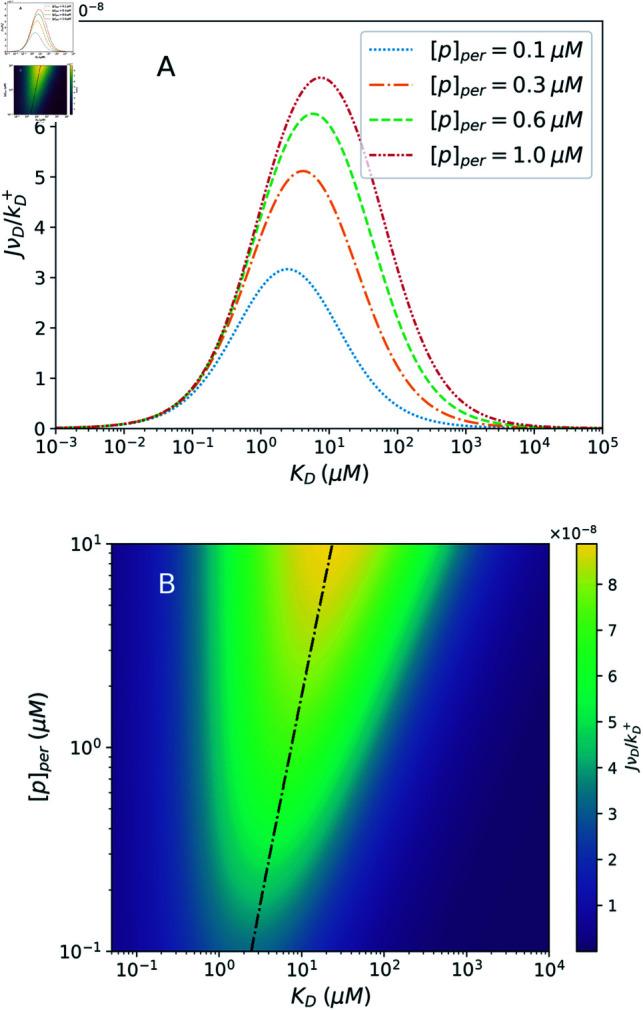
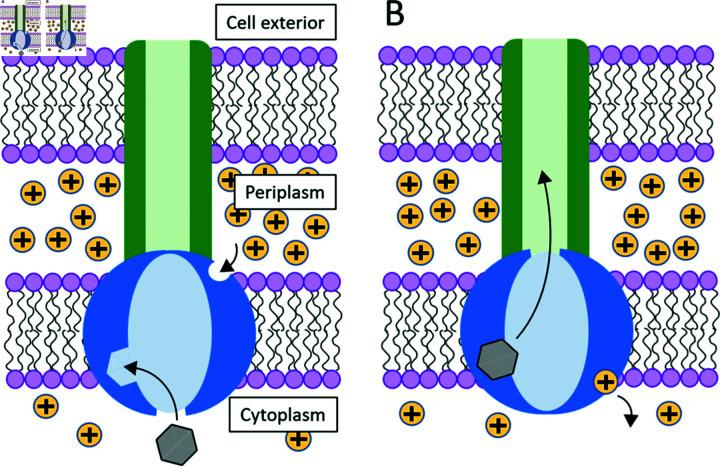
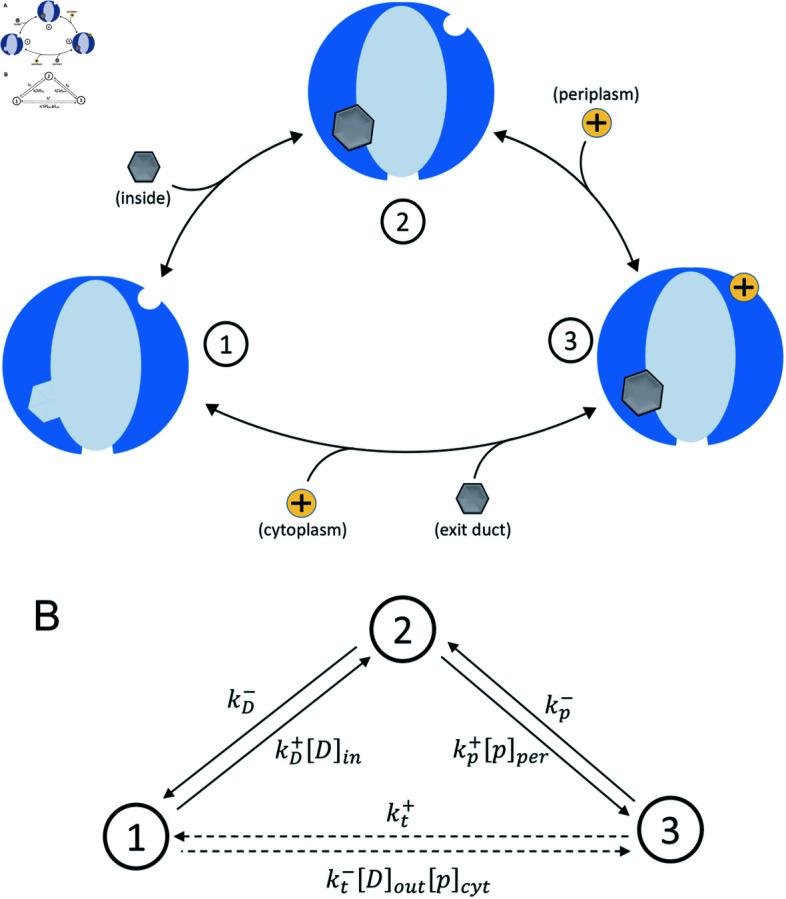
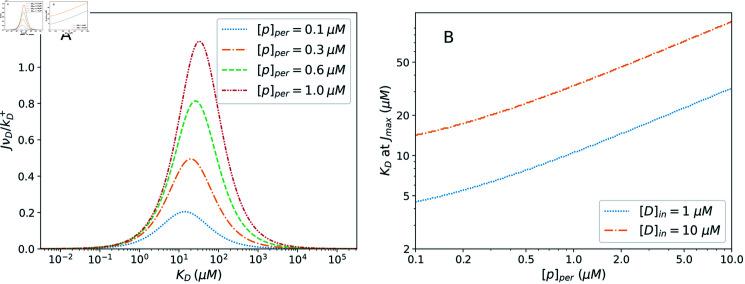
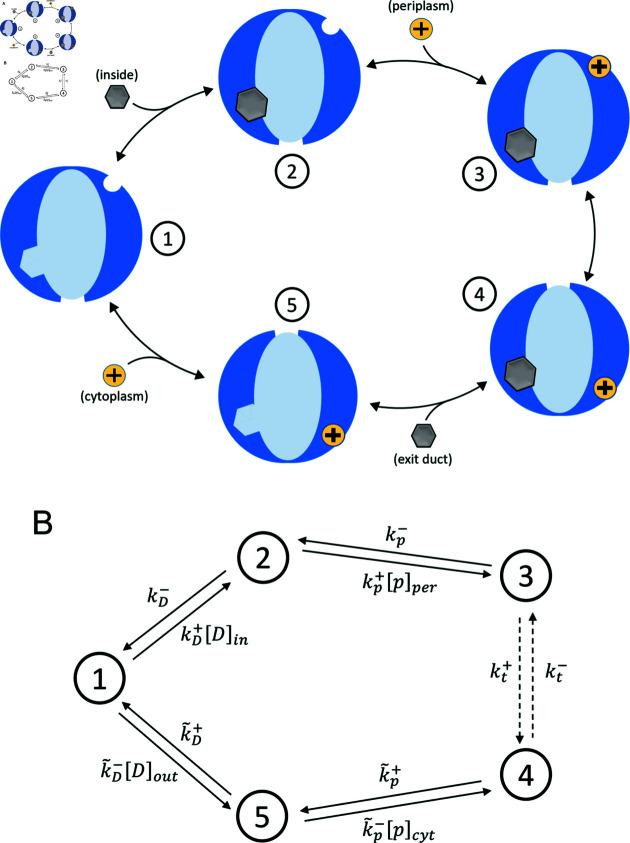
Efflux pumps that transport antibacterial drugs out of bacterial cells have broad specificity, commonly leading to broad spectrum resistance and limiting treatment strategies for infections. It remains unclear how efflux pumps can maintain this broad spectrum specificity to diverse drug molecules while limiting the efflux of other cytoplasmic content. We have investigated the origins of this broad specificity using theoretical models informed by the experimentally determined structural and kinetic properties of efflux pumps. We developed a set of mathematical models describing operation of efflux pumps as a discrete cyclic stochastic process across a network of states characterizing pump conformations and the presence/absence of bound ligands and protons. These include a minimal three-state model that lends itself to clear analytic calculations as well as a five-state model that relaxes some of the simpler model's most strict assumptions. We found that the pump specificity is determined not solely by the drug affinity to the pump-as is commonly assumed-but it is also directly affected by the periplasmic pH and the transmembrane potential. Therefore, changes to the proton concentration gradient and voltage drop across the membrane can influence how effective the pump is at extruding a particular drug molecule. Furthermore, we found that while both the proton concentration gradient across the membrane and the transmembrane potential contribute to the thermodynamic force driving the pump, their effects on the efflux enter not strictly in a combined proton motive force. Rather, they have two distinguishable effects on the overall throughput. These results highlight the unexpected effects of thermodynamic driving forces out of equilibrium and illustrate how efflux pump structure and function are conducive to the emergence of multidrug resistance.
将抗菌药物泵出细菌细胞的外排泵具有广泛的特异性,通常会导致广谱耐药性,并限制感染的治疗策略。目前尚不清楚外排泵如何在限制其他细胞质内容物外排的同时,维持对多种药物分子的这种广谱特异性。我们利用基于外排泵实验测定的结构和动力学特性的理论模型,研究了这种广谱特异性的起源。我们开发了一组数学模型,将外排泵的运行描述为一个离散的循环随机过程,该过程跨越一系列表征泵构象以及结合配体和质子存在与否的状态网络。这些模型包括一个易于进行清晰解析计算的最小三态模型,以及一个放宽了一些较简单模型最严格假设的五态模型。我们发现,泵的特异性并非如通常所认为的那样仅由药物对泵的亲和力决定,它还直接受到周质pH值和跨膜电位的影响。因此,膜两侧质子浓度梯度和电压降的变化会影响泵排出特定药物分子的效率。此外,我们发现虽然膜两侧的质子浓度梯度和跨膜电位都对驱动泵的热力学力有贡献,但它们对药物外排的影响并非严格以组合的质子动力形式体现。相反,它们对总通量有两种可区分的影响。这些结果突出了非平衡热力学驱动力的意外影响,并说明了外排泵的结构和功能如何有利于多药耐药性的产生。

 Zotero 插件