
鼻腔微生物群在调节犬类宿主抗流感免疫中的作用。
Role of nasal microbiota in regulating host anti-influenza immunity in dogs.
作者信息
Geng Jinzhu, Dong Yuhao, Huang Hao, Wen Xia, Xu Ting, Zhao Yanbing, Liu Yongjie
机构信息
Joint International Research Laboratory of Animal Health and Food Safety, College of Veterinary Medicine, Nanjing Agricultural University, Nanjing, China.
出版信息
Microbiome. 2025 Jan 27;13(1):27. doi: 10.1186/s40168-025-02031-y.
BACKGROUND
Numerous studies have confirmed a close relationship between the pathogenicity of influenza and respiratory microbiota, but the mechanistic basis for this is poorly defined. Also, the majority of these studies have been conducted on murine models, and it remains unclear how far these findings can be extrapolated from murine models to other animals. Considering that influenza A virus is increasingly recognized as an important canine respiratory pathogen, this study investigated the cross-talk between nasal and lung tissues mediated by microbes and its association with influenza susceptibility in a beagle dog model.
RESULTS
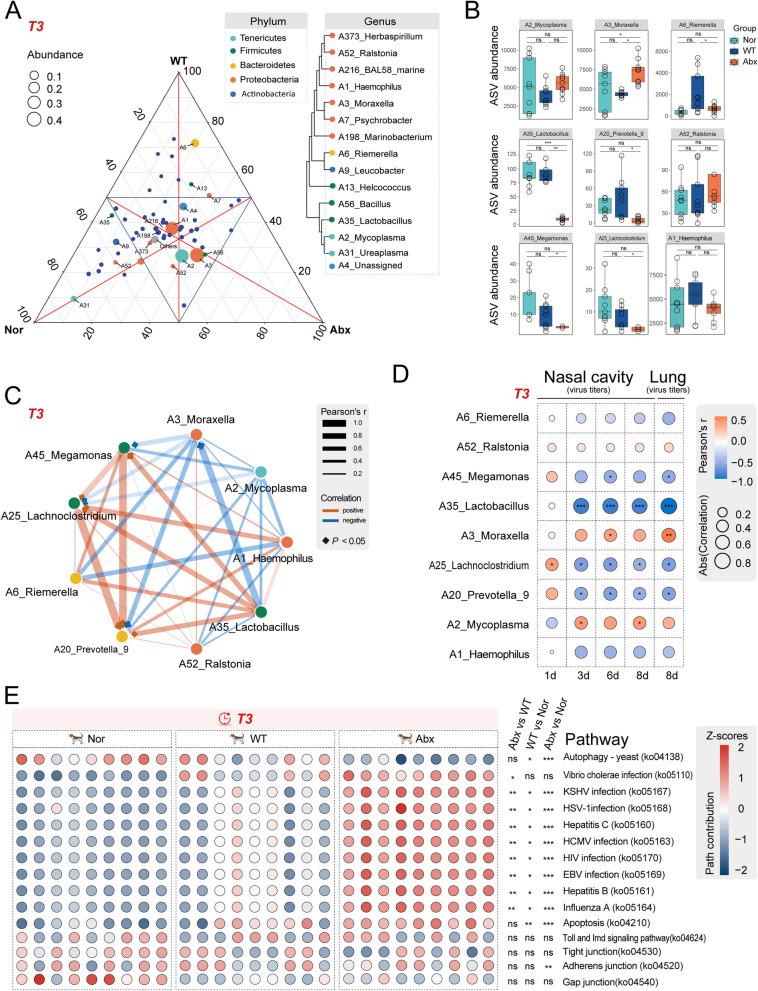
Using 16S rRNA gene sequencing, combined with comparative transcriptomic, anatomical, and histological examinations, we investigated viral presence, gene expression profiles, and microbiota in the nasal cavity and lung after influenza infection in the beagles with antibiotic-induced nasal dysbiosis. Our data showed that dysbiosis of the nasal microbiome exacerbates influenza-induced respiratory disease and the epithelial barrier disruption, and impairs host antiviral responses in the nasal cavity and lung. Moreover, dysregulation of nasal microbiota exacerbates the influenza-induced disturbance in lung microbiota. Further, we also identified a strain of Lactobacillus plantarum isolated from canine nasal cavity with a significant antiviral effect in vitro, and found that its antiviral activity might be associated with the activation of the interferon (IFN) pathway and modulation of the impaired autophagy flux induced by influenza infection.
CONCLUSIONS
Our investigation reveals that nasal microbiota dysbiosis exerts a prominent impact on host antiviral responses, inflammation thresholds, and mucosal barrier integrity during influenza infection. Lactobacilli, as part of the nasal microbiota, may contribute to host antiviral defenses by modulating the IFN and autophagy pathways. Collectively, this study underscores the importance of nasal microbiota homeostasis in maintaining respiratory health. Video Abstract.
背景
众多研究已证实流感致病性与呼吸道微生物群之间存在密切关系,但其机制基础仍不清楚。此外,这些研究大多是在小鼠模型上进行的,目前尚不清楚这些研究结果能在多大程度上从小鼠模型外推到其他动物。鉴于甲型流感病毒日益被认为是一种重要的犬类呼吸道病原体,本研究在比格犬模型中调查了微生物介导的鼻腔和肺组织之间的相互作用及其与流感易感性的关系。
结果
我们使用16S rRNA基因测序,结合比较转录组学、解剖学和组织学检查,研究了抗生素诱导鼻腔生态失调的比格犬感染流感后鼻腔和肺中的病毒存在情况、基因表达谱和微生物群。我们的数据表明,鼻腔微生物群失调会加剧流感诱导的呼吸道疾病和上皮屏障破坏,并损害鼻腔和肺中的宿主抗病毒反应。此外,鼻腔微生物群失调会加剧流感诱导的肺部微生物群紊乱。此外,我们还从犬鼻腔中分离出一株具有显著体外抗病毒作用的植物乳杆菌,并发现其抗病毒活性可能与干扰素(IFN)途径的激活以及流感感染诱导的自噬通量受损的调节有关。
结论
我们的研究表明,鼻腔微生物群失调在流感感染期间对宿主抗病毒反应、炎症阈值和黏膜屏障完整性有显著影响。作为鼻腔微生物群的一部分,乳酸菌可能通过调节IFN和自噬途径有助于宿主抗病毒防御。总的来说这项研究强调了鼻腔微生物群稳态在维持呼吸道健康中的重要性。视频摘要。
 Zotero 插件