
新辅助吡咯替尼联合曲妥珠单抗治疗无早期反应的HER2阳性乳腺癌(NeoPaTHer):一项前瞻性、多中心、适应性反应研究的疗效、安全性及生物标志物分析
Neoadjuvant pyrotinib and trastuzumab in HER2-positive breast cancer with no early response (NeoPaTHer): efficacy, safety and biomarker analysis of a prospective, multicentre, response-adapted study.
作者信息
Wang Fei, Wang Yongjiu, Xiong Bin, Yang Zhenlin, Wang Jingfen, Yao Yumin, Yu Lixiang, Fu Qinye, Li Liang, Zhang Qiang, Zheng Chao, Huang Shuya, Liu Liyuan, Liu Chun, Sun Huaibo, Mao Beibei, Liu Dong-Xu, Yu Zhigang
机构信息
Breast Center, The Second Hospital of Shandong University, Jinan, China.
Shandong Key Laboratory of Cancer Digital Medicine, Jinan, China.
出版信息
Signal Transduct Target Ther. 2025 Jan 29;10(1):45. doi: 10.1038/s41392-025-02138-6.
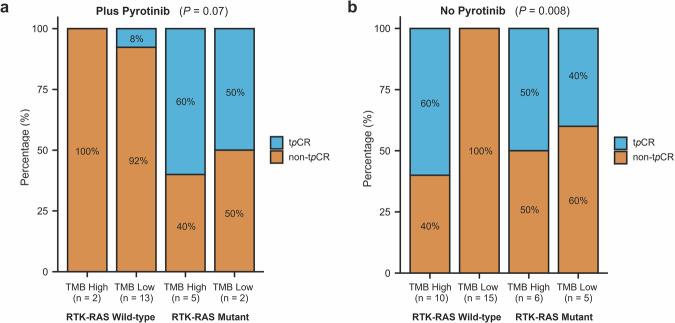
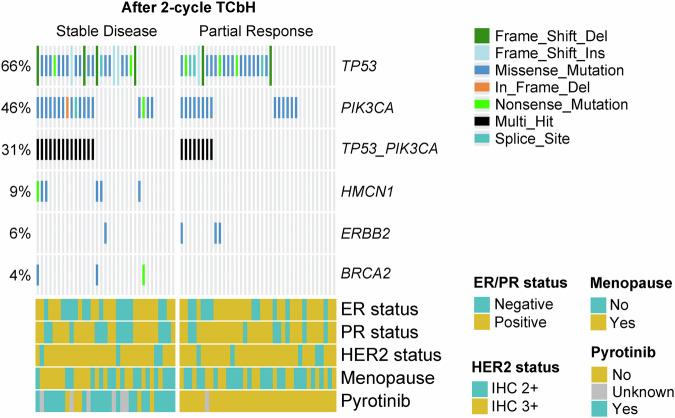
The potential benefits of pyrotinib for patients with trastuzumab-insensitive, HER2-positive early-stage breast cancer remain unclear. This prospective, multicentre, response-adapted study evaluated the efficacy and safety of adding pyrotinib to the neoadjuvant treatment of HER2-positive breast cancer patients with a poor response to initial docetaxel plus carboplatin and trastuzumab (TCbH). Early response was assessed using magnetic resonance imaging (MRI) after two cycles of treatment. Patients showing poor response, as defined by RECIST 1.1, could opt to receive additional pyrotinib or continue standard therapy. The primary endpoint was the total pathological complete response (tpCR; ypT0/isN0) rate. Of the 129 patients enroled, 62 (48.1%) were identified as MRI-responders (cohort A), 26 non-responders continued with four more cycles of TCbH (cohort B), and 41 non-responders received additional pyrotinib (cohort C). The tpCR rate was 30.6% (95% CI: 20.6-43.0%) in cohort A, 15.4% (95% CI: 6.2-33.5%) in cohort B, and 29.3% (95% CI: 17.6-44.5%) in cohort C. Multivariable logistic regression analyses demonstrated comparable odds of achieving tpCR between cohorts A and C (odds ratio = 1.04, 95% CI: 0.40-2.70). No new adverse events were observed with the addition of pyrotinib. Patients with co-mutations of TP53 and PIK3CA exhibited lower rates of early partial response compared to those without or with a single gene mutation (36.0% vs. 60.0%, P = 0.08). These findings suggest that adding pyrotinib may benefit patients who do not respond to neoadjuvant trastuzumab plus chemotherapy. Further investigation is warranted to identify biomarkers predicting patients' benefit from the addition of pyrotinib.
吡咯替尼对曲妥珠单抗不敏感的HER2阳性早期乳腺癌患者的潜在益处仍不明确。这项前瞻性、多中心、适应性反应研究评估了在初始多西他赛加卡铂和曲妥珠单抗(TCbH)治疗反应不佳的HER2阳性乳腺癌患者的新辅助治疗中添加吡咯替尼的疗效和安全性。在两个周期的治疗后,使用磁共振成像(MRI)评估早期反应。根据RECIST 1.1定义,反应不佳的患者可以选择接受额外的吡咯替尼或继续标准治疗。主要终点是总病理完全缓解(tpCR;ypT0/isN0)率。在129名入组患者中,62名(48.1%)被确定为MRI反应者(A组),26名无反应者继续接受四个周期的TCbH治疗(B组),41名无反应者接受额外的吡咯替尼治疗(C组)。A组的tpCR率为30.6%(95%CI:20.6-43.0%),B组为15.4%(95%CI:6.2-33.5%),C组为29.3%(95%CI:17.6-44.5%)。多变量逻辑回归分析显示,A组和C组实现tpCR的几率相当(优势比=1.04,95%CI:0.40-


 Zotero 插件