
注意氧化钴酸性析氧反应电催化剂中的瞬态溶解过程。
Be Aware of Transient Dissolution Processes in CoO Acidic Oxygen Evolution Reaction Electrocatalysts.
作者信息
Priamushko Tatiana, Franz Evanie, Logar Anja, Bijelić Lazar, Guggenberger Patrick, Escalera-López Daniel, Zlatar Matej, Libuda Jörg, Kleitz Freddy, Hodnik Nejc, Brummel Olaf, Cherevko Serhiy
机构信息
Helmholtz-Institute Erlangen-Nürnberg for Renewable Energy (IET-2), Forschungszentrum Jülich, 91058 Erlangen, Germany.
Interface Research and Catalysis, ECRC, Friedrich-Alexander-Universität Erlangen-Nürnberg, 91058 Erlangen, Germany.
出版信息
J Am Chem Soc. 2025 Jan 29;147(4):3517-3528. doi: 10.1021/jacs.4c14952. Epub 2025 Jan 14.
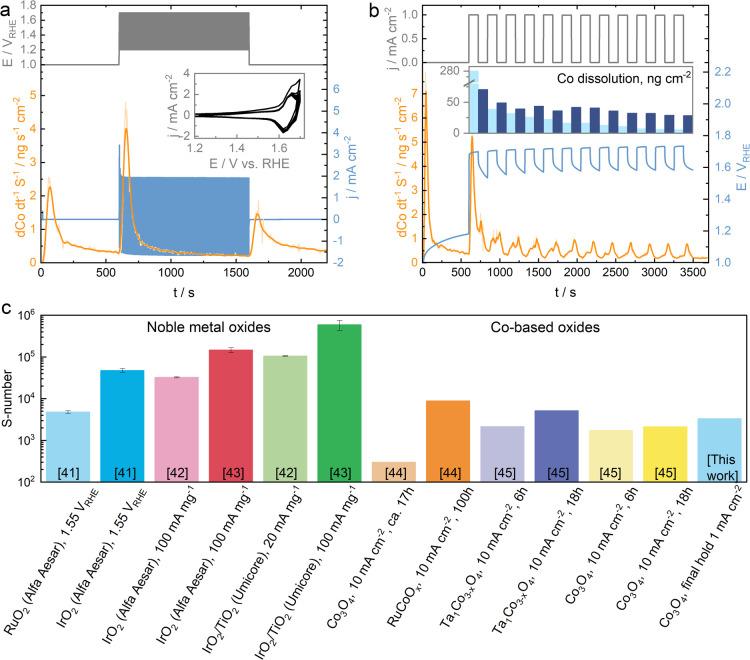
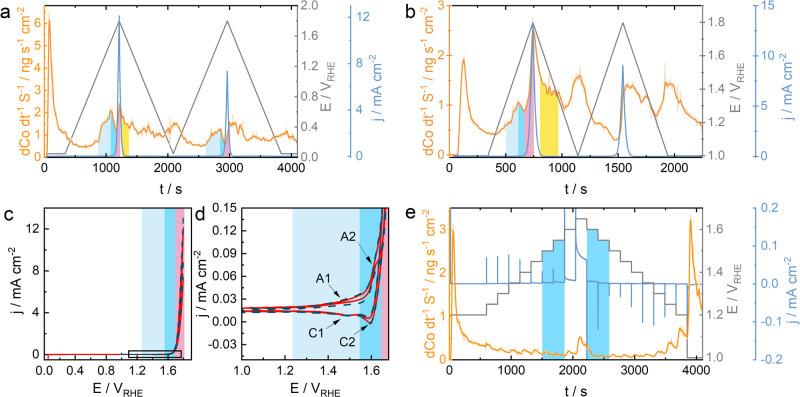
Recently, cobalt-based oxides have received considerable attention as an alternative to expensive and scarce iridium for catalyzing the oxygen evolution reaction (OER) under acidic conditions. Although the reported materials demonstrate promising durability, they are not entirely intact, calling for fundamental research efforts to understand the processes governing the degradation of such catalysts. To this end, this work studies the dissolution mechanism of a model CoO porous catalyst under different electrochemical conditions using online inductively coupled plasma mass spectrometry (online ICP-MS), identical location scanning transmission electron microscopy (IL-STEM), and differential electrochemical mass spectrometry (DEMS). Despite the high thermodynamics tendency reflected in the Pourbaix diagram, it is shown that the cobalt dissolution kinetics is sluggish and can be lowered further by modifying the electrochemical protocol. For the latter, identified in this study, several (electro)chemical reaction pathways that lead to the dissolution of CoO must be considered. Hence, this work uncovers the transient character of cobalt dissolution and provides valuable insights that can help to understand the promising stability of cobalt-based materials in already published works and facilitate the knowledge-driven design of novel, stable, abundant catalysts toward the OER in an acidic environment.
最近,钴基氧化物作为在酸性条件下催化析氧反应(OER)的昂贵且稀缺的铱的替代品,受到了广泛关注。尽管所报道的材料显示出有前景的耐久性,但它们并非完全完整,这就需要开展基础研究工作来了解控制此类催化剂降解的过程。为此,本工作使用在线电感耦合等离子体质谱(在线ICP-MS)、相同位置扫描透射电子显微镜(IL-STEM)和差分电化学质谱(DEMS)研究了一种模型CoO多孔催化剂在不同电化学条件下的溶解机制。尽管Pourbaix图中反映出高热力学趋势,但结果表明钴的溶解动力学较为缓慢,并且可以通过修改电化学协议进一步降低。对于本研究中确定的后者,必须考虑几种导致CoO溶解的(电)化学反应途径。因此,本工作揭示了钴溶解的瞬态特性,并提供了有价值的见解,有助于理解已发表作品中钴基材料有前景的稳定性,并促进在酸性环境中针对OER的新型、稳定、丰富催化剂的知识驱动设计。



 Zotero 插件