
加速实现全球消除乙型肝炎感染的势头:关于减少母婴传播的乙型肝炎指南的范围审查
Accelerating the momentum to achieve global elimination of hepatitis B infection: a scoping review of hepatitis B guidelines to reduce mother to child transmission.
作者信息
Cheung Ka Wang, Li Ying Rong, Au Ms Tiffany Sin-Tung, Seto Mimi Tin Yan
机构信息
Department of Obstetrics and Gynecology, Queen Mary Hospital, the University of Hong Kong, Hong Kong SAR, China.
出版信息
EClinicalMedicine. 2025 Jan 11;80:103038. doi: 10.1016/j.eclinm.2024.103038. eCollection 2025 Feb.
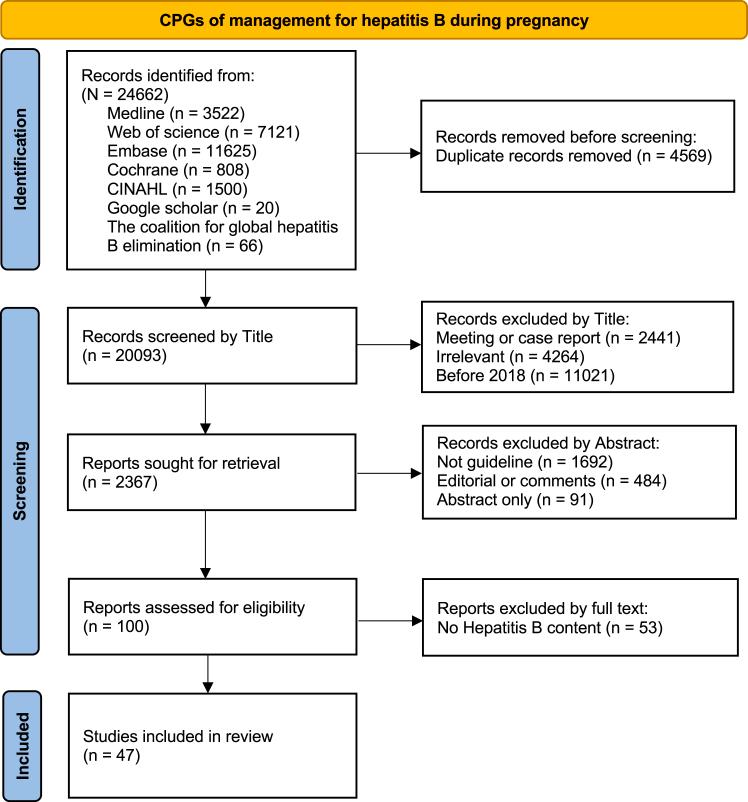
Progress towards achieving global elimination of hepatitis B virus (HBV) by 2030 remains unsatisfactory. Prevention of mother to child transmission is crucial but current Clinical Practice Guidelines (CPGs) gave diverse recommendations, creating confusion and leading to significant challenges in the practical implementation across various regions owing to global inequity. We reviewed 47 CPGs on the management of hepatitis B during pregnancy against twelve important clinical questions. Of 47 guidelines, 80.9% (38/47) supported the universal approach to HBV screening. To select women for antiviral prophylaxis, 78.7% (37/47) recommended the use of HBV DNA levels, while 31.9% (15/47) recommended the use of HBeAg. Of 37 guidelines recommending HBV DNA levels, 94.6% (35/37) recommended a viral load threshold of >200,000 IU/mL to initiate antiviral prophylaxis. Of 16 guidelines addressing the mode of delivery, 87.5% (14/16) encouraged vaginal birth. Of 30 guidelines addressing breastfeeding, 60% (18/30) recommended breastfeeding. However, controversies were found in the optimal timing of HBV disease evaluation during pregnancy and the ideal timing to stop antiviral prophylaxis after delivery. Of 36 guidelines addressing the timing to initiate antiviral prophylaxis, 25% (9/36) advised starting prophylaxis between 24 and 28 weeks, while 75% (27/36) suggested other timings or provided vague descriptions. Of 38 guidelines addressing birth-dose vaccination, 42% (16/38) emphasized the importance of "vaccination as soon as possible after birth." These deficiencies and discrepancies among CPGs could significantly impede global HBV elimination.
到2030年实现全球消除乙型肝炎病毒(HBV)的进展仍不尽人意。预防母婴传播至关重要,但当前的临床实践指南(CPG)给出了不同的建议,由于全球不平等,这造成了混乱,并在各地区的实际实施中带来了重大挑战。我们针对十二个重要临床问题,对47份关于孕期乙型肝炎管理的CPG进行了综述。在47份指南中,80.9%(38/47)支持对HBV进行普遍筛查的方法。为选择进行抗病毒预防的女性,78.7%(37/47)建议使用HBV DNA水平,而31.9%(15/47)建议使用HBeAg。在37份推荐HBV DNA水平的指南中,94.6%(35/37)建议病毒载量阈值>200,000 IU/mL时开始抗病毒预防。在16份涉及分娩方式的指南中,87.5%(14/16)鼓励阴道分娩。在30份涉及母乳喂养的指南中,60%(18/30)建议母乳喂养。然而,在孕期HBV疾病评估的最佳时机以及产后停止抗病毒预防的理想时机方面存在争议。在36份涉及开始抗病毒预防时机的指南中,25%(9/36)建议在24至28周之间开始预防,而75%(27/36)建议其他时机或给出了模糊描述。在38份涉及出生时接种疫苗的指南中,42%(16/38)强调了“出生后尽快接种疫苗”的重要性。CPG之间的这些不足和差异可能会严重阻碍全球消除HBV的进程。
 Zotero 插件