
KPC胰腺癌细胞是一种新型的具有免疫活性的小鼠模型,可支持人腺病毒复制和肿瘤溶瘤作用。
KPC pancreatic cancer cells are a novel immunocompetent murine model supporting human adenovirus replication and tumor oncolysis.
作者信息
Otero-Mateo Marc, Estrany Francesc, Arcas-Márquez Sabrina, Moya-Borrego Laura, Castellano Giancarlo, Castany Miquel, Alemany Ramon, Fillat Cristina
机构信息
Institut d'Investigacions Biomèdiques August Pi i Sunyer (IDIBAPS), 08036 Barcelona, Spain.
Programa de Biomedicina. Universitat de Barcelona, 08036 Barcelona, Spain.
出版信息
Mol Ther Oncol. 2024 Dec 21;33(1):200928. doi: 10.1016/j.omton.2024.200928. eCollection 2025 Mar 20.
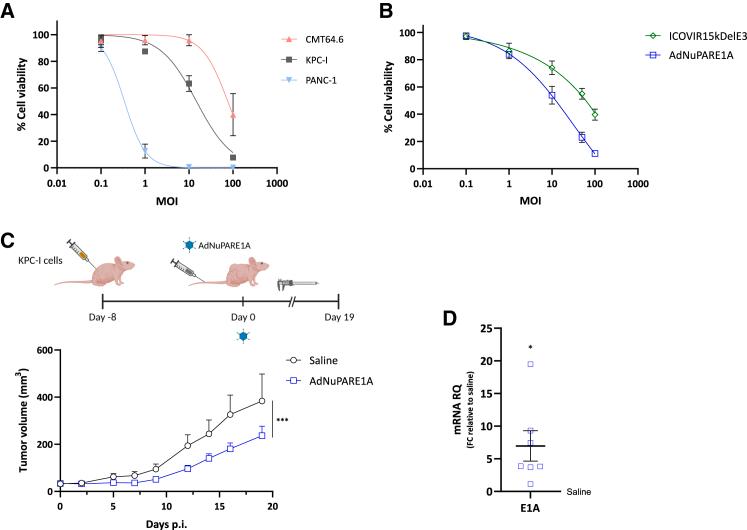
Oncolytic adenoviral therapy is a promising approach for pancreatic cancer treatment. However, the limited capacity of murine cells to produce infectious viral progeny precludes the full evaluation of the virotherapy in a suitable immunocompetent mouse model. Here, we report that the murine KPC-I cell line, established from pancreatic tumors developed in ; ; mice, is susceptible to adenoviral replication and generates a progeny of infective virions similar to those from infected human A549 cells. A comparative study with the semipermissive murine CMT64.6 cells reveals that adenoviral infection of KPC-I cells substantially increases the release of infective particles, with a correlating enhanced susceptibility to adenovirus-induced autophagy. Remarkably, systemic delivery of the oncolytic adenovirus AdNuPARE1A in athymic mice bearing KPC-I tumors results in significant inhibition of tumor growth. Moreover, KPC-I tumors in immunocompetent mice with intratumoral administration of AdNuPARE1A or ICOVIR15kDelE3 display significant antitumoral effects, with evidence of adenoviral replication. Collectively, our data show that KPC-I cells are permissive to human oncolytic adenovirus replication, rendering KPC-I syngeneic tumors an interesting model to evaluate the multifaceted antitumor activities of oncolytic adenovirus.
溶瘤腺病毒疗法是一种很有前景的胰腺癌治疗方法。然而,鼠细胞产生有感染性病毒后代的能力有限,这使得在合适的具有免疫活性的小鼠模型中对病毒疗法进行全面评估受到限制。在此,我们报告,从在……小鼠中发生的胰腺肿瘤建立的鼠KPC-I细胞系对腺病毒复制敏感,并产生与感染的人A549细胞相似的有感染性病毒粒子后代。与半允许性鼠CMT64.6细胞的比较研究表明,KPC-I细胞的腺病毒感染显著增加了感染性颗粒的释放,同时对腺病毒诱导的自噬敏感性增强。值得注意的是,在携带KPC-I肿瘤的无胸腺小鼠中全身递送溶瘤腺病毒AdNuPARE1A可显著抑制肿瘤生长。此外,在免疫活性小鼠中,瘤内给予AdNuPARE1A或ICOVIR15kDelE3的KPC-I肿瘤显示出显著的抗肿瘤作用,并有腺病毒复制的证据。总体而言,我们的数据表明KPC-I细胞允许人溶瘤腺病毒复制,使KPC-I同基因肿瘤成为评估溶瘤腺病毒多方面抗肿瘤活性的一个有趣模型。


 Zotero 插件