
发现具有1-吲哚-3-丙酰胺骨架的新型Na1.7选择性抑制剂以实现有效止痛
Discovery of Novel Na1.7-Selective Inhibitors with the 1-Indole-3-Propionamide Scaffold for Effective Pain Relief.
作者信息
Wang Gaoang, Wu Hang, Wang Yingying, Liu Xiangying, Peng Shuijiao, Wang Wenxing, Wu Meijing, Liu Yifei, Wang Ercheng, Wang Zhe, Xu Lei, Wang Xiaojian, Yang Wei, Chen Haiyi, Zhou Xi, Hou Tingjun
机构信息
College of Pharmaceutical Sciences, Zhejiang University, Hangzhou, Zhejiang 310058, China.
The National and Local Joint Engineering Laboratory of Animal Peptide Drug Development, College of Life Sciences, and Peptide and Small Molecule Drug R&D Platform, Furong Laboratory, Hunan Normal University, Changsha 410081, Hunan, China.
出版信息
Research (Wash D C). 2025 Jan 29;8:0599. doi: 10.34133/research.0599. eCollection 2025.
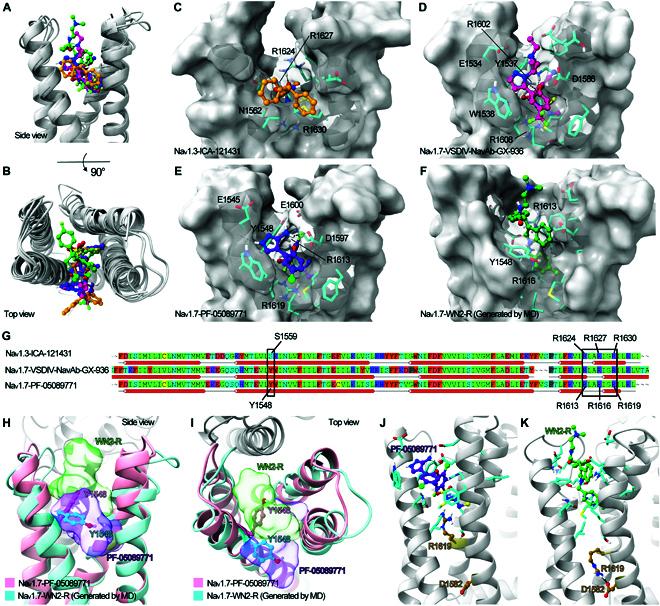
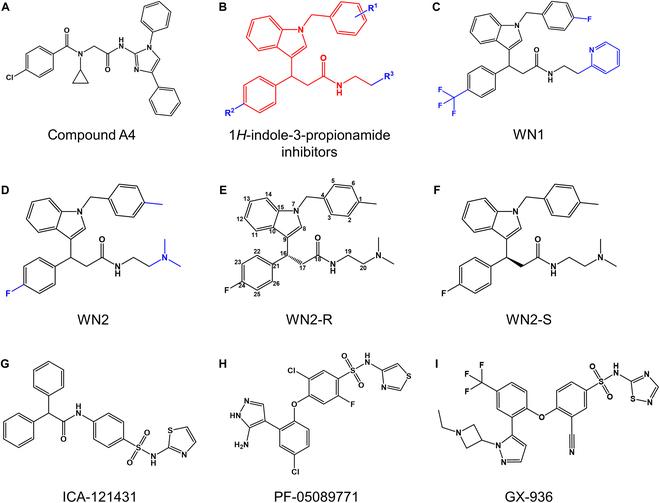
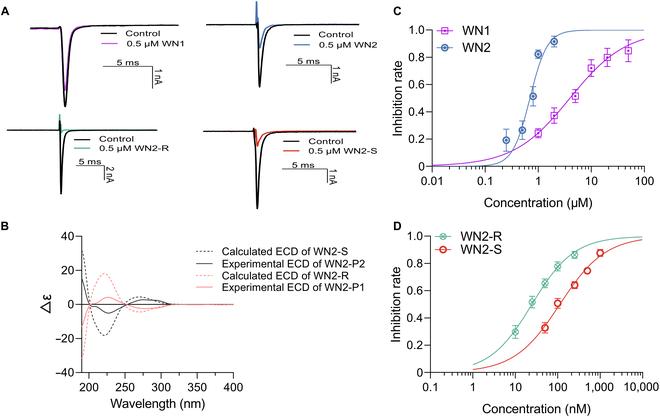
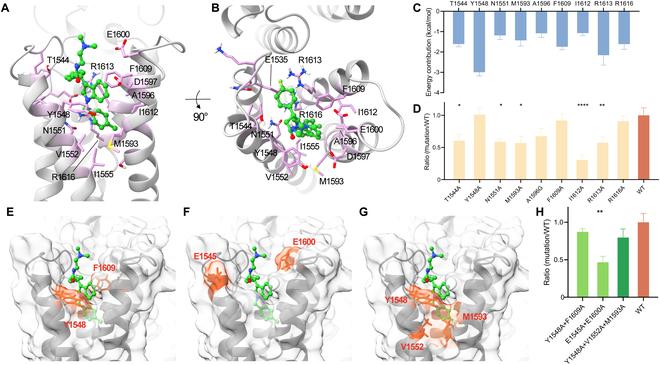
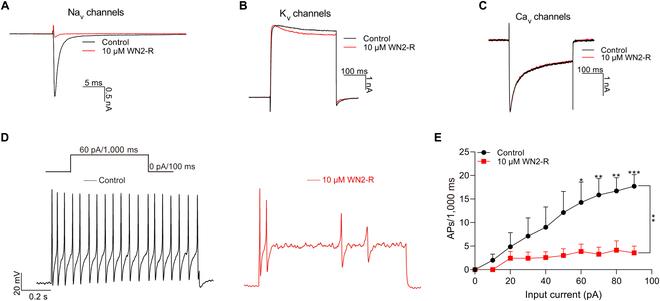
Na1.7 is considered a promising target for developing next-generation analgesic drugs, given its critical role in human pain pathologies. Although most reported inhibitors with strong in vitro activity and high selectivity share the aryl sulfonamide scaffold, they failed to demonstrate marked clinical efficacy. Therefore, exploring new Na1.7-selective antagonists is quite urgent to the development of next-generation analgesic drugs. Here, we report a highly effective 1-indole-3-propionamide inhibitor, WN2, identified through an integrated drug discovery strategy. Notably, the structure of WN2 is quite different from previously reported aryl sulfonamide inhibitors. Molecular dynamics simulations and experimental findings reveal that the R configuration of WN2 (WN2-R) is the preferred form (IC = 24.7 ± 9.4 nM) within the VSDIV pocket of Na1.7. WN2-R exhibits impressive analgesic effects in acute and chronic inflammatory pain, as well as neuropathic pain models in mice. Additionally, it displays favorable subtype selectivity and positive drug safety in acute toxicity studies. Pharmacokinetic studies indicate that WN2-R has high bioavailability ( = 20.29%), highlighting its considerable potential for drug development. Our study establishes WN2-R as a novel Na1.7-selective inhibitor with a unique structural scaffold, offering a promising candidate for the next generation of analgesic drugs.
鉴于Na1.7在人类疼痛病理中起关键作用,它被认为是开发下一代镇痛药的一个有前景的靶点。尽管大多数报道的具有强体外活性和高选择性的抑制剂都具有芳基磺酰胺骨架,但它们未能显示出显著的临床疗效。因此,探索新的Na1.7选择性拮抗剂对于下一代镇痛药的开发非常迫切。在此,我们报告了一种通过综合药物发现策略鉴定出的高效1-吲哚-3-丙酰胺抑制剂WN2。值得注意的是,WN2的结构与先前报道的芳基磺酰胺抑制剂有很大不同。分子动力学模拟和实验结果表明,WN2的R构型(WN2-R)是Na1.7的VSDIV口袋内的优选形式(IC = 24.7±9.4 nM)。WN2-R在小鼠的急性和慢性炎症性疼痛以及神经性疼痛模型中表现出令人印象深刻的镇痛作用。此外,在急性毒性研究中,它表现出良好的亚型选择性和积极的药物安全性。药代动力学研究表明,WN2-R具有高生物利用度( = 20.29%),突出了其在药物开发方面的巨大潜力。我们的研究将WN2-R确立为一种具有独特结构支架的新型Na1.7选择性抑制剂,为下一代镇痛药提供了一个有前景的候选药物。



 Zotero 插件