
供体CLL-1嵌合抗原受体T细胞在异基因造血干细胞移植后复发急性髓系白血病治疗中的应用。
Utilization of donor CLL-1 CAR-T cells for the treatment of relapsed of acute myeloid leukemia following allogeneic hematopoietic stem cell transplantation.
作者信息
Zhang Meng, Zhang Xiaomei, Wang Jiaxi, Lu Wenyi, Xiao Xia, Lyu Hairong, He Xiaoyuan, Pu Yedi, Meng Juanxia, Lyu Cuicui, Cao Xinping, Zhao Mingfeng
机构信息
Hematology Center, National Key Clinical Discipline of Pediatric Hematology, National Key Discipline of Pediatrics (Capital Medical University), Key Laboratory of Major Diseases in Children, Ministry of Education; Beijing Children's Hospital, Capital Medical University, National Center for Children's Health, Beijing, China.
Department of Hematology, Tianjin First Central Hospital, Tianjin, China.
出版信息
Front Immunol. 2025 Jan 17;15:1491341. doi: 10.3389/fimmu.2024.1491341. eCollection 2024.
BACKGROUND
Human C-type lectin-like molecule 1 (CLL-1) represents a promising therapeutic target for Chimeric antigen receptor T (CAR-T) cells therapy in the treatment of acute myeloid leukemia (AML). In this study, we aimed to evaluate the efficacy and safety profile of donor-derived CLL-1 CAR-T cells in AML patients who experienced relapsed post-transplantation.
METHODS
14 AML patients who experienced relapse following allogeneic HSCT were enrolled in our clinical trial. However, 2 patients withdrew from the study due to rapid disease progression. 12 participants received donor-derived CLL-1 CAR-T cells and were categorized into 3 groups based on the dosage of infused CAR-T cells dose (Group A:0.5×10/kg, Group B:1×10/kg, Group C:1.5×10/kg). And scRNA-seq was used to reveal CLL-1 CAR-T cells dynamics in a CAR-T cells infusion products and PBMCs at the peak of expansion for patient 4.
RESULTS
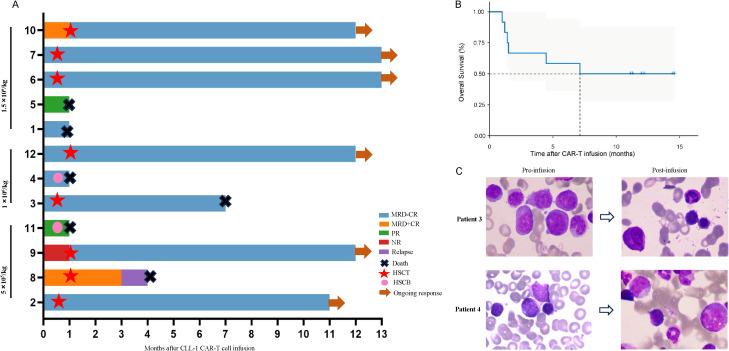
CLL-1 CAR-T cells were well tolerated by all 12 patients. Cytokine Release Syndrome (CRS) was observed in all patients, with 5 patients experiencing grade ≥3. 3 patients developed cytokine release syndrome-associated encephalopathy (CRES), and 1 patient had a grade 4 severity level. All patients demonstrated a reduction in tumor burden, while 7 patients (58.33%) achieved MRD-CR and 2 patients (16.67%) reached MRD+CR. CAR-T cells expansion was detectable in all 12 patients, with the median time of peak expansion was 9 days (range: 7-11 days). In patient 4, compared to the pre-reinfusion state, CD4+ cells at the peak of expansion showed upregulation of cell killing-related genes and memory T cell-related genes ( < 0.01).
CONCLUSIONS
The CLL-1 CAR-T cells therapy derived from allogeneic donors demonstrates both safety and efficacy in the management of relapsed AML following allogeneic HSCT. And adjusting the ratio of CD4+ CAR-T cells and CD8+ CAR-T cells prior to infusion may help mitigate CAR-T cell-related side effects.
CLINICAL TRIAL REGISTRATION
https://www.chictr.org.cn/, identifier ChiCTR2000041054.
背景
人C型凝集素样分子1(CLL-1)是嵌合抗原受体T(CAR-T)细胞疗法治疗急性髓系白血病(AML)的一个有前景的治疗靶点。在本研究中,我们旨在评估供体来源的CLL-1 CAR-T细胞对移植后复发的AML患者的疗效和安全性。
方法
14例异基因造血干细胞移植后复发的AML患者纳入我们的临床试验。然而,2例患者因疾病快速进展退出研究。12名参与者接受了供体来源的CLL-1 CAR-T细胞,并根据输注的CAR-T细胞剂量分为3组(A组:0.5×10⁶/kg,B组:1×10⁶/kg,C组:1.5×10⁶/kg)。对患者4,在CAR-T细胞输注产物和外周血单个核细胞(PBMC)中于扩增峰值时进行单细胞RNA测序(scRNA-seq)以揭示CLL-1 CAR-T细胞动态变化。
结果
12例患者对CLL-1 CAR-T细胞耐受性良好。所有患者均观察到细胞因子释放综合征(CRS),其中5例患者为≥3级。3例患者发生细胞因子释放综合征相关脑病(CRES),1例患者为4级严重程度。所有患者肿瘤负荷均降低,7例患者(58.33%)达到微小残留病完全缓解(MRD-CR),2例患者(16.67%)达到微小残留病阳性完全缓解(MRD+CR)。12例患者均检测到CAR-T细胞扩增,扩增峰值的中位时间为9天(范围:7 - 11天)。在患者4中,与输注前状态相比,扩增峰值时的CD4⁺细胞显示细胞杀伤相关基因和记忆T细胞相关基因上调(P < 0.01)。
结论
异基因供体来源的CLL-1 CAR-T细胞疗法在异基因造血干细胞移植后复发的AML治疗中显示出安全性和有效性。在输注前调整CD4⁺ CAR-T细胞与CD8⁺ CAR-T细胞的比例可能有助于减轻CAR-T细胞相关的副作用。
临床试验注册


 Zotero 插件