
探索病毒模拟与表观遗传学及肿瘤免疫的结合:癌症治疗的新视角。
Exploring viral mimicry combined with epigenetics and tumor immunity: new perspectives in cancer therapy.
作者信息
Wang Ruirui, Dong Xin, Zhang Xiongjian, Liao Jinzhuang, Cui Wei, Li Wei
机构信息
Department of Radiology, The Third Xiangya Hospital of Central South University. Tongzipo Road 138, Changsha, Hunan, People's Republic of China.
Department of Clinical Laboratory, National Cancer Center/National Clinical Research Center for Cancer/Cancer Hospital, Chinese Academy of Medical Sciences and Peking Union Medical College, Beijing, China.
出版信息
Int J Biol Sci. 2025 Jan 6;21(3):958-973. doi: 10.7150/ijbs.103877. eCollection 2025.
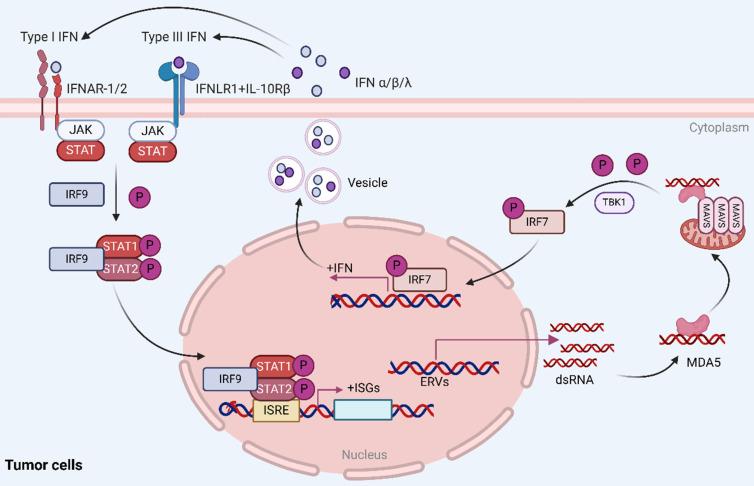
Viral mimicry refers to an active antiviral response triggered by the activation of endogenous retroviruses (ERVs), usually manifested by the formation of double-stranded RNA (dsRNA) and activation of the cellular interferon response, which activates the immune system and produces anti-tumor effects. Epigenetic studies have shown that epigenetic modifications (e.g. DNA methylation, histone modifications, etc.) play a crucial role in tumorigenesis, progression, and treatment resistance. Particularly, alterations in DNA methylation may be closely associated with the suppression of ERVs expression, and treatment by demethylation may restore ERVs activity and thus strengthen the tumor immune response. Therefore, we propose that viral mimicry can induce immune responses in the tumor microenvironment by activating the expression of ERVs, and that epigenetic alterations may play a key regulatory role in this process. In this paper, we review the intersection of viral mimicry, epigenetics and tumor immunotherapy, and explore the possible interactions and synergistic effects among the three, aiming to provide a new theoretical basis and potential strategies for cancer immunotherapy.
病毒模拟是指内源性逆转录病毒(ERVs)激活引发的一种主动抗病毒反应,通常表现为双链RNA(dsRNA)的形成和细胞干扰素反应的激活,进而激活免疫系统并产生抗肿瘤作用。表观遗传学研究表明,表观遗传修饰(如DNA甲基化、组蛋白修饰等)在肿瘤发生、发展和治疗抗性中起关键作用。特别是,DNA甲基化的改变可能与ERVs表达的抑制密切相关,而去甲基化治疗可能恢复ERVs活性,从而增强肿瘤免疫反应。因此,我们提出病毒模拟可通过激活ERVs的表达在肿瘤微环境中诱导免疫反应,并且表观遗传改变可能在此过程中起关键调节作用。在本文中,我们综述了病毒模拟、表观遗传学与肿瘤免疫治疗的交叉点,并探讨三者之间可能的相互作用和协同效应,旨在为癌症免疫治疗提供新的理论基础和潜在策略。



 Zotero 插件