
在低温条件下探测软X射线诱导的模型锰配合物的光还原作用。
Probing soft X-ray induced photoreduction of a model Mn-complex at cryogenic conditions.
作者信息
Chatterjee Kuntal, Lee Sang Jun, Kao Li Cheng, Doyle Margaret D, Titus Charles J, Leone Stephen R, Yano Junko, Yachandra Vittal K, Wernet Philippe, Kern Jan F
机构信息
Molecular Biophysics and Integrated Bioimaging Division, Lawrence Berkeley National Laboratory, Berkeley, CA 94720, USA.
SLAC National Accelerator Laboratory, Menlo Park, CA 94025, USA.
出版信息
J Synchrotron Radiat. 2025 Mar 1;32(Pt 2):399-407. doi: 10.1107/S1600577524012189. Epub 2025 Feb 3.
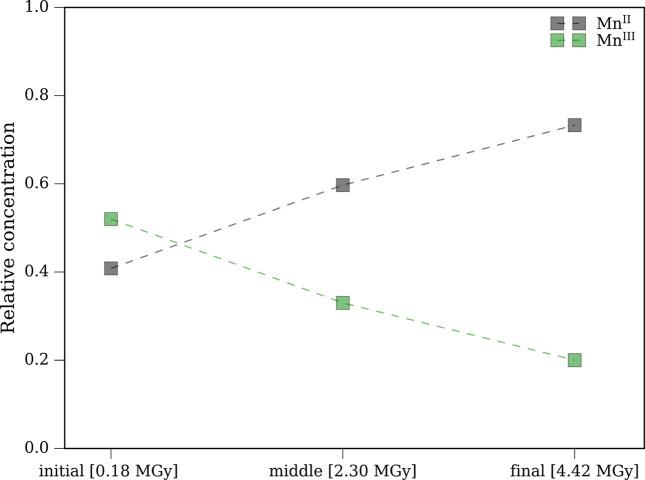
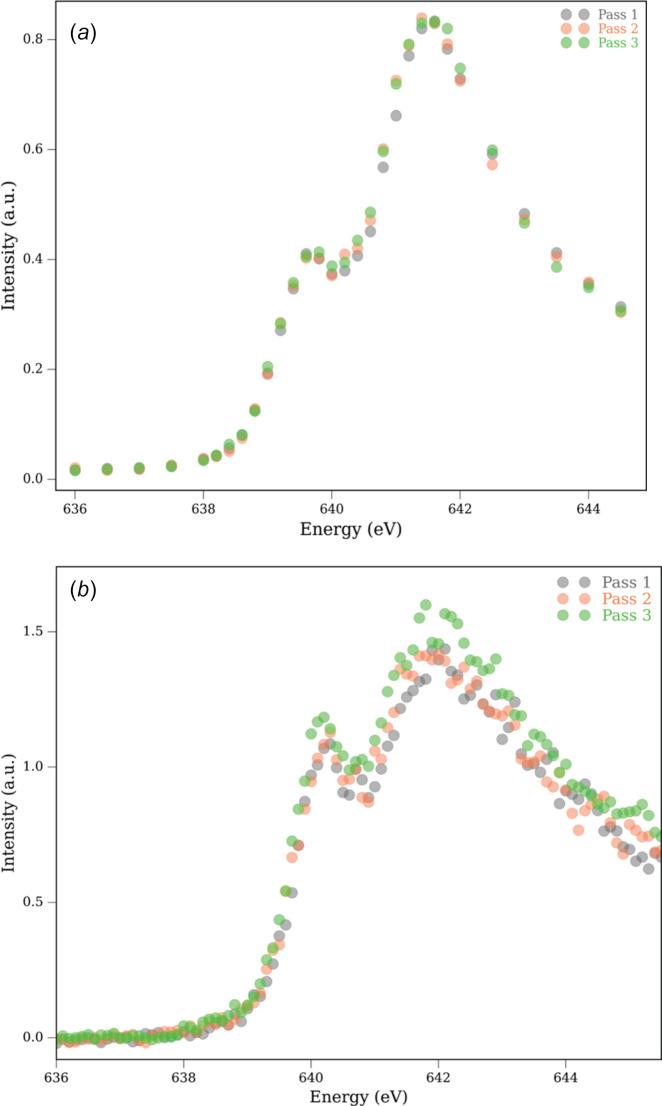
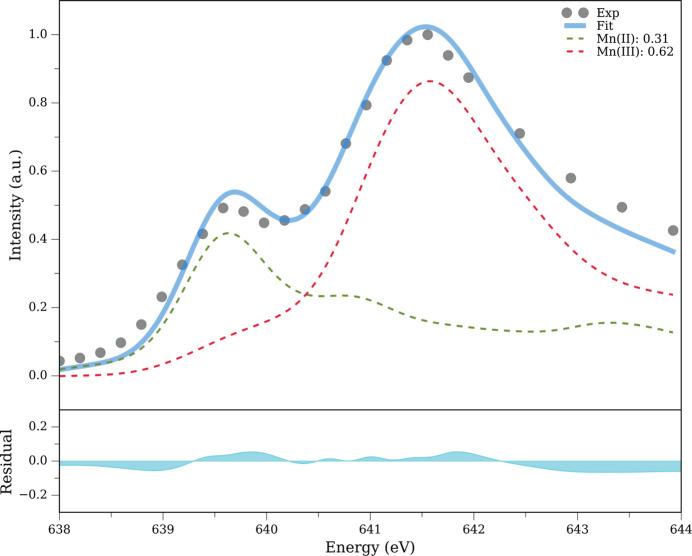
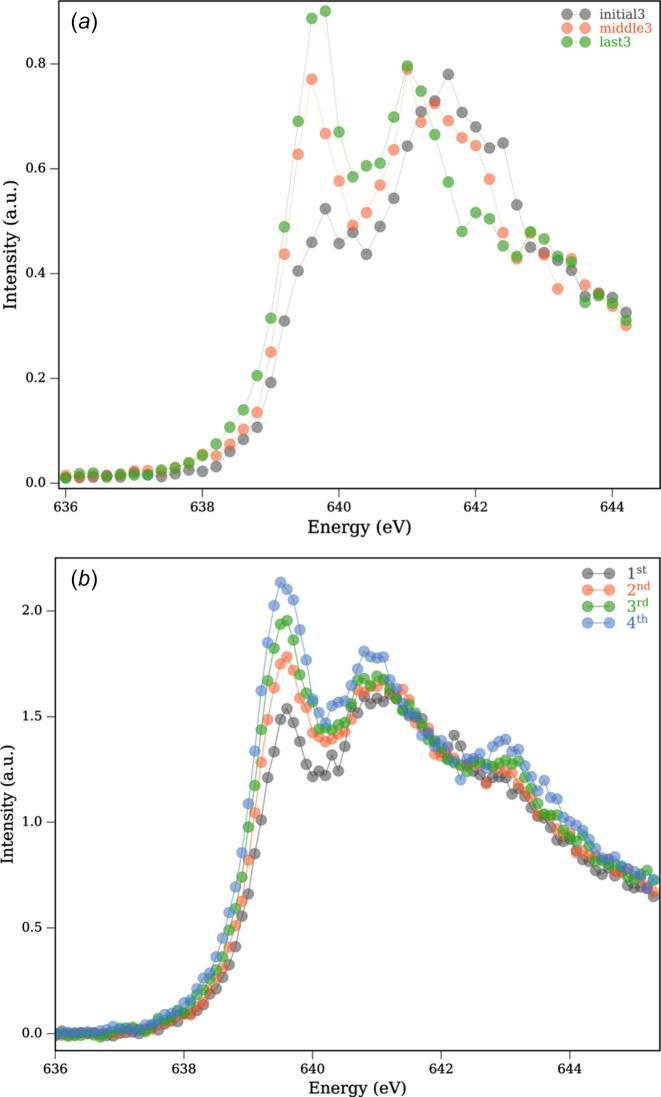
Soft X-ray absorption spectroscopy of first row transition elements at their respective L-edges provides important information about the oxidation and spin states of the metal centers. However, the associated sample damage in radiation-sensitive samples substantially alters the electronic and chemical structures of redox-active metal centers. Here, we measure the soft X-ray spectrum of the model Mn(acac) complex containing a redox-active Mn metal center in an octahedral environment with a superconducting transition-edge sensor detector. To reduce the secondary damage resulting primarily from the diffusion of radicals and electrons, the spectra are collected at 30 K and 80 K on solid samples. Starting from the first scan, we detect the contribution of X-ray induced sample damage leading to a change in the Mn intensity. However, at low temperatures, particularly at 30 K, we do not observe a gradual increase in the radiation damage with successive scans with the X-ray beam at the same spot. At our estimated dose of 90 kGy, we find 62% of Mn(acac) is still intact at 30 K. However, at room temperature, we see a gradual increase in radiation damage with increasing numbers of scans at the same spot, which is consistent with the possibility of increased diffusion rates of secondary radicals and electrons as noted in other studies.
第一排过渡元素在其各自L边的软X射线吸收光谱提供了有关金属中心氧化态和自旋态的重要信息。然而,辐射敏感样品中相关的样品损伤会显著改变氧化还原活性金属中心的电子和化学结构。在这里,我们用超导转变边缘传感器探测器测量了在八面体环境中含有氧化还原活性锰金属中心的模型Mn(acac)配合物的软X射线光谱。为了减少主要由自由基和电子扩散引起的二次损伤,在30 K和80 K下对固体样品收集光谱。从第一次扫描开始,我们检测到X射线诱导的样品损伤导致锰强度变化的贡献。然而,在低温下,特别是在30 K时,我们没有观察到在同一点用X射线束连续扫描时辐射损伤逐渐增加。在我们估计的90 kGy剂量下,我们发现在30 K时62%的Mn(acac)仍然完好无损。然而,在室温下,我们看到在同一点扫描次数增加时辐射损伤逐渐增加,这与其他研究中提到的二次自由基和电子扩散速率增加的可能性一致。
 Zotero 插件