
肿瘤细胞衍生的细胞外囊泡对免疫逃逸的影响。
Effect of Extracellular Vesicles Derived From Tumor Cells on Immune Evasion.
作者信息
Liu Xuanfan, To Kenneth K W, Zeng Qinsong, Fu Liwu
机构信息
State Key Laboratory of Oncology in South China, Guangdong Provincial Clinical Research Center for Cancer, Collaborative Innovation Center for Cancer Medicine, Guangdong Esophageal Cancer Institute, Sun Yat-sen University Cancer Center, Guangzhou, 510060, P. R. China.
Department of Urology, The First Affiliated Hospital of Sun Yat-sen University, Guangzhou, 510080, P. R. China.
出版信息
Adv Sci (Weinh). 2025 Mar;12(12):e2417357. doi: 10.1002/advs.202417357. Epub 2025 Feb 3.
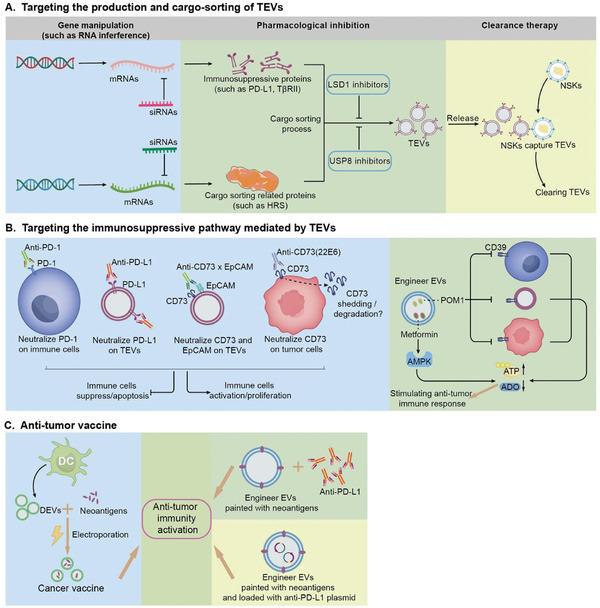
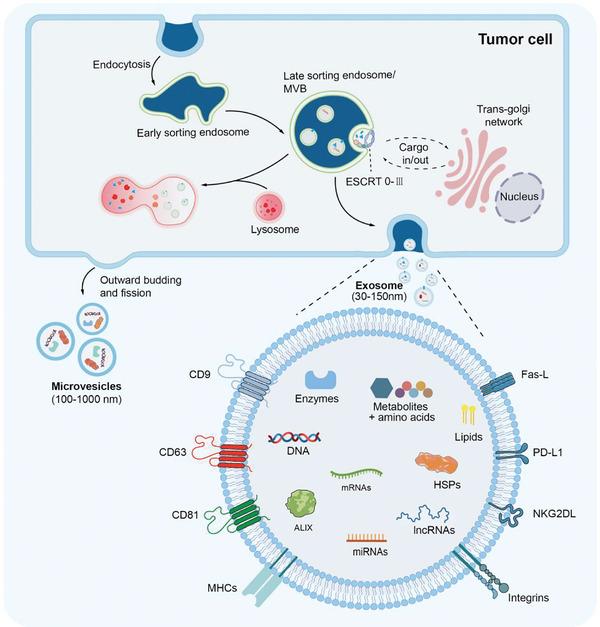
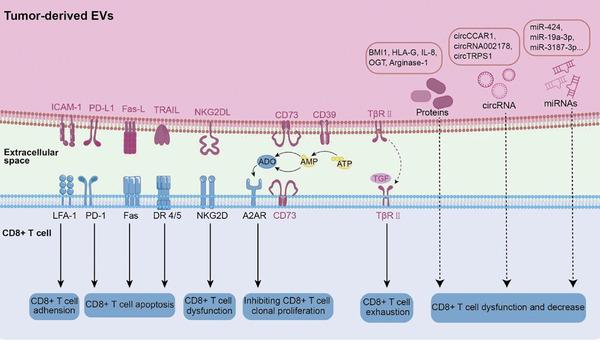
The crosstalk between immunity and cancer in the regulation of tumor growth is considered a hallmark of cancer. Antitumor immunity refers to the innate and adaptive immune responses that regulate cancer development and proliferation. Tumor immune evasion represents a major hindrance to effective anticancer treatment. Extracellular vesicles (EVs) are nano-sized and lipid-bilayer-enclosed particles that are secreted to the extracellular space by all cell types. They are critically involved in numerous biological functions including intercellular communication. Tumor-derived extracellular vesicles (TEVs) can transport a variety of cargo to modulate immune cells in the tumor microenvironment (TME). This review provides the latest update about how tumor cells evade immune surveillance by exploiting TEVs. First, the biogenesis of EVs and the cargo-sorting machinery are discussed. Second, how tumor cells modulate immune cell differentiation, activation, and function via TEVs to evade immune surveillance is illustrated. Last but not least, the novel antitumor strategies that can reverse immune escape are summarized.
免疫与癌症在肿瘤生长调控中的相互作用被认为是癌症的一个标志。抗肿瘤免疫是指调节癌症发展和增殖的先天性和适应性免疫反应。肿瘤免疫逃逸是有效抗癌治疗的一个主要障碍。细胞外囊泡(EVs)是纳米级的、被脂质双层包裹的颗粒,由所有细胞类型分泌到细胞外空间。它们在包括细胞间通讯在内的众多生物学功能中起着关键作用。肿瘤来源的细胞外囊泡(TEVs)可以运输多种物质来调节肿瘤微环境(TME)中的免疫细胞。这篇综述提供了关于肿瘤细胞如何通过利用TEVs逃避免疫监视的最新进展。首先,讨论了EVs的生物发生和货物分选机制。其次,阐述了肿瘤细胞如何通过TEVs调节免疫细胞的分化、激活和功能以逃避免疫监视。最后但同样重要的是,总结了可以逆转免疫逃逸的新型抗肿瘤策略。

 Zotero 插件