
基于机器学习的药物诱导毒性预测
Machine Learning-Enabled Drug-Induced Toxicity Prediction.
作者信息
Bai Changsen, Wu Lianlian, Li Ruijiang, Cao Yang, He Song, Bo Xiaochen
机构信息
Academy of Medical Engineering and Translational Medicine, Tianjin University, Tianjin, 300072, China.
Department of Advanced & Interdisciplinary Biotechnology, Academy of Military Medical Sciences, Beijing, 100850, China.
出版信息
Adv Sci (Weinh). 2025 Apr;12(16):e2413405. doi: 10.1002/advs.202413405. Epub 2025 Feb 3.
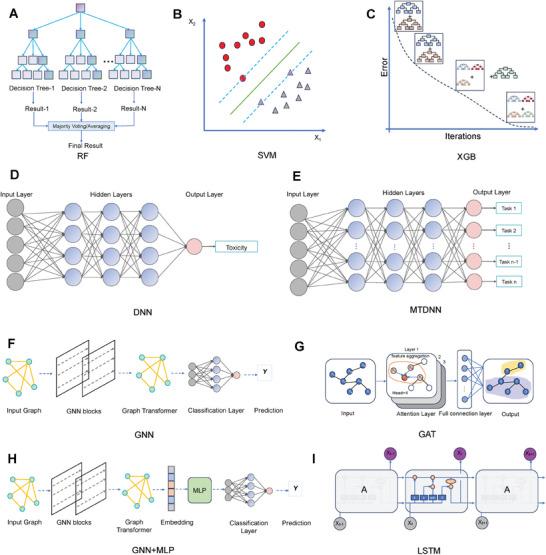
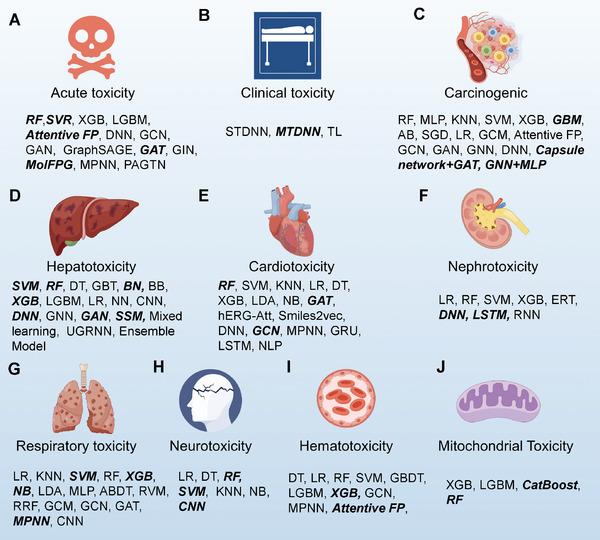
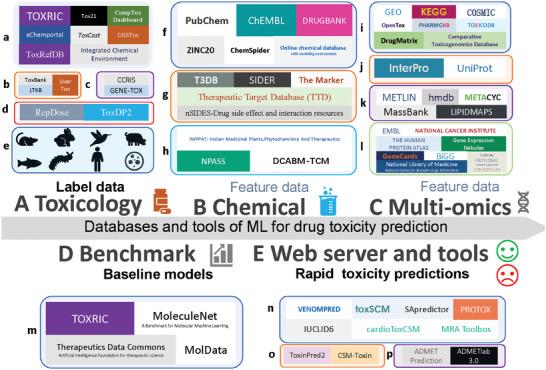
Unexpected toxicity has become a significant obstacle to drug candidate development, accounting for 30% of drug discovery failures. Traditional toxicity assessment through animal testing is costly and time-consuming. Big data and artificial intelligence (AI), especially machine learning (ML), are robustly contributing to innovation and progress in toxicology research. However, the optimal AI model for different types of toxicity usually varies, making it essential to conduct comparative analyses of AI methods across toxicity domains. The diverse data sources also pose challenges for researchers focusing on specific toxicity studies. In this review, 10 categories of drug-induced toxicity is examined, summarizing the characteristics and applicable ML models, including both predictive and interpretable algorithms, striking a balance between breadth and depth. Key databases and tools used in toxicity prediction are also highlighted, including toxicology, chemical, multi-omics, and benchmark databases, organized by their focus and function to clarify their roles in drug-induced toxicity prediction. Finally, strategies to turn challenges into opportunities are analyzed and discussed. This review may provide researchers with a valuable reference for understanding and utilizing the available resources to bridge prediction and mechanistic insights, and further advance the application of ML in drugs-induced toxicity prediction.
意外毒性已成为候选药物开发的重大障碍,占药物研发失败案例的30%。通过动物试验进行传统毒性评估既昂贵又耗时。大数据和人工智能(AI),尤其是机器学习(ML),正在有力地推动毒理学研究的创新与进步。然而,针对不同类型毒性的最佳AI模型通常各不相同,因此有必要对不同毒性领域的AI方法进行比较分析。多样的数据来源也给专注于特定毒性研究的科研人员带来了挑战。在本综述中,我们研究了10类药物诱导的毒性,总结了其特征以及适用的ML模型,包括预测性算法和可解释算法,在广度和深度之间取得平衡。还重点介绍了毒性预测中使用的关键数据库和工具,包括毒理学、化学、多组学和基准数据库,并根据其重点和功能进行了整理,以阐明它们在药物诱导毒性预测中的作用。最后,分析并讨论了将挑战转化为机遇的策略。本综述可为科研人员提供有价值的参考,帮助他们理解和利用现有资源,弥合预测与机理洞察之间的差距,并进一步推动ML在药物诱导毒性预测中的应用。


 Zotero 插件