
增强鲸类动物的表观遗传衰老时钟:对小须鲸、虎鲸、领航鲸、白鲸、座头鲸和弓头鲸等濒危小型海豚科动物进行准确的年龄估计。
Enhancing epigenetic aging clocks in cetaceans: accurate age estimations in small endangered delphinids, killer whales, pilot whales, belugas, humpbacks, and bowhead whales.
作者信息
Zoller Joseph A, Lu Ake T, Haghani Amin, Horvath Steve, Robeck Todd
机构信息
Department of Biostatistics, Fielding School of Public Health, University of California, Los Angeles, Los Angeles, CA, USA.
Altos Labs, San Diego, CA, USA.
出版信息
Sci Rep. 2025 Feb 3;15(1):4048. doi: 10.1038/s41598-025-86705-5.
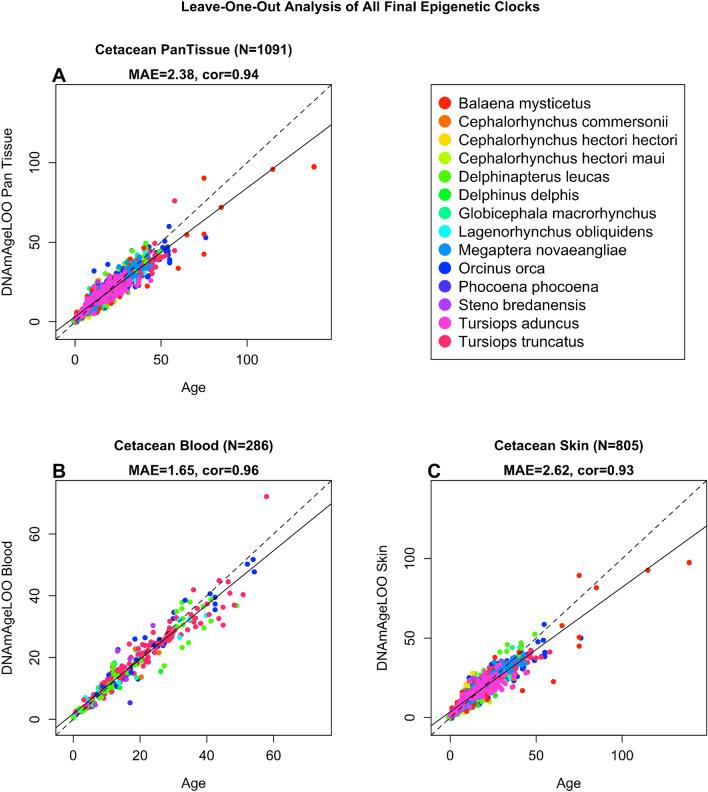
This study presents refined epigenetic clocks for cetaceans, building on previous research that estimated ages in several species from bottlenose dolphins to bowhead and humpback whales using cytosine methylation levels. We combined publicly available data (generated on the HorvathMammalMethylChip40 platform) from skin (n = 805) and blood (n = 286) samples across 13 cetacean species, aged 0 to 139 years. By combining methylation data from different sources, we enhanced our sample size, thereby strengthening the statistical validity of our clocks. We used elastic net regression with leave one sample out (LOO) and leave one species out (LOSO) cross validation to produce highly accurate blood only (Median Absolute Error [MAE] = 1.64 years, r = 0.96), skin only (MAE = 2.32 years, r = 0.94) and blood and skin multi-tissue (MAE = 2.24 years, r = 0.94) clocks. In addition, the LOSO blood and skin (MAE = 5.6 years, repeated measures r = 0.83), skin only (MAE = 6.22 years, repeated measures r = 0.81), and blood only (MAE = 4.11 years, repeated measures r = 0.95) clock analysis demonstrated relatively high correlation toward cetacean species not included within this current data set and provide evidence for a broader application of this model. Our results introduce a multi-species, two-tissue clock for broader applicability across cetaceans, alongside single-tissue multi-species clocks for blood and skin, which allow for more detailed aging analysis depending on the availability of samples. In addition, we developed species-specific clocks for enhanced precision, resulting in four blood-specific clocks and eight skin-specific clocks for individual species; all improving upon existing accuracy estimates for previously published species-specific clocks. By pooling methylation data from various studies, we increased our sample size, significantly enhancing the statistical power for building accurate clocks. These new epigenetic age estimators for cetaceans provide more accurate tools for aiding in conservation efforts of endangered cetaceans.
本研究在先前研究的基础上,利用胞嘧啶甲基化水平估计了从宽吻海豚到弓头鲸和座头鲸等多个物种的年龄,提出了针对鲸类动物的优化表观遗传时钟。我们整合了来自13种鲸类动物(年龄从0到139岁)的皮肤样本(n = 805)和血液样本(n = 286)的公开数据(在HorvathMammalMethylChip40平台上生成)。通过整合来自不同来源的甲基化数据,我们扩大了样本量,从而增强了我们时钟的统计有效性。我们使用弹性网络回归结合留一法(LOO)和留一物种法(LOSO)交叉验证,生成了高度准确的仅血液(中位数绝对误差[MAE]=1.64年,r = 0.96)、仅皮肤(MAE = 2.32年,r = 0.94)以及血液和皮肤多组织(MAE = 2.24年,r = 0.94)时钟。此外,LOSO血液和皮肤(MAE = 5.6年,重复测量r = 0.83)、仅皮肤(MAE = 6.22年,重复测量r = 0.81)以及仅血液(MAE = 4.11年,重复测量r = 0.95)时钟分析表明,与当前数据集中未包含的鲸类物种具有相对较高的相关性,并为该模型的更广泛应用提供了证据。我们的结果引入了一种多物种、双组织时钟,适用于更广泛的鲸类动物,同时还有针对血液和皮肤的单组织多物种时钟,这使得根据样本的可用性进行更详细的衰老分析成为可能。此外,我们开发了物种特异性时钟以提高精度,为单个物种生成了四个血液特异性时钟和八个皮肤特异性时钟;所有这些都改进了先前发表的物种特异性时钟的现有准确性估计。通过汇总来自各种研究的甲基化数据,我们增加了样本量,显著增强了构建准确时钟的统计能力。这些新的鲸类动物表观遗传年龄估计器为濒危鲸类动物的保护工作提供了更准确的工具。





 Zotero 插件