
加速表型衰老、遗传风险和生活方式与2型糖尿病进展的关联:一项使用多状态模型的前瞻性研究
Association of accelerated phenotypic aging, genetic risk, and lifestyle with progression of type 2 diabetes: a prospective study using multi-state model.
作者信息
Pan Lulu, Liu Yahang, Huang Chen, Huang Yifang, Lin Ruilang, Wei Kecheng, Yao Ye, Qin Guoyou, Yu Yongfu
机构信息
Department of Biostatistics, Key Laboratory of Public Health Safety of Ministry of Education, NHC Key Laboratory for Health Technology Assessment, School of Public Health, Fudan University, 138 Yi Xue Yuan Road, Shanghai, 200032, China.
Shanghai Institute of Infectious Disease and Biosecurity, Fudan University, Shanghai, China.
出版信息
BMC Med. 2025 Feb 4;23(1):62. doi: 10.1186/s12916-024-03832-y.
BACKGROUND
Aging is a major risk factor for type 2 diabetes (T2D), but individuals of the same chronological age may vary in their biological aging rate. The associations of Phenotypic Age Acceleration (PhenoAgeAccel), a new accelerated biological aging indicator based on clinical chemistry biomarkers, with the risk of dynamic progression remain unclear. We aimed to assess these associations and examine whether these associations varied by genetic risk and lifestyle.
METHODS
We conducted a prospective cohort study that included 376,083 adults free of T2D and diabetes-related events at baseline in UK Biobank. PhenoAgeAccel > 0 and ≤ 0 were defined as biologically older and younger than chronological age. The outcomes of interest were incident T2D, diabetic complications, and mortality. Hazard ratios (HRs) with 95% confidence intervals (CIs) and population attributable fractions (PAFs) for these associations were calculated using multi-state model.
RESULTS
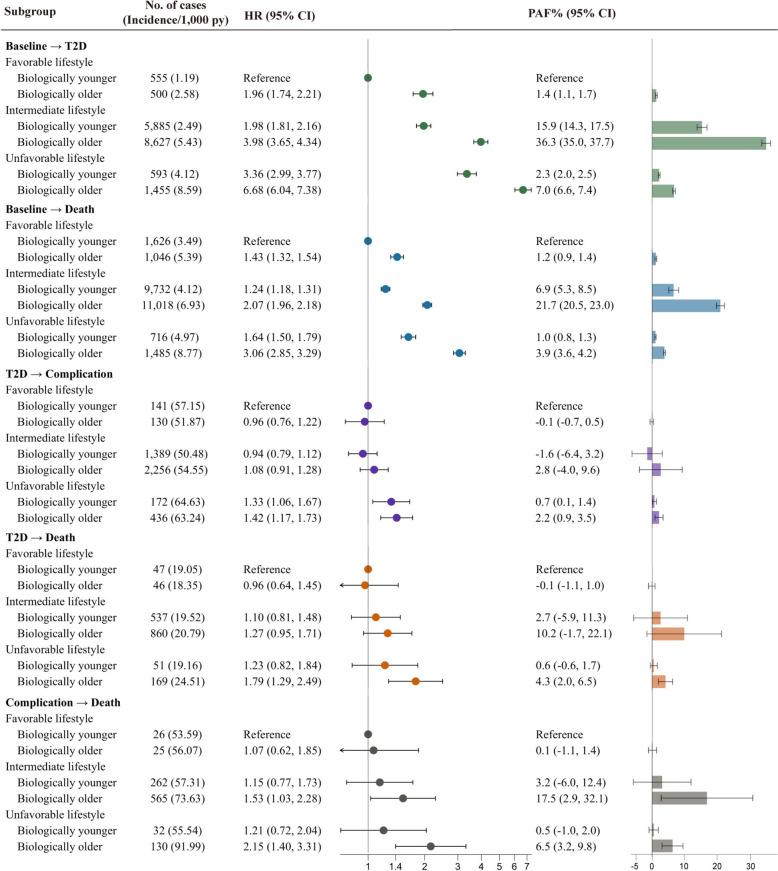
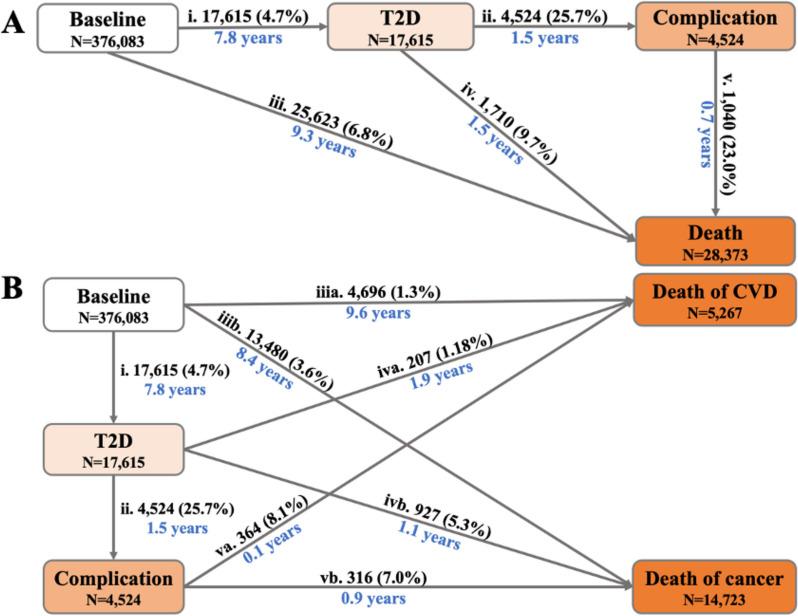
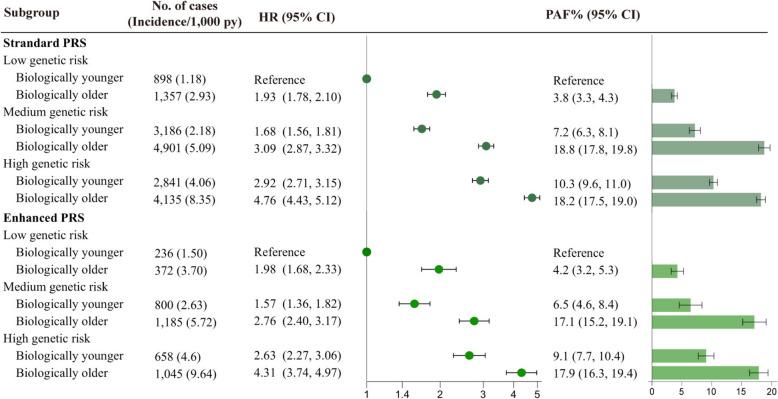
During a median follow-up of 13.7 years, 17,615 participants developed T2D, of whom, 4,524 subsequently developed complications, and 28,373 died. Being biologically older was associated with increased risks of transitions from baseline to T2D (HR 1.77, 95% CI 1.71-1.82; PAF 24.8 [95% CI 23.5-26.2]), from T2D to diabetic complications (1.10, 1.04-1.17; 4.4 [1.4-7.4]), from baseline to all-cause death (1.53, 1.49-1.57; 17.6 [16.6-18.6]), from T2D to all-cause death (1.14, 1.03-1.26; 7.4 [1.8-13.0]), and from diabetic complications to all-cause death (1.32, 1.15-1.51; 15.4 [7.5-23.2]) than being biologically younger. Additionally, participants with older biological age and high genetic risk had a higher risk of incident T2D (4.76,4.43-5.12;18.2 [17.5-19.0]) than those with younger biological age and low genetic risk. Compared with participants with younger biological age and healthy lifestyle, those with older biological age and unhealthy lifestyle had higher risks of transitions in the T2D trajectory, with HRs and PAFs ranging from 1.34 (1.16-1.55; 3.7 [1.8-5.6]) to 5.39 (5.01-5.79; 13.0 [12.4-13.6]).
CONCLUSIONS
PhenoAgeAccel was consistently associated with an increased risk of all transitions in T2D progression. It has the potential to be combined with genetic risk to identify early T2D incidence risk and may guide interventions throughout T2D progression while tracking their effectiveness.
背景
衰老为2型糖尿病(T2D)的主要风险因素,但相同实足年龄的个体其生物学衰老速率可能存在差异。基于临床化学生物标志物的新型加速生物学衰老指标——表型年龄加速(PhenoAgeAccel)与动态进展风险之间的关联尚不清楚。我们旨在评估这些关联,并研究这些关联是否因遗传风险和生活方式而异。
方法
我们进行了一项前瞻性队列研究,纳入了英国生物银行中376,083名基线时无T2D及糖尿病相关事件的成年人。PhenoAgeAccel>0和≤0分别定义为生物学年龄大于和小于实足年龄。感兴趣的结局为新发T2D、糖尿病并发症和死亡率。使用多状态模型计算这些关联的风险比(HR)及95%置信区间(CI)和人群归因分数(PAF)。
结果
在中位随访13.7年期间,17,615名参与者发生了T2D,其中4,524人随后出现并发症,28,373人死亡。与生物学年龄较小者相比,生物学年龄较大者从基线转变为T2D(HR 1.77,95%CI 1.71 - 1.82;PAF 24.8 [95%CI 23.5 - 26.2])、从T2D转变为糖尿病并发症(1.10,1.04 - 1.17;4.4 [1.4 - 7.4])、从基线转变为全因死亡(1.53,1.49 - 1.57;17.6 [16.6 - 18.6])、从T2D转变为全因死亡(1.14,1.03 - 1.26;7.4 [1.8 - 13.0])以及从糖尿病并发症转变为全因死亡(1.32,1.15 - 1.51;15.4 [7.5 - 23.2])的风险均增加。此外,与生物学年龄较小且遗传风险较低的参与者相比,生物学年龄较大且遗传风险较高的参与者发生新发T2D的风险更高(4.76,4.43 - 5.12;18.2 [17.5 - 19.0])。与生物学年龄较小且生活方式健康的参与者相比,生物学年龄较大且生活方式不健康的参与者在T2D病程中的转变风险更高,HR和PAF范围为1.34(1.16 - 1.55;3.7 [1.8 - 5.6])至5.39(5.01 - 5.79;13.0 [12.4 - 13.6])。
结论
PhenoAgeAccel与T2D进展中所有转变风险的增加始终相关。它有可能与遗传风险相结合以识别T2D早期发病风险,并可在T2D进展过程中指导干预措施,同时跟踪其有效性。
 Zotero 插件