
成人呼吸道合胞病毒住院情况的十年监测:发病率及病例定义的影响
Ten-Year Surveillance of Respiratory Syncytial Virus Hospitalizations in Adults: Incidence Rates and Case Definition Implications.
作者信息
Urchueguía-Fornes Arantxa, Muñoz-Quiles Cintia, Mira-Iglesias Ainara, López-Lacort Mónica, Mengual-Chuliá Beatriz, López-Labrador F Xavier, Díez-Domingo Javier, Orrico-Sánchez Alejandro
机构信息
Vaccines Research Unit, Fundación para el Fomento de la Investigación Sanitaria y Biomédica de la Comunitat Valenciana, FISABIO-Public Health, Valencia, Spain.
CIBER de Epidemiología y Salud Pública, Instituto de Salud Carlos III, Madrid, Spain.
出版信息
J Infect Dis. 2025 Jun 2;231(5):e830-e839. doi: 10.1093/infdis/jiaf056.
BACKGROUND
The impact of respiratory syncytial virus (RSV) in older adults is underrecognized, and the limited existing studies on the incidence of hospitalizations show great variability. This study aims to estimate the seasonal incidence rates (IRs) of RSV hospitalizations among adults aged ≥60 years and evaluate how different case definitions influence these estimates.
METHODS
A prospective, multicenter observational study with active monitoring was conducted over 10 seasons (2010-2011 to 2019-2020) in 4-10 hospitals (depending on the season) and covered 21%-46% of the region's total population (about 5 million people). RSV hospitalization IRs per 100 000 person-years and 95% confidence intervals were calculated with the exact Poisson method and were stratified by age group (≥60, ≥70, or ≥80 years), RSV season, sex, and the entire study period. Two case definitions were compared: influenzalike illness (ILI) and the combined use of ILI and extended severe acute respiratory infection (ILI/SARI).
RESULTS
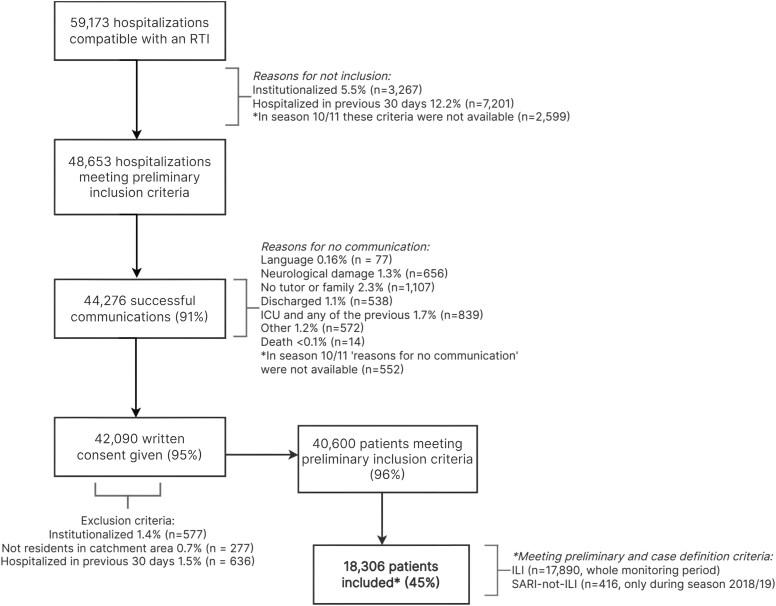
A total of 40 600 hospitalizations of individuals aged ≥60 years were included. The RSV hospitalization IRs ranged from 21 to 402 per 100 000 person-years, varying by season, age group, and case definition. The highest IRs were observed in those aged ≥80 years. The ILI case definition underestimated RSV hospitalizations by 13%-40% when compared with the ILI/SARI case definition.
CONCLUSIONS
On average, approximately 1 in every 1000 adults aged ≥60 years is hospitalized due to RSV. The risk of a severe RSV infection increases with age and varies significantly between seasons. These are key results for the estimation of the potential impact of the new available RSV vaccines.
背景
呼吸道合胞病毒(RSV)对老年人的影响尚未得到充分认识,现有的关于住院率的有限研究显示出很大的差异。本研究旨在估计60岁及以上成年人RSV住院的季节性发病率(IRs),并评估不同的病例定义如何影响这些估计值。
方法
在4至10家医院(取决于季节)进行了一项为期10个季节(2010 - 2011年至2019 - 2020年)的前瞻性、多中心主动监测观察性研究,覆盖该地区总人口的21% - 46%(约500万人)。采用精确泊松法计算每10万人年的RSV住院IRs及95%置信区间,并按年龄组(≥60岁、≥70岁或≥80岁)、RSV季节、性别和整个研究期进行分层。比较了两种病例定义:流感样疾病(ILI)以及ILI与扩展的严重急性呼吸道感染联合使用(ILI/SARI)。
结果
共纳入40600例60岁及以上个体的住院病例。RSV住院IRs每10万人年在21至402之间,因季节、年龄组和病例定义而异。≥80岁人群的IRs最高。与ILI/SARI病例定义相比,ILI病例定义使RSV住院病例数低估了13% - 40%。
结论
平均而言,每1000名60岁及以上成年人中约有1人因RSV住院。严重RSV感染的风险随年龄增加,且季节间差异显著。这些是估计新型RSV疫苗潜在影响的关键结果。

 Zotero 插件