
利用液体活检生物标志物开发风险评分,以筛选转移性黑色素瘤患者的免疫治疗反应者并对疾病进展风险进行分层。
Developing a risk score using liquid biopsy biomarkers for selecting Immunotherapy responders and stratifying disease progression risk in metastatic melanoma patients.
作者信息
Azzariti Amalia, De Summa Simona, Marvulli Tommaso M, De Risi Ivana, De Palma Giuseppe, Di Fonte Roberta, Fasano Rossella, Serratì Simona, Strippoli Sabino, Porcelli Letizia, Guida Michele
机构信息
Experimental Pharmacology Laboratory, IRCCS Istituto Tumori Giovanni Paolo II, V.le O. Flacco, 65, Bari, 70124, Italy.
Biostatistic and Bioinformatic Laboratory, IRCCS Istituto Tumori Giovanni Paolo II, Bari, Italy.
出版信息
J Exp Clin Cancer Res. 2025 Feb 5;44(1):40. doi: 10.1186/s13046-025-03306-w.
BACKGROUND
Despite the high response rate to PD-1 blockade therapy in metastatic melanoma (MM) patients, a significant proportion of patients do not respond. Identifying biomarkers to predict patient response is crucial, ideally through non-invasive methods such as liquid biopsy.
METHODS
Soluble forms of PD1, PD-L1, LAG-3, CTLA-4, CD4, CD73, and CD74 were quantified using ELISA assay in plasma of a cohort of 110 MM patients, at baseline, to investigate possible correlations with clinical outcomes. A clinical risk prediction model was applied and validated in pilot studies.
RESULTS
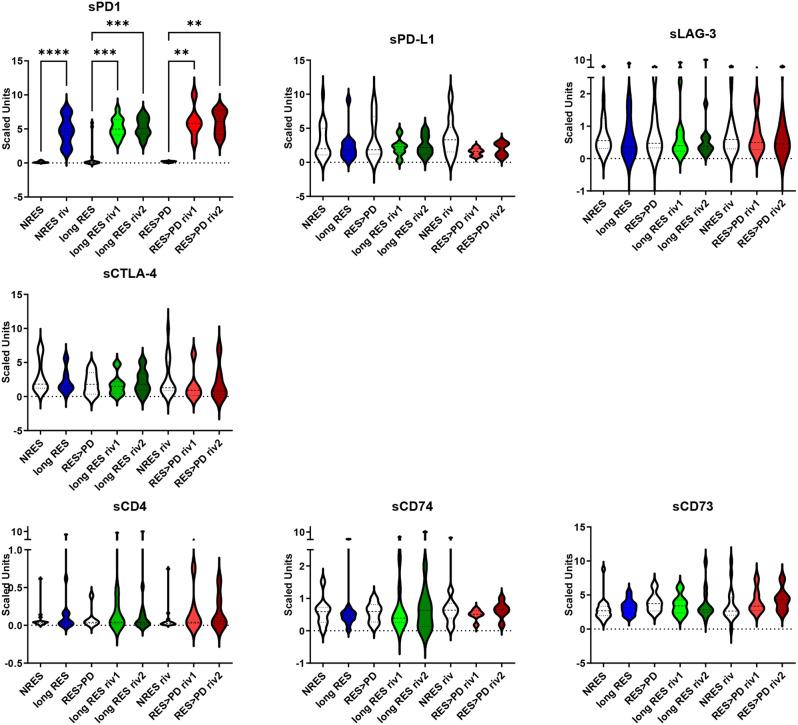
No biomarker showed statistically significant differences between responders and non-responders. However, high number of significant correlations were observed among certain biomarkers in non-responders. Through univariate and multivariate Cox analyses, we identified sPD-L1, sCTLA-4, sCD73, and sCD74 as independent biomarkers predicting progression-free survival and overall survival. According to ROC analysis we discovered that, except for sCD73, values of sPD-L1, sCTLA-4, and sCD74 lower than the cut-off predicted lower disease progression and reduced mortality. A comprehensive risk score for predicting progression-free survival was developed by incorporating the values of the two identified independent factors, sCTLA-4 and sCD74, which significantly improved the accuracy of outcome prediction. Pilot validations highlighted the potential use of the risk score in treatment-naive individuals and long responders.
CONCLUSION
In summary, risk score based on circulating sCTLA-4 and sCD74 reflects the response to immune checkpoint inhibitor (ICI) therapy in MM patients. If confirmed, through further validation, these findings could assist in recommending therapy to patients likely to experience a long-lasting response.
背景
尽管转移性黑色素瘤(MM)患者对PD-1阻断疗法的反应率很高,但仍有相当一部分患者无反应。识别预测患者反应的生物标志物至关重要,理想情况下是通过液体活检等非侵入性方法。
方法
使用酶联免疫吸附测定(ELISA)法对110例MM患者队列的血浆在基线时的可溶性PD1、PD-L1、LAG-3、CTLA-4、CD4、CD73和CD74形式进行定量,以研究与临床结果的可能相关性。在试点研究中应用并验证了一种临床风险预测模型。
结果
没有生物标志物在反应者和无反应者之间显示出统计学上的显著差异。然而,在无反应者中某些生物标志物之间观察到大量显著相关性。通过单变量和多变量Cox分析,我们确定可溶性PD-L1、可溶性CTLA-4、可溶性CD73和可溶性CD74为预测无进展生存期和总生存期的独立生物标志物。根据受试者工作特征(ROC)分析,我们发现,除可溶性CD73外,可溶性PD-L1、可溶性CTLA-4和可溶性CD74低于临界值预示着较低的疾病进展和降低的死亡率。通过纳入两个确定的独立因素可溶性CTLA-4和可溶性CD74的值,开发了一种用于预测无进展生存期的综合风险评分,这显著提高了结果预测的准确性。试点验证突出了风险评分在未接受过治疗的个体和长期反应者中的潜在用途。
结论
总之,基于循环可溶性CTLA-4和可溶性CD74的风险评分反映了MM患者对免疫检查点抑制剂(ICI)治疗的反应。如果通过进一步验证得到证实,这些发现可能有助于为可能经历持久反应的患者推荐治疗方案。


 Zotero 插件