
不同微塑料对水稻根际土壤理化性质和微生物多样性的影响。
Effects of different microplastics on the physicochemical properties and microbial diversity of rice rhizosphere soil.
作者信息
Lai Sheng, Fan Cunzhong, Yang Ping, Fang Yuanyuan, Zhang Lanting, Jian Minfei, Dai Guofei, Liu Jutao, Yang Huilin, Shen Liqin
机构信息
Jiangxi Academy of Water Science and Engineering, Nanchang, China.
College of Life Science, Jiangxi Normal University, Nanchang, China.
出版信息
Front Microbiol. 2025 Jan 21;15:1513890. doi: 10.3389/fmicb.2024.1513890. eCollection 2024.
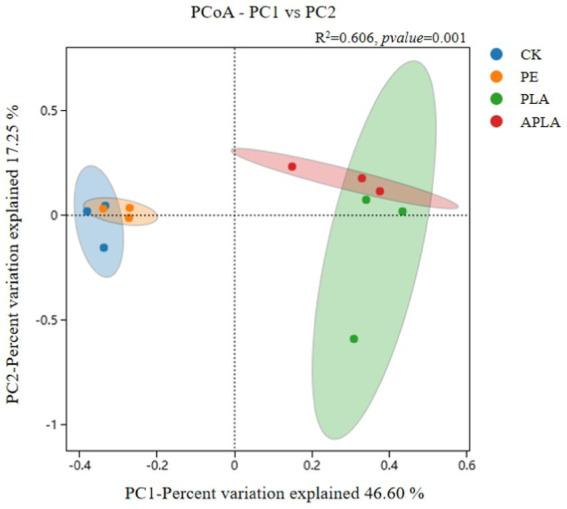
Biodegradable plastics, as alternatives to conventional waste plastics, are increasingly applied across various fields. However, the ecological risks associated with the widespread use of biodegradable plastics remain unclear. Additionally, biodegradable plastics tend to age in the environment, leading to changes in their physicochemical properties. The ecological risks brought by the aging of microplastics have also been scarcely studied. In this study, we selected conventional microplastics (PE-MPs), biodegradable microplastics (PLA-MPs), and aged biodegradable microplastics (aging-PLA-MPs) to explore their effects on the rhizosphere soil environment of rice. The results showed that microplastics reduced the soil N and P content, with PE slightly increasing the DOC content, while PLA and aging-PLA significantly increased DOC by 21.13 and 24.04%, respectively. Microplastics also decreased soil enzyme activity, with aging-PLA having a somewhat stimulatory effect on enzyme activity compared to PLA. Furthermore, microplastics reduced the soil bacterial diversity index and altered the community structure of dominant bacterial species, with DOC content and FDA hydrolase being the main factors influencing the soil bacterial community. Bacteria were most sensitive to PLA, and the stability of the bacterial microbial network structure decreased, although aging reduced the negative impact of PLA on the bacterial community. This study contributes to our understanding of the ecological risks posed by biodegradable plastics and their aging processes on the environment.
可生物降解塑料作为传统废弃塑料的替代品,正越来越多地应用于各个领域。然而,与可生物降解塑料广泛使用相关的生态风险仍不明确。此外,可生物降解塑料在环境中容易老化,导致其物理化学性质发生变化。微塑料老化带来的生态风险也鲜有研究。在本研究中,我们选择了传统微塑料(PE-MPs)、可生物降解微塑料(PLA-MPs)和老化的可生物降解微塑料(aging-PLA-MPs),以探讨它们对水稻根际土壤环境的影响。结果表明,微塑料降低了土壤氮和磷含量,PE略微增加了溶解有机碳(DOC)含量,而PLA和aging-PLA分别使DOC显著增加了21.13%和24.04%。微塑料还降低了土壤酶活性,与PLA相比,aging-PLA对酶活性有一定的刺激作用。此外,微塑料降低了土壤细菌多样性指数,改变了优势细菌物种的群落结构,DOC含量和FDA水解酶是影响土壤细菌群落的主要因素。细菌对PLA最敏感,细菌微生物网络结构的稳定性下降,尽管老化降低了PLA对细菌群落的负面影响。本研究有助于我们了解可生物降解塑料及其老化过程对环境造成的生态风险。




 Zotero 插件