
2022年中国西部中暑患者的临床特征及危险因素分析:一项多中心回顾性研究
Analysis of clinical characteristics and risk factors for patients with heat stroke in western China in 2022: a multicenter retrospective study.
作者信息
Zheng Xin, Gao Yuchun, Xie Qinli, Chen Qiulan, Guo Chuan, Dong Qionglan, Tang Jin, Luo Jun, Ge Ying, He Jian, Hou Xiaolin, Zhou Guanghong, Chen Yuan, Cao Haiquan, Xiao Jiujia, Lan An, Chen Qiu, Zeng Yonghong, Huang Jing, Long Huaicong
机构信息
Department of Geriatric Intensive Care Unit, Sichuan Provincial People's Hospital, University of Electronic Science and Technology of China, Chengdu, China.
Department of Physical Examination Center, Chongqing Emergency Medical Center, Chongqing Key Laboratory of Emergency Medicine, Chongqing University Central Hospital, Chongqing, China.
出版信息
Front Med (Lausanne). 2025 Jan 22;12:1467771. doi: 10.3389/fmed.2025.1467771. eCollection 2025.
OBJECTIVES
To analyzed the clinical characteristics and treatment modalities of heat stroke (HS) and to identify risk factors for a poor prognosis of HS and provide reference suggestions for its treatment and prevention.
MEASUREMENTS AND MAIN RESULTS
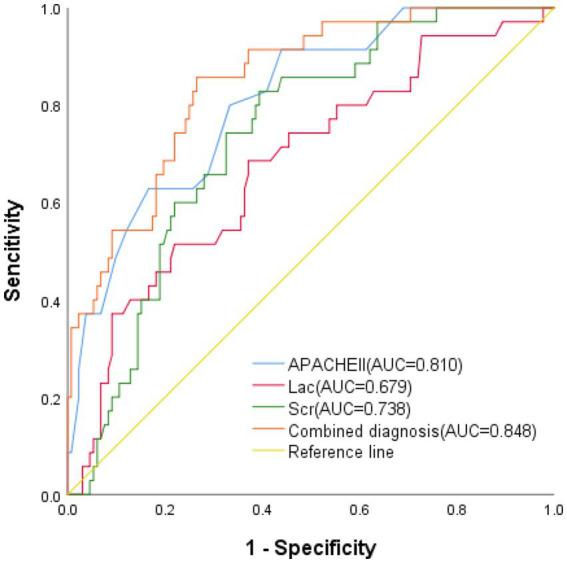
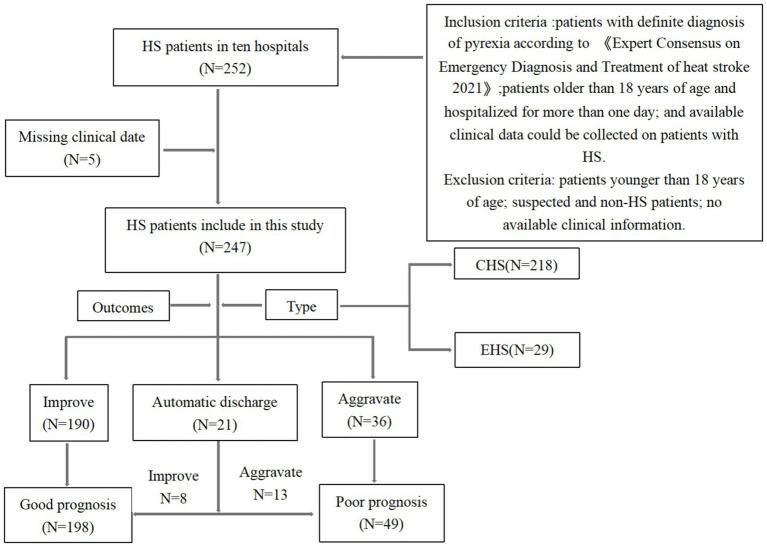
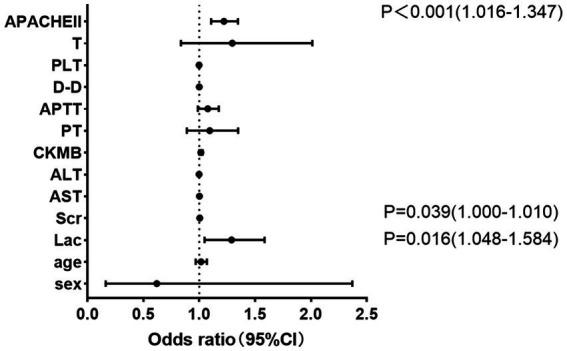
We enrolled a total of 247 patients, with hypertension, diabetes, and psychosis being the top three comorbidities associated with HS. The incidence of HS was higher among males and older individuals. Compared to the control group, the poor prognosis group experienced higher temperatures, a higher incidence of cerebral edema, and gastrointestinal bleeding (all < 0.05). The poor prognosis group had significantly higher blood pH, HCO3-, Lac, Scr, AST, ALT, DBIL, CKMB, PT, DD, and PLT (all < 0.05). Furthermore, logistic regression analysis revealed that Lac, Scr, and APACHE II were risk factors for poor prognosis ( < 0.05). The AUC values for the combined diagnostic model were 0.848 (95% CI: 0.781-0.914). Male morbidity, the number of patients with combined hypertension, the prognosis, and the APACHE II score and ALT level were all greater ( < 0.05) in the CHS group. The Kaplan-Meier analysis revealed that the CHS group had a significantly higher mortality rate than the EHS group.
CONCLUSION
A high incidence of hypertension, diabetes, psychosis, men, and older persons may be associated with HS. HS patients with high blood cell counts, impaired coagulation, liver and kidney diseases, and those with a specific type of CHS may face a poor prognosis. In patients with heart failure, APACHE II, Lac, and Scr were independent risk factors for a poor prognosis.
目的
分析热射病(HS)的临床特征及治疗方式,识别HS预后不良的危险因素,并为其治疗与预防提供参考建议。
测量指标及主要结果
共纳入247例患者,高血压、糖尿病和精神病是与HS相关的前三大合并症。HS在男性和老年人中的发病率较高。与对照组相比,预后不良组体温更高,脑水肿和胃肠道出血的发生率更高(均P<0.05)。预后不良组的血pH值、HCO3-、乳酸(Lac)、肌酐(Scr)、天门冬氨酸氨基转移酶(AST)、丙氨酸氨基转移酶(ALT)、直接胆红素(DBIL)、肌酸激酶同工酶(CKMB)、凝血酶原时间(PT)、D-二聚体(DD)和血小板(PLT)显著更高(均P<0.05)。此外,逻辑回归分析显示,Lac、Scr和急性生理与慢性健康状况评分系统II(APACHE II)是预后不良的危险因素(P<0.05)。联合诊断模型的曲线下面积(AUC)值为0.848(95%可信区间:0.781-0.914)。中暑合并症(CHS)组的男性发病率、合并高血压患者数量、预后以及APACHE II评分和ALT水平均更高(P<0.05)。Kaplan-Meier分析显示,CHS组的死亡率显著高于经典热射病(EHS)组。
结论
高血压、糖尿病、精神病、男性和老年人的高发病率可能与HS有关。血细胞计数高、凝血功能受损、肝肾疾病的HS患者以及特定类型的CHS患者可能预后不良。在心力衰竭患者中,APACHE II、Lac和Scr是预后不良的独立危险因素。
 Zotero 插件