
药物性红细胞增多症的诊断、管理及预后:一项系统综述
Diagnosis, management, and outcomes of drug-induced erythrocytosis: a systematic review.
作者信息
Liu Jessica, Chin-Yee Benjamin, Ho Jenny, Lazo-Langner Alejandro, Chin-Yee Ian H, Iansavitchene Alla, Hsia Cyrus C
机构信息
Department of Medicine, London Health Sciences Centre, London, ON, Canada.
Schulich School of Medicine and Dentistry, Western University, London, ON, Canada.
出版信息
Blood Adv. 2025 May 13;9(9):2108-2118. doi: 10.1182/bloodadvances.2024015410.
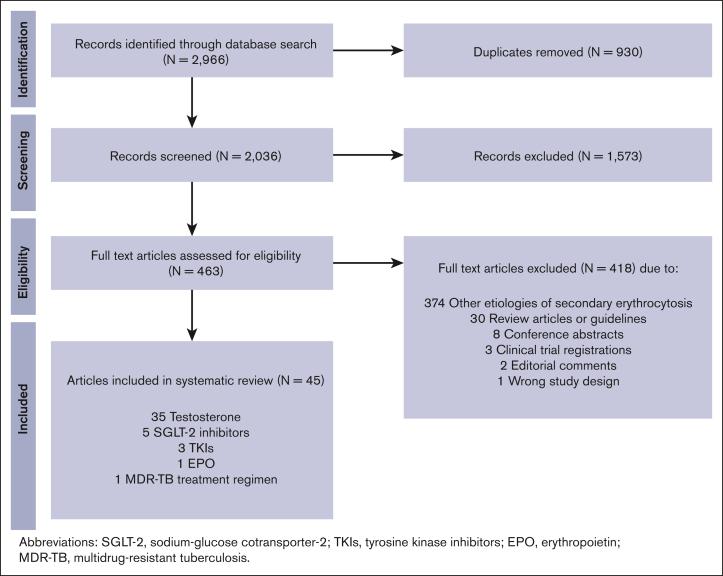
Secondary erythrocytosis refers to an elevation in hemoglobin or hematocrit due to elevated serum erythropoietin levels. Medications including testosterone and sodium-glucose cotransporter-2 (SGLT-2) inhibitors are increasingly recognized as causes of secondary erythrocytosis. We conducted a systematic review to inform the clinical management of drug-induced erythrocytosis. Following Preferred Reporting Items for Systematic Reviews and Meta-Analyses guidelines, we performed a systematic literature search in MEDLINE, EMBASE, CENTRAL (all via Ovid), and Google Scholar. Of the 2036 articles screened for eligibility, 45 studies were included in our review, with 35 studies on testosterone and other androgen use, 5 studies on SGLT-2 inhibitors, 3 studies on antiangiogenic tyrosine kinase inhibitors (TKIs), 1 study on erythropoiesis-stimulating agents, and 1 study on a treatment regimen for multidrug-resistant tuberculosis. Cisgender and transgender men on prescription testosterone had erythrocytosis rates of up to 66.7%, with intramuscular formulations, higher doses, and older age associated with increased risk of erythrocytosis. Up to 2.7% of men on testosterone therapy developed thromboembolic events. Among individuals on SGLT-2 inhibitors, erythrocytosis rates ranged from 2.1% to 22%, with those who discontinued therapy demonstrating improvement or resolution of erythrocytosis. Thromboembolic events were reported in up to 10% of these individuals. Antiangiogenic TKIs were studied in patients with cancer, with erythrocytosis developing in up to 43.5% of patients. Drug-induced erythrocytosis is a heterogeneous condition for which there is no clear consensus among clinicians about its diagnosis and management. We offer recommendations for clinical practice within the scope of this systematic review, although further research is required.
继发性红细胞增多症是指由于血清促红细胞生成素水平升高导致血红蛋白或血细胞比容升高。包括睾酮和钠-葡萄糖协同转运蛋白2(SGLT-2)抑制剂在内的药物越来越被认为是继发性红细胞增多症的病因。我们进行了一项系统评价,以指导药物性红细胞增多症的临床管理。按照系统评价和Meta分析的首选报告项目指南,我们在MEDLINE、EMBASE、CENTRAL(均通过Ovid)和谷歌学术上进行了系统的文献检索。在筛选出的2036篇符合条件的文章中,有45项研究纳入了我们的评价,其中35项研究涉及睾酮和其他雄激素的使用,5项研究涉及SGLT-2抑制剂,3项研究涉及抗血管生成酪氨酸激酶抑制剂(TKIs),1项研究涉及促红细胞生成素刺激剂,1项研究涉及耐多药结核病的治疗方案。接受处方睾酮治疗的顺性别和跨性别男性的红细胞增多症发生率高达66.7%,肌肉注射制剂、更高剂量和年龄较大与红细胞增多症风险增加相关。接受睾酮治疗的男性中,高达2.7%发生了血栓栓塞事件。在使用SGLT-2抑制剂的个体中,红细胞增多症发生率在2.1%至22%之间,停药者的红细胞增多症有所改善或缓解。这些个体中报告的血栓栓塞事件高达10%。在癌症患者中对抗血管生成TKIs进行了研究,高达43.5%的患者发生了红细胞增多症。药物性红细胞增多症是一种异质性疾病,临床医生对其诊断和管理尚无明确共识。尽管还需要进一步研究,但我们在本系统评价范围内为临床实践提供了建议。
 Zotero 插件