
探讨母亲心理健康在社会经济剥夺与儿童发展结果之间关联中的潜在中介作用。
Examining the Potential Mediating Role of Maternal Mental Health in the Association Between Socioeconomic Deprivation and Child Development Outcomes.
作者信息
Okelo Kenneth, Murray Aja, King Josiah, Hardie Iain, Hall Hildigunnur Anna, Luedecke Emily, Marryat Louise, Thompson Lucy, Minnis Helen, Lombardo Michael, Wilson Philip, Auyeung Bonnie
机构信息
Department of Psychology, School of Philosophy, Psychology and Language Sciences, University of Edinburgh, 7 George Square, Edinburgh, EH8 9JZ, UK.
Centre for Health Security and Communicable Disease Control, Directorate of Health, Reykjavík, Iceland.
出版信息
Matern Child Health J. 2025 Mar;29(3):338-348. doi: 10.1007/s10995-025-04050-5. Epub 2025 Feb 7.
BACKGROUND
Socioeconomic deprivation has been linked to negative child developmental outcomes including brain development, psychological well-being, educational attainment, and social-emotional well-being. Maternal mental health has also been linked to mothers' parenting practices and their children's developmental outcomes. However, limited evidence exists regarding the role of maternal mental health (prenatal and postnatal) in the association between socioeconomic deprivation and children's developmental outcomes.
METHODS
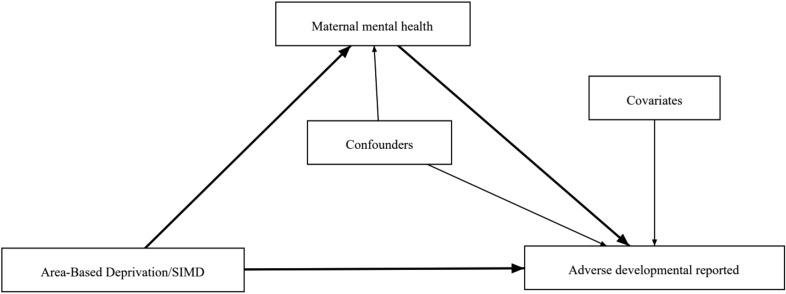
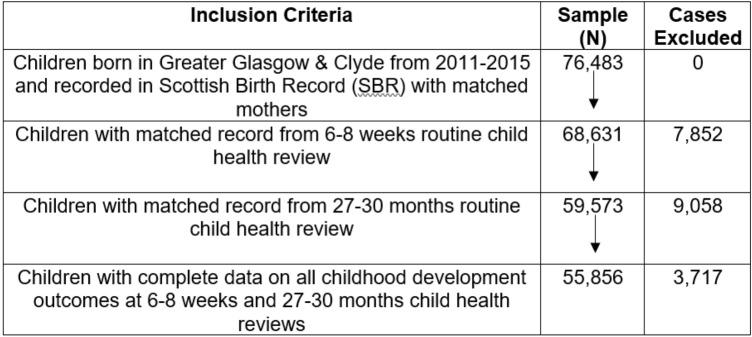
We examined the potential role of maternal mental health in the association between socioeconomic deprivation (SED) and child development outcomes. We used a large linked administrative health dataset covering children born between 2011 and 2015 in Greater Glasgow and Clyde, Scotland. Of the 76,483 participants, 55,856 mothers with matched children's developmental outcome data were included. A mediation analysis model, adjusted for confounders and covariates, was used.
RESULTS
Maternal mental health assessed by a history of hospital admissions mediated, but to a small extent, the relationship between SED and children's developmental outcomes. The average direct effect (ADE), of SED in the first model with a history of hospital admissions, was ADE: ES = - 0.0875 (95% CI = - 0.097, - 0.08; p < 0.001) and ACME: ES = - 0.0002 (95% CI = - 0.001, - 0.0001; p = 0.01). The proportion mediated by the history of mental health admission was 0.3%.
CONCLUSION
The association between SED and children's developmental outcomes appears to be partially mediated by maternal mental health, although the proportional-mediated effect was very small.
背景
社会经济剥夺与儿童负面发育结果有关,包括大脑发育、心理健康、教育成就和社会情感健康。母亲的心理健康也与母亲的育儿方式及其子女的发育结果有关。然而,关于母亲心理健康(产前和产后)在社会经济剥夺与儿童发育结果之间的关联中所起的作用,证据有限。
方法
我们研究了母亲心理健康在社会经济剥夺(SED)与儿童发育结果之间关联中的潜在作用。我们使用了一个大型的关联行政健康数据集,涵盖了2011年至2015年在苏格兰大格拉斯哥和克莱德出生的儿童。在76483名参与者中,纳入了55856名有匹配儿童发育结果数据的母亲。使用了一个经过混杂因素和协变量调整的中介分析模型。
结果
通过住院史评估的母亲心理健康在一定程度上介导了SED与儿童发育结果之间的关系,但程度较小。在第一个包含住院史的模型中,SED的平均直接效应(ADE)为:ADE:ES = -0.0875(95%CI = -0.097,-0.08;p < 0.001),ACME:ES = -0.0002(95%CI = -0.001,-0.0001;p = 0.01)。由心理健康住院史介导的比例为0.3%。
结论
SED与儿童发育结果之间的关联似乎部分由母亲心理健康介导,尽管比例介导效应非常小。
 Zotero 插件