
感染艾滋病毒的老年人表观遗传衰老中的性别差异。
Sex differences in epigenetic ageing for older people living with HIV.
作者信息
Johnston Carrie D, Pang Alina P S, Siegler Eugenia L, Thomas Charlene, Burchett Chelsie O, Crowley Mia, O'Brien Rochelle, Ndhlovu Lishomwa C, Glesby Marshall J, Corley Michael J
机构信息
Department of Medicine, Division of Infectious Diseases, Weill Cornell Medicine, New York City, New York, USA.
Department of Medicine, Division of Geriatrics and Palliative Medicine, Weill Cornell Medicine, New York City, New York, USA.
出版信息
EBioMedicine. 2025 Mar;113:105588. doi: 10.1016/j.ebiom.2025.105588. Epub 2025 Feb 8.
BACKGROUND
HIV-1 infection impacts biological ageing, and epigenetic clocks highlight epigenetic age acceleration in people with HIV. Despite evidence indicating sex differences in clinical, immunological, and virological measures, females have been underrepresented in most HIV epigenetic studies. Hence, we generated a more representative epigenetic dataset to examine sex differences in epigenetic ageing and relationships to clinical phenotypes and proteomics.
METHODS
We calculated first, second, and third-generation epigenetic ages using DNA methylation data in an observational cohort of 52 females and 106 males with HIV age 50 and over. We profiled plasma biomarkers with Olink high-throughput proteomics to test associations with epigenetic age acceleration. Survival was ascertained over 5 years.
FINDINGS
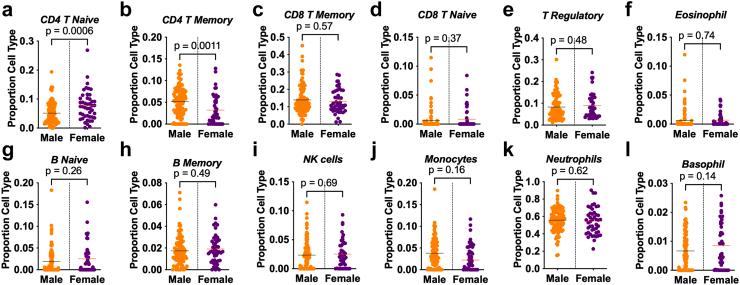
Epigenetic age acceleration measured by three principal-component based chronological epigenetic age clocks (p = 0.0029, 0.021, 0.010) and one epigenetic mortality risk clock was significantly lower in females living with HIV compared to males (p = 0.0011). Additionally, sex was significantly associated with epigenetic biomarker scores for proportion of naïve CD4+ T cells (p = 0.0006), physical fitness including DNAmGait (p = 0.0010), DNAmGrip (p < 0.0001), and DNAmV02 max (p < 0.0001). We found epigenetic age acceleration associated with plasma proteomic markers involved in inflammation, senescence, immune regulation, kidney function, and tissue homoeostasis (p < 0.0001). Higher epigenetic frailty risk scores were associated with lower CD4 T cell counts (p = 0.0072) and lower CD4/CD8 ratio (p = 0.0017). Slower gait (p = 0.0017), greater frailty (p = 0.0074), and history of smoking (p = 0.042) were associated with increased DNAmFitAge. Risk of death was increased in females with PCPhenoAge acceleration over a 5-year timespan compared to men with PCPhenoAge acceleration (p = 0.03).
INTERPRETATION
These results highlight the importance of studying sex-specific differences in epigenetic ageing biomarkers for HIV-related geroscience research.
FUNDING
National Institute on Aging (K23AG072960), National Center for Advancing Translational Sciences (UL1TR000457), National Institute of Mental Health (R21 MH115821).
背景
HIV-1感染会影响生物衰老,表观遗传时钟凸显了HIV感染者的表观遗传年龄加速现象。尽管有证据表明在临床、免疫学和病毒学指标方面存在性别差异,但在大多数HIV表观遗传学研究中,女性的代表性不足。因此,我们生成了一个更具代表性的表观遗传数据集,以研究表观遗传衰老中的性别差异以及与临床表型和蛋白质组学的关系。
方法
我们使用DNA甲基化数据,在一个包含52名年龄在50岁及以上的HIV感染女性和106名HIV感染男性的观察队列中,计算了第一代、第二代和第三代表观遗传年龄。我们使用Olink高通量蛋白质组学对血浆生物标志物进行分析,以测试与表观遗传年龄加速的关联。确定了5年的生存期。
研究结果
基于三个主成分的按时间顺序排列的表观遗传年龄时钟(p = 0.0029、0.021、0.010)和一个表观遗传死亡风险时钟测量的表观遗传年龄加速,在感染HIV的女性中显著低于男性(p = 0.0011)。此外,性别与幼稚CD4+ T细胞比例的表观遗传生物标志物评分(p = 0.0006)、包括DNAmGait(p = 0.0010)、DNAmGrip(p < 0.0001)和DNAmV02 max(p < 0.000!)在内的身体健康状况显著相关。我们发现表观遗传年龄加速与参与炎症、衰老、免疫调节、肾功能和组织稳态的血浆蛋白质组学标志物相关(p < 0.0001)。较高的表观遗传衰弱风险评分与较低的CD4 T细胞计数(p = 0.0072)和较低的CD4/CD8比值(p = 0.0017)相关。步态较慢(p = 0.0017)、衰弱程度较高(p = 0.0074)和吸烟史(p = 0.042)与DNAmFitAge增加相关。与PCPhenoAge加速的男性相比,PCPhenoAge加速的女性在5年时间跨度内的死亡风险增加(p = 0.03)。
解读
这些结果凸显了在HIV相关老年科学研究中,研究表观遗传衰老生物标志物中性别特异性差异的重要性。
资金来源
美国国立衰老研究所(K23AG072960)、美国国立推进转化科学中心(UL1TR000457)、美国国立精神卫生研究所(R21 MH115821)。



 Zotero 插件