
肿瘤相关巨噬细胞:非小细胞肺癌肿瘤微环境中的关键角色
Tumor-Associated Macrophages: Key Players in the Non-Small Cell Lung Cancer Tumor Microenvironment.
作者信息
Lv Tongtong, Fan Rui, Wu Jiaqi, Gong Haolan, Gao Xiaoru, Liu Xin, Gong Yixin, Luo Bo, Zhang Yanhua, Peng Xiaochun, Liang Gai
机构信息
Department of Hematology, The First Affiliated Hospital of Yangtze University, Jingzhou, China.
Department of Pathophysiology, School of Basic Medicine, Health Science Center, Yangtze University, Jingzhou, China.
出版信息
Cancer Med. 2025 Feb;14(3):e70670. doi: 10.1002/cam4.70670.
BACKGROUND
Lung cancer is among the most common and deadliest malignant tumors worldwide. It is often detected at late stages, resulting in unfavorable outcomes, with tumor cell heterogeneity and medication resistance. Tumor-associated macrophages are among the key cells contributing to cancer progression. They are categorized into two primary phenotypes: Proinflammatory (M1) and anti-inflammatory (M2) which are involved in the onset and progression of NSCLC. The role of common cytokines secreted by macrophages in the progression of lung cancer are described, and the effects of various substances such as RNA or protein on the differentiation and polarization of two phenotypes of macrophages are highlighted to characterize the impact of the immune state of tumors on therapeutic effect of treatments and patient prognosis. Researchers have primarily aimed to investigate innovative carriers and strategies based on macrophages to modify the tumor microenvironment.
OBJECTIVES
These approaches are often integrated with other treatments, particularly immunotherapy, to enhance therapeutic efficacy.
METHODS
A comprehensive review was carried out by systematically synthesizing existing literature on PubMed, using the combination of the keywords "TAMs", "NSCLC", "Drug resistance", and "therapy". The available studies were screened for selection based on quality and relevance.
CONCLUSIONS
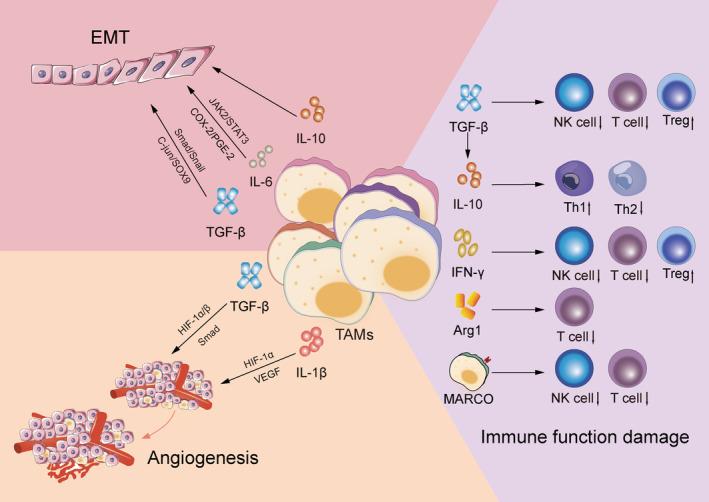
TAMs promote tumor invasion, growth, and metastasis by promoting angiogenesis and EMT. In addition, they contribute to the development of drug resistance and the immunosuppressive microenvironment establishment. The immunosuppressive factors secreted by TAM can weaken the activity of immune cells, inhibit their killing effect on tumors, leading to immune suppression and hindering the effectiveness of treatment. Therefore, TAM is a key target for the development of cancer immunotherapy. Various strategies are being explored, including reducing the recruitment of TAMs and influencing their polarization to treat NSCLC. In addition, TAMs based treatment systems can achieve precise delivery of drugs or gene interfering molecules without causing side effects.
背景
肺癌是全球最常见且最致命的恶性肿瘤之一。它常常在晚期才被发现,导致预后不佳,存在肿瘤细胞异质性和耐药性。肿瘤相关巨噬细胞是促进癌症进展的关键细胞之一。它们主要分为两种表型:促炎(M1)和抗炎(M2),这两种表型都参与非小细胞肺癌的发生和发展。本文描述了巨噬细胞分泌的常见细胞因子在肺癌进展中的作用,并强调了各种物质如RNA或蛋白质对两种巨噬细胞表型分化和极化的影响,以表征肿瘤免疫状态对治疗效果和患者预后的影响。研究人员主要致力于研究基于巨噬细胞的创新载体和策略,以改变肿瘤微环境。
目的
这些方法通常与其他治疗方法,特别是免疫疗法相结合,以提高治疗效果。
方法
通过系统综合PubMed上关于“肿瘤相关巨噬细胞”(TAMs)、“非小细胞肺癌”(NSCLC)、“耐药性”和“治疗”的现有文献进行全面综述。根据质量和相关性对现有研究进行筛选以选择纳入。
结论
肿瘤相关巨噬细胞通过促进血管生成和上皮-间质转化促进肿瘤侵袭、生长和转移。此外,它们有助于耐药性的发展和免疫抑制微环境的建立。肿瘤相关巨噬细胞分泌的免疫抑制因子可削弱免疫细胞的活性,抑制其对肿瘤的杀伤作用,导致免疫抑制并阻碍治疗效果。因此,肿瘤相关巨噬细胞是癌症免疫治疗发展的关键靶点。目前正在探索各种策略,包括减少肿瘤相关巨噬细胞的募集并影响其极化以治疗非小细胞肺癌。此外,基于肿瘤相关巨噬细胞的治疗系统可以实现药物或基因干扰分子的精准递送而不产生副作用。


 Zotero 插件