
基于网络药理学和分子对接的萆薢泽兰饮治疗膝骨关节炎作用的分子机制
Molecular mechanism of the effect of BixiezelanYin on knee osteoarthritis based on network pharmacology and molecular docking.
作者信息
Huang Renkun, Lu Jiehua, Yang Xueyi, Sheng Guanyun, Qin Fangyi, Yang Xiongwu
机构信息
Guangxi University of Chinese Medicine, Nanning City, Guangxi, China.
Liuzhou Traditional Chinese Medicine Hospital, Liuzhou City, Guangxi, China.
出版信息
Medicine (Baltimore). 2025 Feb 7;104(6):e41459. doi: 10.1097/MD.0000000000041459.
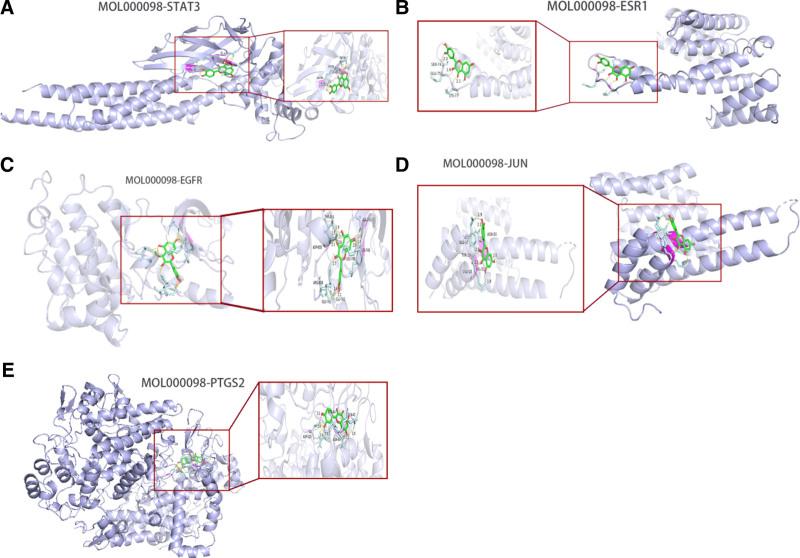
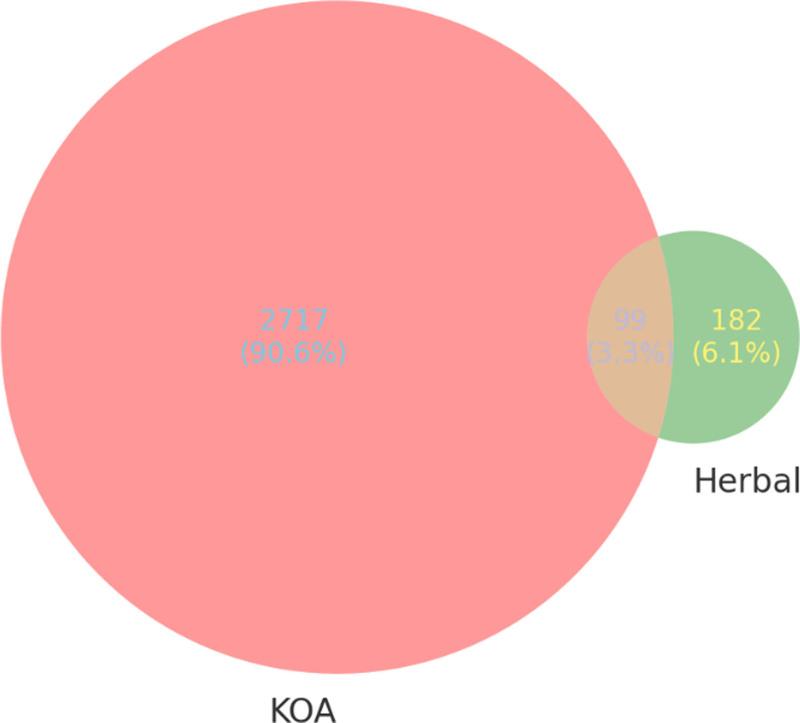
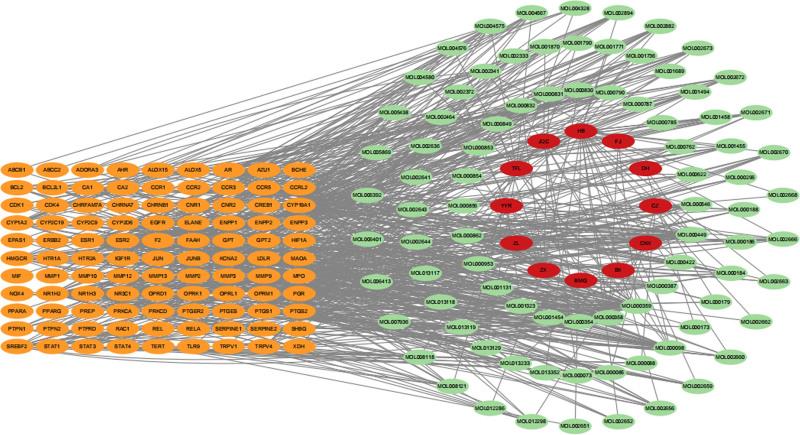
The BixizelanYin (BXZLY) is a traditional herbal formula for treating damp-heat type knee osteoarthritis (KOA). This study aimed to investigate the potential therapeutic effects of BXZLY on KOA by using network pharmacology and molecular docking. Active ingredients and their corresponding targets of BXZLY were screened through the Traditional Chinese Medicine Systems Pharmacology Database and Analysis Platform. The known disease targets of KOA were retrieved from GeneCards and the Online Mendelian Inheritance in Man database. The effective targets of BXZLY for treating KOA were obtained with the Venny platform. A drug-component-target network diagram was constructed using Cytoscape 3.7.2 software, and a protein-protein interaction network was established via the STRING database. The protein-protein interaction network was visualized by Cytoscape 3.7.2 software. The biological functions of the targets wereanalyzed through Gene Ontology and Kyoto Encyclopedia of Genes and Genomes (KEGG) pathway enrichment analysis with the DAVID database. The Gene Ontology enrichment and KEGG pathway visualization bubble charts were generated using the OmicShare online platform to explore the biological functions of BXZLY in treating KOA. The main signaling pathways of BXZLY in treating KOA were investigated by KEGG pathway enrichment analysis. Finally, AutoDockTools software was used for molecular docking validation of the key molecules of the drug and the key proteins of the disease. A total of 108 active compounds and 280 target proteins of BXZLY were identified. There were 2816 disease-related targets related to KOA, among which 99 were targeted by BXZLY for KOA treatment. Key compounds included β-sitosterol, stigmasterol, campesterol, quercetin, and dioscin. Core target proteins consisted of STAT3, ESR1, EGFR, JUN, and PTGS2. The pathways mainly involved the advanced glycation end products - receptor for advanced glycation end products, estrogen, HIF-1, and relaxin signal pathways. Molecular docking showed a strong binding affinity between active ingredients and core target proteins. Docking candidates were selected based on oral bioavailability ≥ 30%, drug-likeness ≥ 0.18, and degree values in Cytoscape. This strategy ensured a reliable selection of compounds with high therapeutic relevance. BXZLY provides a comprehensive therapeutic strategy for KOA treatment by regulating cell proliferation and alleviating inflammation through its multi-component, multi-target, and multi-pathway effects.
痹膝泽兰饮(BXZLY)是一种用于治疗湿热型膝骨关节炎(KOA)的传统中药方剂。本研究旨在通过网络药理学和分子对接研究BXZLY对KOA的潜在治疗作用。通过中药系统药理学数据库和分析平台筛选BXZLY的活性成分及其相应靶点。从GeneCards和人类孟德尔遗传在线数据库检索KOA的已知疾病靶点。利用Venny平台获得BXZLY治疗KOA的有效靶点。使用Cytoscape 3.7.2软件构建药物-成分-靶点网络图,并通过STRING数据库建立蛋白质-蛋白质相互作用网络。利用Cytoscape 3.7.2软件对蛋白质-蛋白质相互作用网络进行可视化。通过基因本体论(Gene Ontology)和京都基因与基因组百科全书(KEGG)通路富集分析,利用DAVID数据库分析靶点的生物学功能。利用OmicShare在线平台生成基因本体论富集和KEGG通路可视化气泡图,以探索BXZLY治疗KOA的生物学功能。通过KEGG通路富集分析研究BXZLY治疗KOA的主要信号通路。最后,使用AutoDockTools软件对药物的关键分子和疾病的关键蛋白进行分子对接验证。共鉴定出BXZLY的108种活性化合物和280个靶蛋白。与KOA相关的疾病相关靶点有2816个,其中99个是BXZLY治疗KOA的靶点。关键化合物包括β-谷甾醇、豆甾醇、菜油甾醇、槲皮素和薯蓣皂苷元。核心靶蛋白包括信号转导和转录激活因子3(STAT3)、雌激素受体1(ESR1)、表皮生长因子受体(EGFR)、原癌基因蛋白c-Jun(JUN)和前列腺素内过氧化物合酶2(PTGS2)。主要涉及的通路有晚期糖基化终末产物-晚期糖基化终末产物受体、雌激素、低氧诱导因子-1(HIF-1)和松弛素信号通路。分子对接显示活性成分与核心靶蛋白之间具有较强的结合亲和力。根据口服生物利用度≥30%、类药性≥0.18以及在Cytoscape中的度值选择对接候选物。该策略确保可靠地选择具有高治疗相关性的化合物。BXZLY通过其多成分、多靶点、多途径作用调节细胞增殖和减轻炎症,为KOA治疗提供了一种综合治疗策略。


 Zotero 插件