
《尿路结石管理临床实践指南》第三版总结
Summary of the clinical practice guideline for the management of urinary stones, third edition.
作者信息
Miyazawa Katsuhito, Yamaguchi Satoshi, Iguchi Taro, Chikazawa Ippei, Yasui Takahiro, Takahashi Satoru, Hinotsu Shiro, Akakura Koichiro, Iida Shizuka, Ishito Noritaka, Inoue Takaaki, Kohjimoto Yasuo, Sakamoto Shinichi, Sato Yoshikazu, Takazawa Ryoji, Takayama Tatsuya, Tsujihata Masao, Naya Yukio, Hamamoto Shuzo, Masai Motoyuki, Masaki Takuro, Matsuzaki Junichi, Mugiya Soichi
机构信息
Department of Urology, Kanazawa Medical University, Kahoku-gun, Ishikawa, Japan.
The Urinary Stone Medical Center, Kitasaito Hospital, Asahikawa, Hokkaido, Japan.
出版信息
Int J Urol. 2025 May;32(5):462-474. doi: 10.1111/iju.70004. Epub 2025 Feb 10.
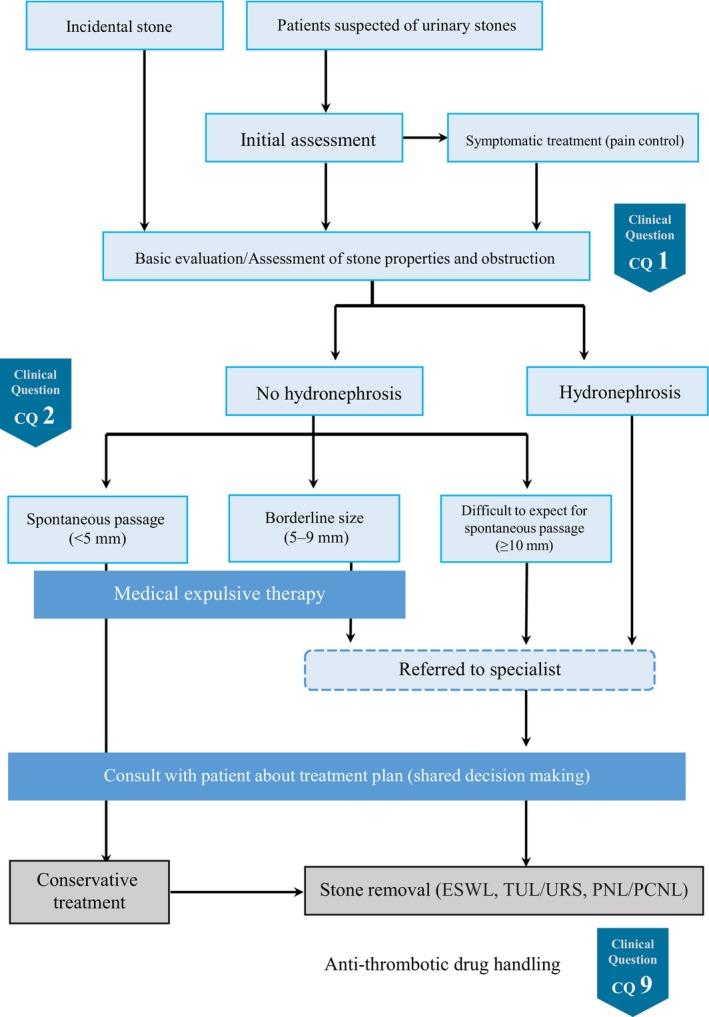
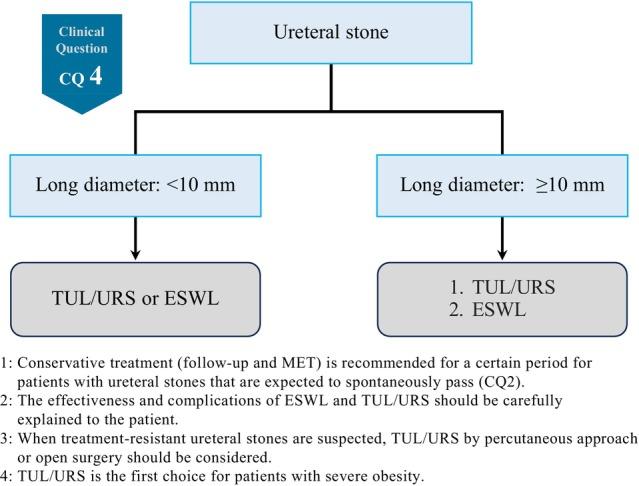
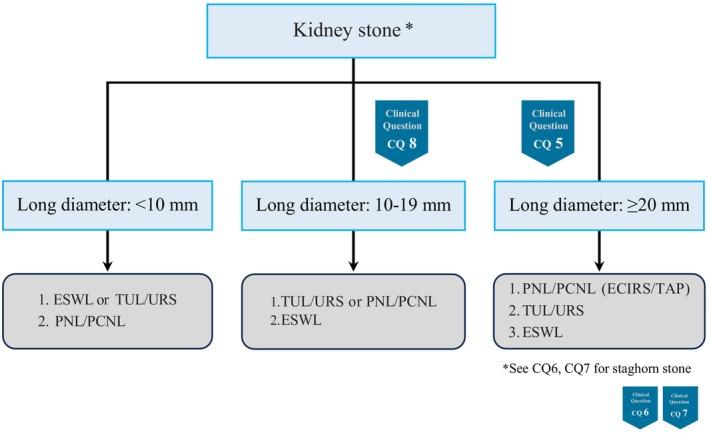
This third edition of the Japanese Clinical Practice Guidelines for Urinary stones (2023) has been developed under the leadership of the Japanese Urological Association, the Japanese Society of Endourology and Robotics, and the Japanese Society on Urolithiasis Research. This revision adheres to the Minds Manual for Guideline Development (2017) and incorporates new findings from a nationwide survey conducted in 2015, which highlighted the epidemiological characteristics of urolithiasis in Japan since the previous guidelines were published in 2013. A significant advancement in this edition is the systematic review (SR) methodology applied to formulate recommendations for 12 clinical questions (CQs). Both quantitative and qualitative SRs were performed, leading to recommendations determined through consensus among 21 members of the guideline development group. Additionally, nine algorithms were created to support clinical decision-making based on these findings. Topics not addressed by the CQs, considered as foundational knowledge, are outlined in an "Explanation of Related Matters" section, which includes 26 items. This article provides an overview of these guidelines. This section ensures that practitioners have access to comprehensive information, covering aspects of urolithiasis management beyond the scope of the systematic reviews. This article provides an overview of the guidelines, emphasizing their relevance and importance in improving the management and treatment outcomes for patients with urinary stones. The guidelines are designed to be a practical resource for clinicians, facilitating evidence-based care in the evolving landscape of urolithiasis treatment.
《日本尿路结石临床实践指南(2023年版)》第三版是在日本泌尿外科学会、日本腔内泌尿外科学与机器人学会以及日本尿路结石研究学会的领导下制定的。本次修订遵循《指南制定手册(2017年版)》,纳入了2015年全国性调查的新发现,该调查突出了自2013年发布上一版指南以来日本尿路结石的流行病学特征。本版的一项重大进展是应用系统评价(SR)方法为12个临床问题(CQs)制定建议。进行了定量和定性系统评价,从而得出由指南制定小组21名成员通过共识确定的建议。此外,还创建了9种算法,以基于这些发现支持临床决策。未被临床问题涵盖但被视为基础知识的主题在“相关事项解释”部分进行了概述,该部分包括26项内容。本文对这些指南进行了概述。本节确保从业者能够获取全面信息,涵盖系统评价范围之外的尿路结石管理方面。本文对指南进行了概述,强调了它们在改善尿路结石患者管理和治疗结果方面的相关性和重要性。这些指南旨在成为临床医生的实用资源,在不断发展的尿路结石治疗领域促进循证医疗。


 Zotero 插件