
RIPK1在tau蛋白病中的表达与抑制:对神经炎症和神经保护的影响
RIPK1 expression and inhibition in tauopathies: implications for neuroinflammation and neuroprotection.
作者信息
Silva-Llanes Ignacio, Madruga Enrique, Martínez Ana, Lastres-Becker Isabel
机构信息
Department of Biochemistry, School of Medicine, Universidad Autónoma de Madrid (UAM), Madrid, Spain.
Instituto de Investigación Sanitaria La Paz (IdiPaz), Madrid, Spain.
出版信息
Front Neurosci. 2025 Jan 27;18:1530809. doi: 10.3389/fnins.2024.1530809. eCollection 2024.
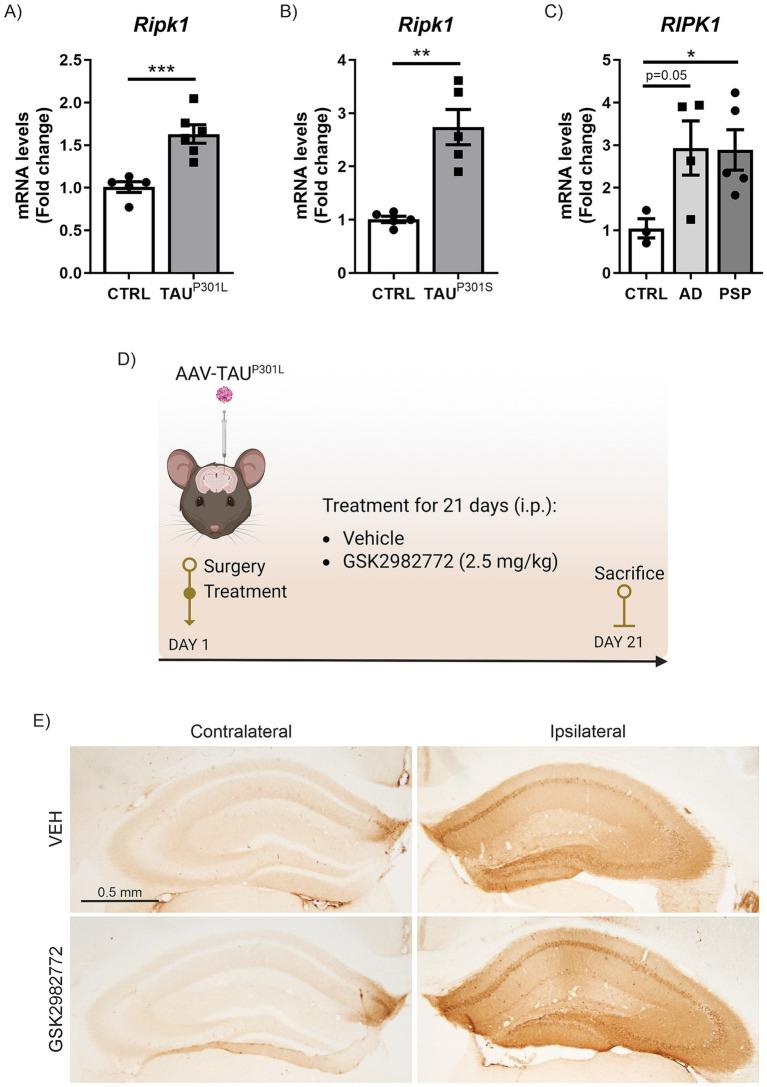
Tauopathies are a group of neurodegenerative diseases characterized by the alteration/aggregation of TAU protein. One of the main challenges of these diseases is that they have neither biomarkers nor pharmacological targets to stop the neurodegenerative process. Apart from the neurodegenerative process, tauopathies are also characterized by a chronic low-grade neuroinflammation process, where the receptor-interacting protein kinase 1 (RIPK1) protein plays an essential role. Our research aimed to explore the role of RIPK1 in various tauopathies. We examined mouse models of frontotemporal dementia (FTD), as well as brain tissue samples from patients with progressive supranuclear palsy (PSP), a primary form of 4R tauopathy, and Alzheimer's disease (AD), which is considered a secondary tauopathy. Our findings show elevated levels of mRNA levels across various forms of tauopathies, in both mouse models and human tissue samples associated with primary and secondary TAU-related disorders. Furthermore, we investigated the potential of using a RIPK1 inhibitor, known as GSK2982772, in a mouse model as a novel treatment strategy for FTD. The data showed that GSK2982772 treatment effectively reduced the reactive astrocyte response triggered by TAU overexpression. However, this RIPK1 inhibitor failed to protect against the neurodegeneration caused by elevated TAU levels in the hippocampal region. These results suggest that although inhibiting RIPK1 activity may help reduce TAU-related astrogliosis in the brain, the complexity of the inflammatory pathways involved could explain the absence of neuroprotective effects against TAU-induced neurodegeneration.
tau蛋白病是一组以TAU蛋白改变/聚集为特征的神经退行性疾病。这些疾病的主要挑战之一是既没有生物标志物也没有药理靶点来阻止神经退行性过程。除了神经退行性过程外,tau蛋白病还以慢性低度神经炎症过程为特征,其中受体相互作用蛋白激酶1(RIPK1)蛋白起着至关重要的作用。我们的研究旨在探索RIPK1在各种tau蛋白病中的作用。我们研究了额颞叶痴呆(FTD)的小鼠模型,以及进行性核上性麻痹(PSP,4R tau蛋白病的一种主要形式)患者和阿尔茨海默病(AD,被认为是继发性tau蛋白病)患者的脑组织样本。我们的研究结果表明,在与原发性和继发性TAU相关疾病相关的小鼠模型和人体组织样本中,各种形式的tau蛋白病的mRNA水平都有所升高。此外,我们研究了在小鼠模型中使用一种名为GSK2982772的RIPK1抑制剂作为FTD新治疗策略的潜力。数据显示,GSK2982772治疗有效地降低了TAU过表达引发的反应性星形胶质细胞反应。然而,这种RIPK1抑制剂未能预防海马区TAU水平升高引起的神经退行性变。这些结果表明,尽管抑制RIPK1活性可能有助于减少大脑中与TAU相关的星形胶质细胞增生,但所涉及的炎症途径的复杂性可能解释了对TAU诱导的神经退行性变缺乏神经保护作用的原因。


 Zotero 插件