
MiR-3664-3p通过抑制(相关因子)并提高结肠癌细胞对伊立替康的敏感性。 (注:原文中“suppressing”后缺少具体对象,译文根据语境补充了“相关因子”)
MiR-3664-3p through suppressing and increases the sensitivity of colorectal cancer cells to irinotecan.
作者信息
Farrokhnazar Elham, Moghbelinejad Sahar, Najafipour Reza, Teimoori-Toolabi Ladan
机构信息
Research Institute for Prevention of Non-Communicable Diseases, Cellular and Molecular Research Center, Qazvin University of Medical Sciences, Qazvin, Iran.
Molecular Medicine Department, Biotechnology Research Center, Pasteur Institute of Iran, Iran.
出版信息
Heliyon. 2025 Jan 15;11(3):e41933. doi: 10.1016/j.heliyon.2025.e41933. eCollection 2025 Feb 15.
BACKGROUND
Colorectal cancer (CRC) is the third most frequently diagnosed malignancy worldwide. Currently, irinotecan (CPT-11) is used alone or in combination with other drugs to treat patients with advanced CRC. However, the 5-year survival rate for metastatic CRC remains below 10 %, largely due to chemotherapy resistance. Several genes, including , and contribute to irinotecan resistance. This study aimed to identify microRNAs that simultaneously regulate the expression of these genes in irinotecan-resistant cell lines and study their effect on resistant colorectal cancer cells.
METHODS
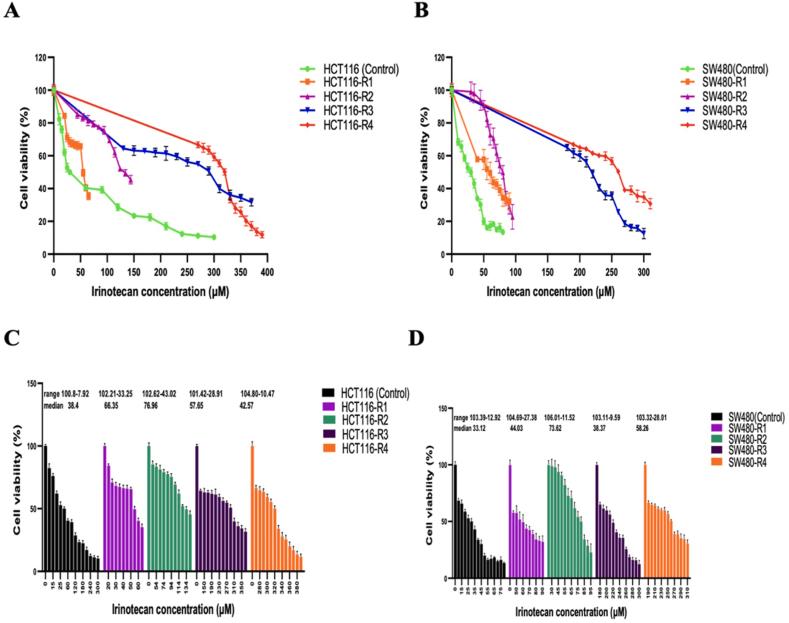
Irinotecan-resistant colorectal cancer cell lines were developed by intermittently exposing HCT116 and SW480 cell lines to gradually increasing doses of irinotecan over four generations. These resistant cell lines were designated HCT116-R1, HCT116-R2, HCT116-R3, HCT116-R4 and SW480-R1, SW480-R2, SW480-R3, SW480-R4. The induction of resistance was confirmed using MTT assays, by calculating IC values for each generation and comparing them to the parental cells. The expression levels of the , and genes, along with miR-3664-3p, were initially measured in all resistant and parental cell lines using quantitative real-time PCR. Following transfection of HCT116-R3 and SW480-R3 cells with pre-miR-3664-3p, the expression levels of , and miR-3664-3p were re-evaluated using real-time PCR.
RESULTS
In resistant cell lines derived from HCT116 and SW480, increased expression of the , and genes was observed. However, a reduction in expression was noted in the final resistant lines from both cell lines. Additionally, while expression increased in HCT116-derived cell lines, no significant increase was observed in SW480-derived lines. A consistent decrease in miR-3664-3p expression was found across all resistant cell lines. When we transfected HCT116-R3 and SW480-R3 cells with pre-miR-3664-3p, there was an increase in miR-3664-3p expression and a reduction in , and gene expression. This led to increased sensitivity to irinotecan.
CONCLUSION
It can be concluded that miR-3664-3p can be considered a regulator of resistance to irinotecan by modulating the expression of , and genes.
背景
结直肠癌(CRC)是全球第三大最常被诊断出的恶性肿瘤。目前,伊立替康(CPT - 11)单独使用或与其他药物联合用于治疗晚期CRC患者。然而,转移性CRC的5年生存率仍低于10%,这在很大程度上归因于化疗耐药性。包括 、 和 在内的几个基因与伊立替康耐药性有关。本研究旨在鉴定在伊立替康耐药细胞系中同时调节这些基因表达的微小RNA,并研究它们对耐药结直肠癌细胞的影响。
方法
通过将HCT116和SW480细胞系在四代时间内间歇性暴露于逐渐增加剂量的伊立替康,建立伊立替康耐药结直肠癌细胞系。这些耐药细胞系分别命名为HCT116 - R1、HCT116 - R2、HCT116 - R3、HCT116 - R4以及SW480 - R1、SW480 - R2、SW480 - R3、SW480 - R4。使用MTT法,通过计算每一代的IC值并与亲代细胞进行比较,确认耐药性的诱导情况。最初使用定量实时PCR在所有耐药细胞系和亲代细胞系中测量 、 和 基因以及miR - 3664 - 3p的表达水平。在用pre - miR - 3664 - 3p转染HCT116 - R3和SW480 - R3细胞后,使用实时PCR重新评估 、 和miR - 3664 - 3p的表达水平。
结果
在源自HCT116和SW480的耐药细胞系中,观察到 、 和 基因的表达增加。然而,在来自这两个细胞系的最终耐药细胞系中, 表达降低。此外,虽然在源自HCT116的细胞系中 表达增加,但在源自SW480的细胞系中未观察到显著增加。在所有耐药细胞系中均发现miR - 3664 - 3p表达持续下降。当我们用pre - miR - 3664 - 3p转染HCT116 - R3和SW480 - R3细胞时,miR - 3664 - 3p表达增加, 、 和 基因表达降低。这导致对伊立替康的敏感性增加。
结论
可以得出结论,miR - 3664 - 3p可通过调节 、 和 基因的表达被视为伊立替康耐药性的调节剂。




 Zotero 插件