
卢旺达接受两剂埃博拉疫苗接种的女性的避孕措施使用情况与妊娠情况:对UMURINZI疫苗接种活动数据的回顾性分析
Contraception use and pregnancy in women receiving a 2-dose Ebola vaccine in Rwanda: A retrospective analysis of UMURINZI vaccination campaign data.
作者信息
Ingabire Rosine, Nyombayire Julien, Mazzei Amelia, Mazarati Jean-Baptiste, Noben Jozef, Katwere Michael, Parker Rachel, Nsanzimana Sabin, Wall Kristin M, Sharkey Tyronza, Sayinzoga Felix, Tichacek Amanda, Hammoud Niina, Martinson Ellen, Magod Ben, Allen Susan, Karita Etienne
机构信息
Center for Family Health Research, Kigali, Rwanda.
Rwanda Biomedical Center, Kigali, Rwanda.
出版信息
PLoS Med. 2025 Feb 11;22(2):e1004508. doi: 10.1371/journal.pmed.1004508. eCollection 2025 Feb.
BACKGROUND
Rwandan individuals bordering the Democratic Republic of the Congo (DRC) are at-risk of Ebola virus disease. A 2019 to 2021 vaccination campaign called UMURINZI offered a Janssen Vaccines & Prevention B.V. 2-dose heterologous Ebola vaccine regimen (Ad26.ZEBOV, MVA-BN-Filo) to Rwandan individuals aged ≥2 years and not pregnant. In this region with high rates of pregnancy, preventing pregnancy until their second dose of the Ebola vaccine is essential to ensure full protection. This analysis describes contraceptive use, pregnancy incidence, serious adverse events (SAE), and the effect of pregnancy and SAE on receipt of the second dose among women in the UMURINZI vaccination campaign.
METHODS AND FINDINGS
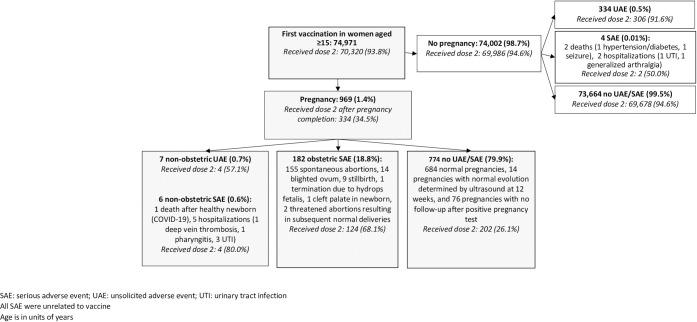
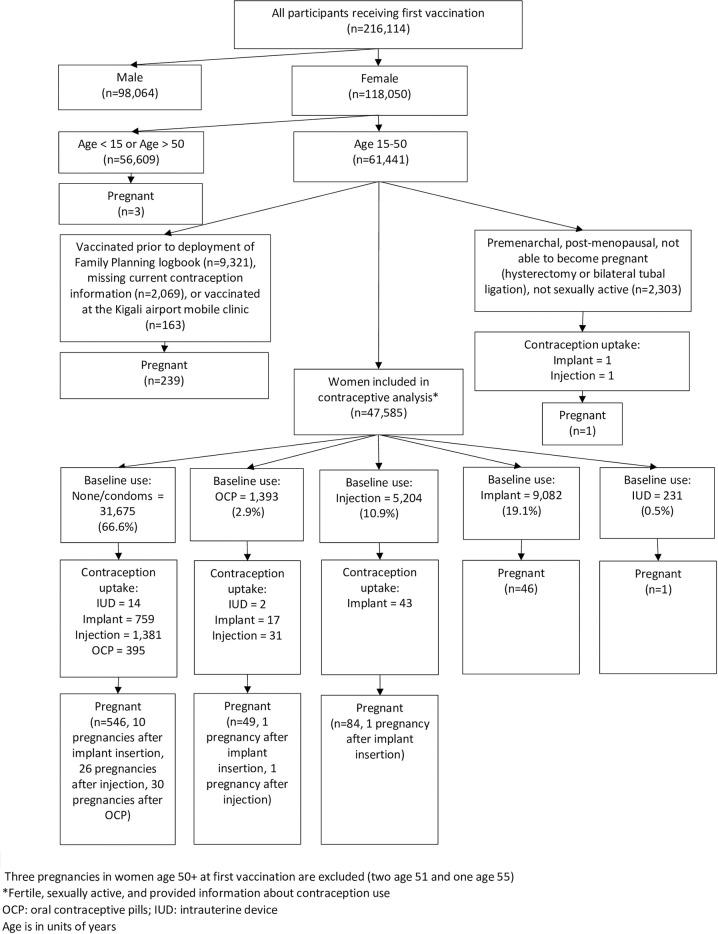
During the vaccination campaign, women who were fertile and sexually active were counseled as part of the campaign by trained UMURINZI nursing staff about preventing pregnancy until dose two (56 days post-dose one) and offered contraception. Women were followed up to their second dose appointment. Contraception, pregnancy incidence, and SAE were recorded. Of the 47,585 fertile and sexually active women, the mean age was 28·0 years (standard deviation 9·9 years), 54·7% (n = 26,051) were from Rubavu and 45·3% (n = 21,534) were from Rusizi, and 71·9% (n = 34,158) had not crossed the DRC border in the last year. Sixty-six percent (66·6%, n = 31,675) were not using modern contraception at baseline and 19·1% (n = 9,082) were using hormonal implants, 10·9% (n = 5,204) injectables, 2·9% (n = 1,393) oral contraceptive pills (OCPs), and 0·5% (n = 231) intrauterine devices. After contraceptive counseling, 8·0% (n = 2,549) of non-users initiated a method of contraception and 3·6% (n = 50) of OCP users switched to a more effective method. Of the 969 incident pregnancies detected after dose one, 18·8% (n = 182) resulted in an obstetric SAE, primarily due to spontaneous abortion which occurred in 16·0% (n = 155) of all incident pregnancies. Other obstetric SAE included 14 blighted ova, 9 stillbirths, 1 termination due to hydrops fetalis, 1 cleft palate, and 2 threatened abortions resulting in normal deliveries. Six pregnant women had a non-obstetric SAE (0·6%), including 1 postpartum death from COVID-19 and 5 hospitalizations. Among the 74,002 women without an incident pregnancy detected after dose one, 0·01% (n = 4) had an SAE; 2 were fatalities due to hypertension and diabetes in one case and seizures in the other, and the other 2 were hospitalizations. No SAE were determined to be related to the vaccine by the program physicians. Among the 74,002 women without an incident pregnancy detected after dose one, 94·6% (n = 69,986) received dose two; in contrast, among the 969 women with an incident pregnancy detected after dose one, 34·5% (n = 334) received dose two after pregnancy completion.
CONCLUSIONS
Many fertile and sexually active women who sought vaccination during UMURINZI were not using contraception prior to vaccination, and contraceptive method uptake after family planning counseling and method provision was low. Most women who became pregnant after the first vaccination dose did not receive the second dose, thus potentially reducing protection against Ebola. Family planning messaging for this context should be developed and pilot-tested. The estimated risk of spontaneous abortion was similar to previous estimates from Rwanda and other African countries.
背景
与刚果民主共和国(DRC)接壤的卢旺达居民面临埃博拉病毒病风险。2019年至2021年开展的名为“UMURINZI”的疫苗接种活动为年龄≥2岁且未怀孕的卢旺达居民提供了杨森疫苗与预防公司的两剂次异源埃博拉疫苗接种方案(Ad26.ZEBOV,MVA-BN-Filo)。在这个高妊娠率地区,在接种第二剂埃博拉疫苗之前预防怀孕对于确保全面保护至关重要。本分析描述了“UMURINZI”疫苗接种活动中女性的避孕措施使用情况、妊娠发生率、严重不良事件(SAE),以及妊娠和SAE对接种第二剂疫苗的影响。
方法与结果
在疫苗接种活动期间,UMURINZI的专业护理人员对有生育能力且有性行为的女性进行咨询,告知她们在接种第二剂疫苗(接种第一剂疫苗后56天)之前预防怀孕的相关事宜,并提供避孕措施。对女性进行随访直至她们预约接种第二剂疫苗,并记录避孕措施使用情况、妊娠发生率和SAE。在47585名有生育能力且有性行为的女性中,平均年龄为28.0岁(标准差9.9岁),54.7%(n =26051)来自鲁巴武,45.3%(n =21534)来自鲁济济区,71.9%(n =34158)在过去一年未越过刚果民主共和国边境。66.6%(n =31675)在基线时未使用现代避孕方法,19.1%(n =9082)使用激素植入剂避孕,10.9%(n =5204)使用注射用避孕药,2.9%(n =1393)使用口服避孕药(OCP),0.5%(n =231)使用宫内节育器。经过避孕咨询后,8.0%(n =2549)未使用避孕措施的女性开始采取避孕方法,3.6%(n =50)使用OCP的女性更换为更有效的避孕方法。在接种第一剂疫苗后检测到的969例妊娠中,18.8%(n =182)导致产科SAE,主要原因是自然流产,占所有妊娠的16.0%(n =155)。其他产科SAE包括14例胚胎停育,9例死产,1例因胎儿水肿终止妊娠,1例腭裂,2例先兆流产最终顺产分娩。6名孕妇发生非产科SAE(0.6%),包括1例因新冠肺炎导致的产后死亡和5例住院治疗病例。在接种第一剂疫苗后未检测到妊娠事件的74002名女性中,0.01%(n =4)发生SAE;1例因高血压和糖尿病导致死亡,另1例因癫痫发作导致死亡,另外2例为住院治疗病例。项目医生确定没有SAE与疫苗相关。在接种第一剂疫苗后未检测到妊娠事件的74002名女性中,94.6%(n =69986)接种了第二剂疫苗;相比之下,在接种第一剂疫苗后检测到妊娠事件的969名女性中,34.5%(n =334)在妊娠结束后接种了第二剂疫苗。
结论
许多在“UMURINZI”活动期间寻求接种疫苗且有生育能力和性行为的女性在接种疫苗前未采取避孕措施,在计划生育咨询和提供避孕方法后,避孕方法的采用率较低。大多数在接种第一剂疫苗后怀孕的女性未接种第二剂疫苗,因此可能会降低对埃博拉的防护效果。应制定针对这种情况计划生育宣传信息并进行试点测试。自然流产的估计风险与卢旺达和其他非洲国家之前的估计相似
 Zotero 插件