
真实世界中复杂肺部疾病的综合管理算法
Comprehensive Management Algorithm for Complex Pulmonary Disease in the Real-World Setting.
作者信息
Morimoto Kozo, Daley Charles L
机构信息
Respiratory Disease Center and.
Division of Clinical Research, Fukujuji Hospital, Japan Anti-Tuberculosis Association, Tokyo, Japan.
出版信息
Ann Am Thorac Soc. 2025 May;22(5):651-659. doi: 10.1513/AnnalsATS.202408-904FR.
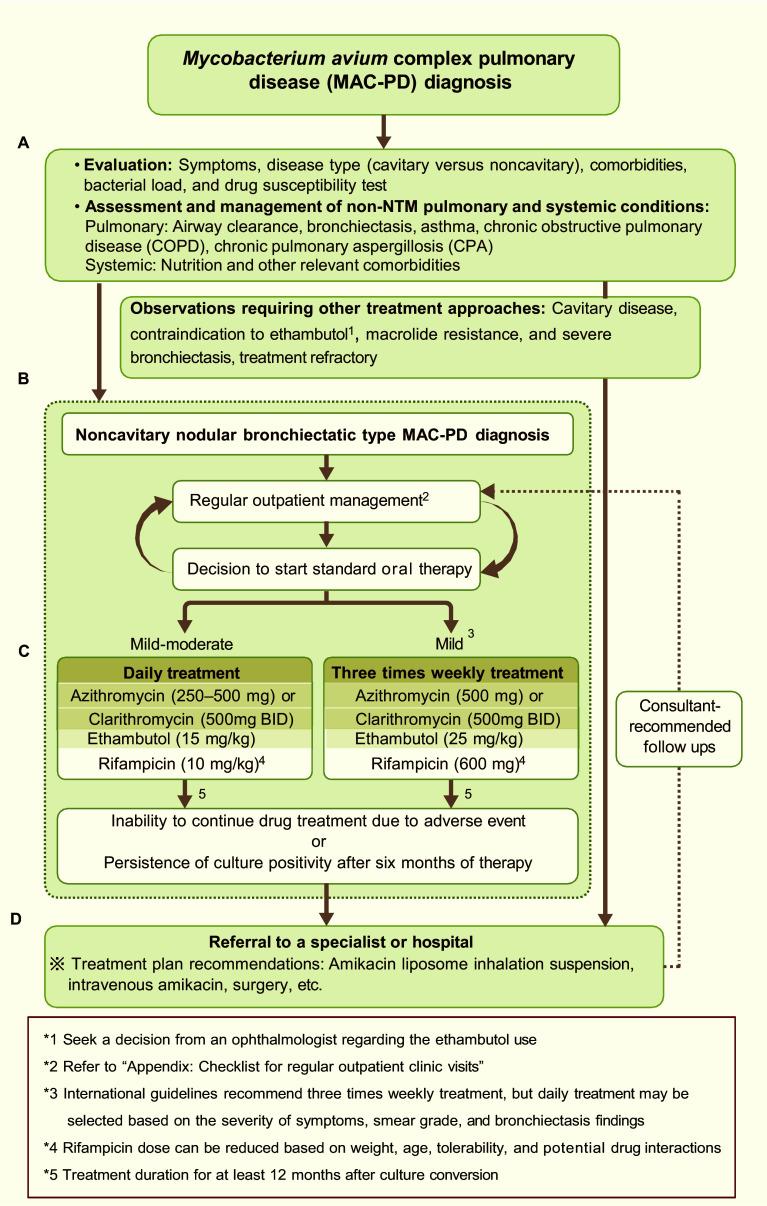
The management of complex pulmonary disease (MAC-PD) is challenging because of limited efficacy and frequent adverse events associated with standard treatments. The 2020 guidelines from the American Thoracic Society, European Respiratory Society, European Society of Clinical Microbiology and Infectious Diseases, and Infectious Diseases Society of America provide recommendations, but real-world adherence is often hindered by these issues, leading many patients to be unable to complete standard therapy. This review proposes a comprehensive management algorithm for MAC-PD, emphasizing multidisciplinary approaches and integrating nonantimicrobial management before, during, and after drug treatment to enhance patient outcomes. When a patient presents with chronic respiratory symptoms suggestive of nontuberculous mycobacteria, clinicians should follow a guideline-based approach to diagnosis, as diagnostic delays are common because of nonspecific symptoms. Proper evaluation should determine the disease phenotype (existence of cavitary lesions), as it influences treatment choices. Airway clearance, nutritional support, and management of underlying conditions are essential nonantimicrobial components. Regular outpatient monitoring helps detect disease progression and optimize treatment. Treatment strategies vary based on disease severity. For noncavitary nodular bronchiectatic disease, a thrice-weekly regimen is preferred because of better tolerability. Severe cases or those with cavitary forms may require daily treatment with additional aminoglycosides. Amikacin liposome inhalation suspension is recommended for patients not responding to standard regimens after 6 months. Recent research addresses drug intolerance, suggesting alternatives such as a two-drug regimen without rifamycin in certain cases. Consultation with nontuberculous mycobacteria specialists is advised for complex cases, particularly those with macrolide resistance or requiring surgical intervention. The algorithm emphasizes shared decision making, patient education, and family support to improve adherence and outcomes.
由于标准治疗的疗效有限且频繁出现不良事件,复杂肺部疾病(非结核分枝杆菌肺病,MAC-PD)的管理具有挑战性。美国胸科学会、欧洲呼吸学会、欧洲临床微生物学和传染病学会以及美国传染病学会2020年发布的指南提供了相关建议,但这些问题常常阻碍了在现实世界中的遵循情况,导致许多患者无法完成标准治疗。本综述提出了一种针对MAC-PD的综合管理算法,强调多学科方法,并在药物治疗前、治疗期间和治疗后整合非抗菌管理,以改善患者预后。当患者出现提示非结核分枝杆菌的慢性呼吸道症状时,临床医生应遵循基于指南的诊断方法,因为非特异性症状常见,所以诊断延迟很普遍。正确的评估应确定疾病表型(空洞性病变的存在),因为它会影响治疗选择。气道清理、营养支持和基础疾病的管理是必不可少的非抗菌组成部分。定期门诊监测有助于发现疾病进展并优化治疗。治疗策略因疾病严重程度而异。对于非空洞性结节性支气管扩张疾病,由于耐受性较好,首选每周三次的治疗方案。严重病例或有空洞形式的病例可能需要每日治疗并加用氨基糖苷类药物。对于6个月后对标准方案无反应的患者,推荐使用阿米卡星脂质体吸入混悬液。最近的研究探讨了药物不耐受问题,表明在某些情况下可采用如不含利福霉素的两药方案等替代方案。对于复杂病例,尤其是那些对大环内酯类耐药或需要手术干预的病例,建议咨询非结核分枝杆菌专家。该算法强调共同决策、患者教育和家庭支持,以提高依从性和改善预后。
 Zotero 插件