
患有米斯曼角膜营养不良的一个家族中该基因的一种新型致病变异。
A Novel Pathogenic Variant in the Gene in a Family with Meesmann Corneal Dystrophy.
作者信息
De Faria Alix, Charoenrook Víctor, Larena Raquel, Ferragut-Alegre Álvaro, Valero Rebeca, Julio Gemma, Barraquer Rafael I
机构信息
Centro de Oftalmología Barraquer, 08021 Barcelona, Spain.
Institut Universitari Barraquer, Universitat Autònoma de Barcelona, 08021 Barcelona, Spain.
出版信息
J Clin Med. 2025 Jan 28;14(3):851. doi: 10.3390/jcm14030851.
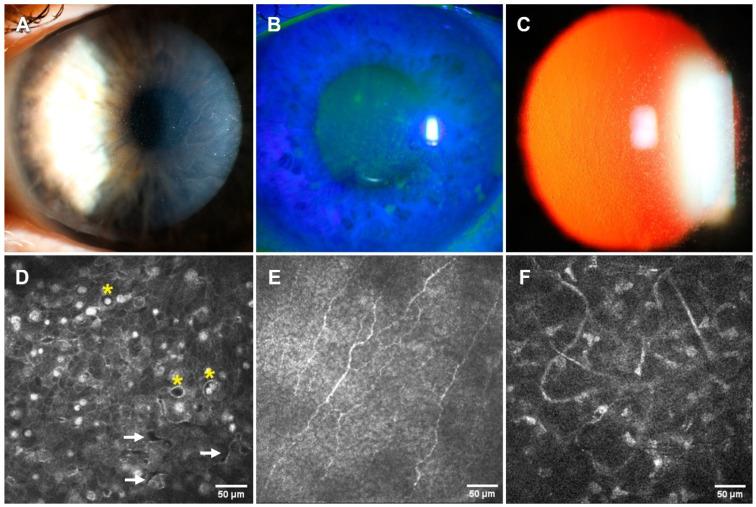
to report a novel KRT3 Meesmann corneal dystrophy (MECD) mutation and its clinical findings in a Spanish family, thus completing the international database. Case series study. Two generations of three family members were studied. The clinical ophthalmologic evaluation was made including best-corrected visual acuity (BCVA), biomicroscopy with and without fluorescein, fundoscopy, Schirmer test I, non-invasive break-up time (NiBUT), and esthesiometry. In vivo confocal microscopy (IVCM), anterior segment optical coherence tomography (AS-OCT) with an epithelial map, and genetic analysis were also performed. A novel heterozygous mutation in the KRT3 gene c.1527G>T (p. Glu509Asp) was identified. Biomicroscopy revealed bilateral multiple corneal intraepithelial cysts. IVCM showed numerous and relatively small microcysts (12-32 µm), hyperreflective materials, subepithelial nerve and Bowman's layer alterations. AS-OCT scan revealed diffuse hyperreflectivity and the epithelial map displayed thickening of the corneal epithelium in the interpalpebral zone (proband: 52-68 µm and father's proband: 55-71 µm) with a slightly thinned cornea. We identified a new mutation in the KRT3 gene-c.1527G>T (p. Glu509Asp) in a Spanish family with MECD. A comprehensive characterization of the clinical signs, using different techniques, especially an epithelial map, could be useful to diagnose and monitor epithelial changes by quantitative measures. Epithelial map changes provide better understanding of MECD differential epithelial behavior and its progression changes. Larger studies will be necessary to better understand these specific patterns and clinically evaluate new therapies.
报告一个西班牙家族中的一种新型角蛋白3型米斯曼角膜营养不良(MECD)突变及其临床发现,从而完善国际数据库。病例系列研究。对一个家族的两代三名成员进行了研究。进行了临床眼科评估,包括最佳矫正视力(BCVA)、有无荧光素的生物显微镜检查、眼底镜检查、Schirmer试验I、非侵入性泪膜破裂时间(NiBUT)和感觉测量。还进行了共聚焦显微镜活体检查(IVCM)、带有上皮地形图的眼前节光学相干断层扫描(AS-OCT)以及基因分析。在KRT3基因中鉴定出一种新型杂合突变c.1527G>T(p.Glu509Asp)。生物显微镜检查发现双侧多个角膜上皮内囊肿。IVCM显示有许多相对较小的微囊肿(12 - 32 µm)、高反射性物质、上皮下神经和Bowman层改变。AS-OCT扫描显示弥漫性高反射性,上皮地形图显示睑裂区角膜上皮增厚(先证者:52 - 68 µm,先证者父亲:55 - 71 µm),角膜稍变薄。我们在一个患有MECD的西班牙家族中鉴定出KRT3基因的一个新突变——c.1527G>T(p.Glu509Asp)。使用不同技术,尤其是上皮地形图,对临床体征进行全面表征,可能有助于通过定量测量来诊断和监测上皮变化。上皮地形图变化有助于更好地理解MECD不同的上皮行为及其进展变化。需要进行更大规模的研究,以更好地理解这些特定模式并对新疗法进行临床评估。


 Zotero 插件