
苯基位置对阳离子铱(III)配合物发光及TNP传感性能的影响
The Effect of the Position of a Phenyl Group on the Luminescent and TNP-Sensing Properties of Cationic Iridium(III) Complexes.
作者信息
Yang Xiaoran, Du Jiahao, Cai Rui, Liu Chun
机构信息
State Key Laboratory of Fine Chemicals, Frontier Science Center for Smart Materials, School of Chemical Engineering, Dalian University of Technology, Linggong Road 2, Dalian 116024, China.
出版信息
Sensors (Basel). 2025 Jan 30;25(3):839. doi: 10.3390/s25030839.
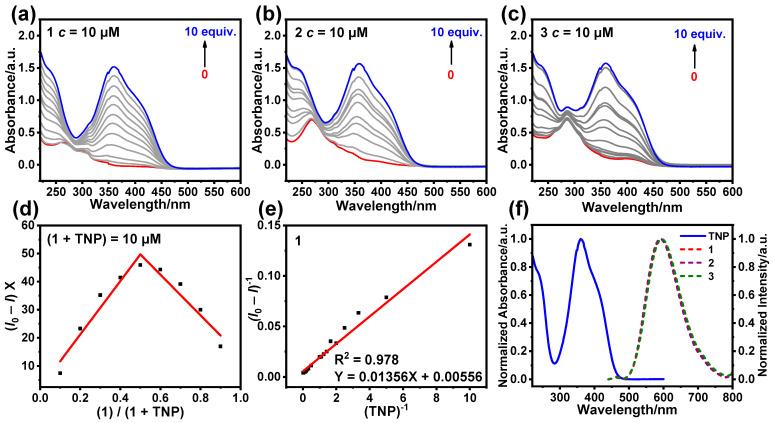
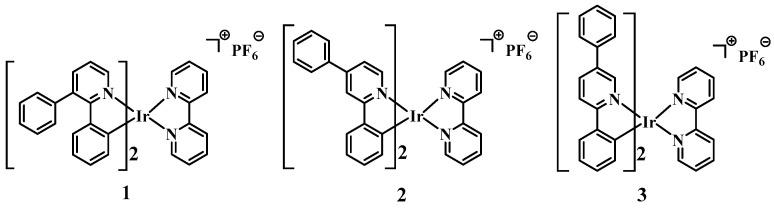
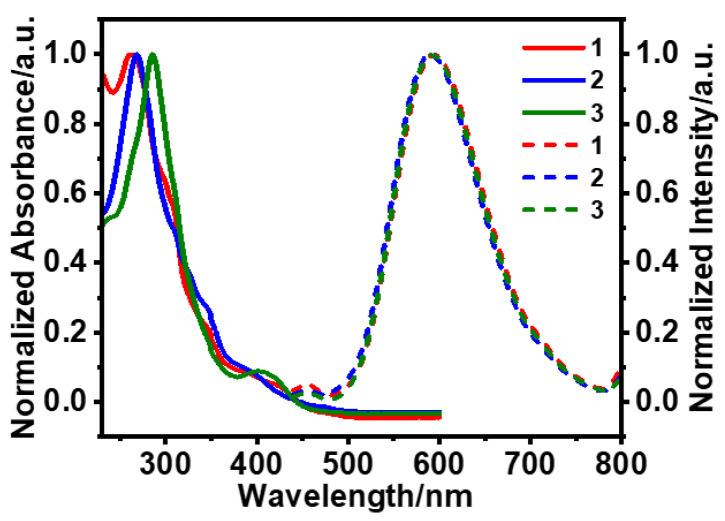
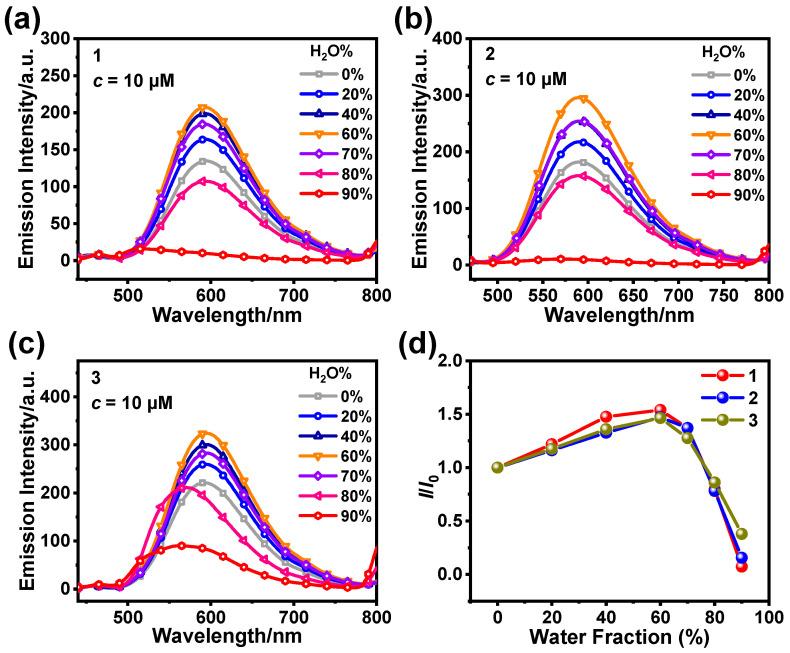
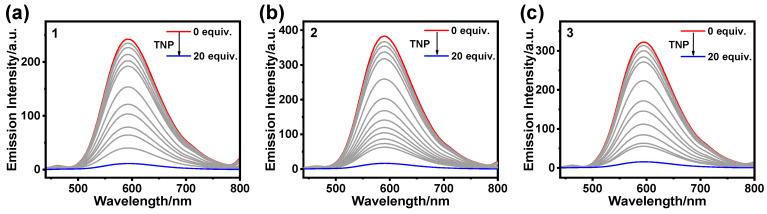
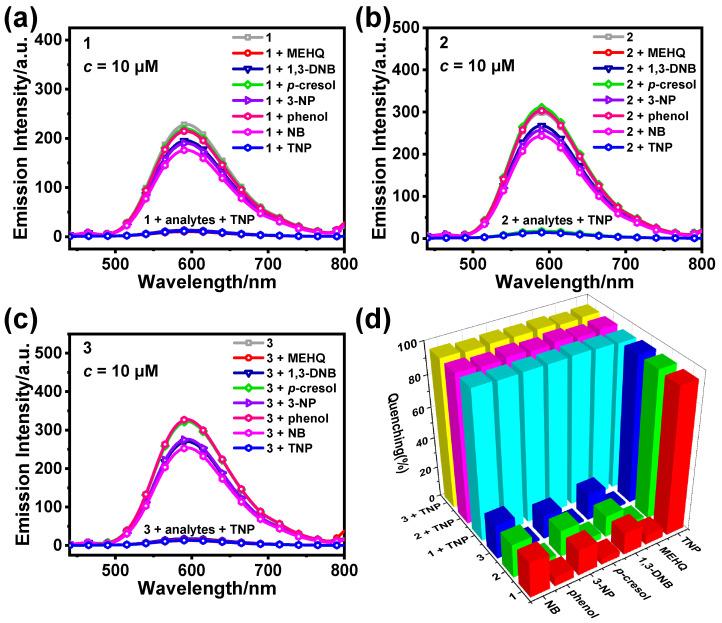
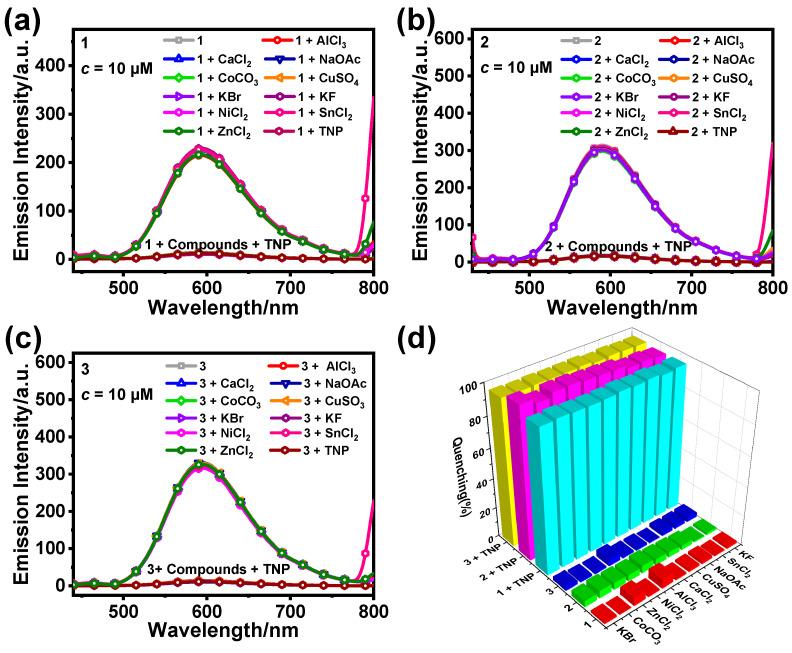
Three cationic Ir(III) complexes, , , and , were successfully synthesized and characterized by tuning the position of a phenyl group at the pyridyl moiety in 2-phenylpyridine. All three complexes exhibited typical aggregation-induced phosphorescence emission (AIPE) properties in CHCN/HO. The AIPE property was further utilized to achieve the highly sensitive detection of 2,4,6-trinitrophenol (TNP) in aqueous media with low limit of detection (LOD) values of 164, 176, and 331 nM, respectively. This suggests that the different positions of the phenyl group influence the effectiveness of , , and in the detection of TNP. In addition, , , and showed superior selectivity and anti-interference properties for the detection of TNP and were observed to have the potential to be used to detect TNP in practical applications. The changes in the luminescence lifetime and UV-Vis absorption spectra of , , and before and after the addition of TNP indicate that the corresponding quenching process is a combination of static and dynamic quenching. Additionally, the proton nuclear magnetic resonance spectra and results of spectral studies show that the detection mechanism is photo-induced electron transfer (PET).
通过调节2-苯基吡啶中吡啶部分苯基的位置,成功合成并表征了三种阳离子铱(III)配合物,即 、 和 。这三种配合物在CHCN/HO中均表现出典型的聚集诱导磷光发射(AIPE)特性。利用AIPE特性在水介质中实现了对2,4,6-三硝基苯酚(TNP)的高灵敏度检测,检测限(LOD)值分别为164、176和331 nM。这表明苯基的不同位置会影响 、 和 检测TNP的效果。此外, 、 和 在检测TNP时表现出优异的选择性和抗干扰性能,并且在实际应用中具有检测TNP的潜力。加入TNP前后 、 和 的发光寿命及紫外-可见吸收光谱的变化表明,相应的猝灭过程是静态猝灭和动态猝灭的结合。此外,质子核磁共振光谱和光谱研究结果表明检测机理是光诱导电子转移(PET)。

 Zotero 插件