
在一家门诊专科心理健康诊所为患有抑郁症和焦虑症的成年人实施计算机辅助认知行为治疗项目。
Implementation of a computer-assisted cognitive-behavioral therapy program for adults with depression and anxiety in an outpatient specialty mental health clinic.
作者信息
Steidtmann Dana, McBride Samantha, Pew Cary, Solenske Shaelyn, Dempsey Allison, Shore Jay, Mishkind Matthew
机构信息
Helen & Arthur E. Johnson Depression Center, Department of Psychiatry, University of Colorado-Anschutz Medical Campus, Aurora, CO, USA.
Brain and Behavior Innovation Center, Department of Psychiatry, University of Colorado-Anschutz Medical Campus, Aurora, CO, USA.
出版信息
Mhealth. 2024 Dec 11;11:10. doi: 10.21037/mhealth-24-22. eCollection 2025.
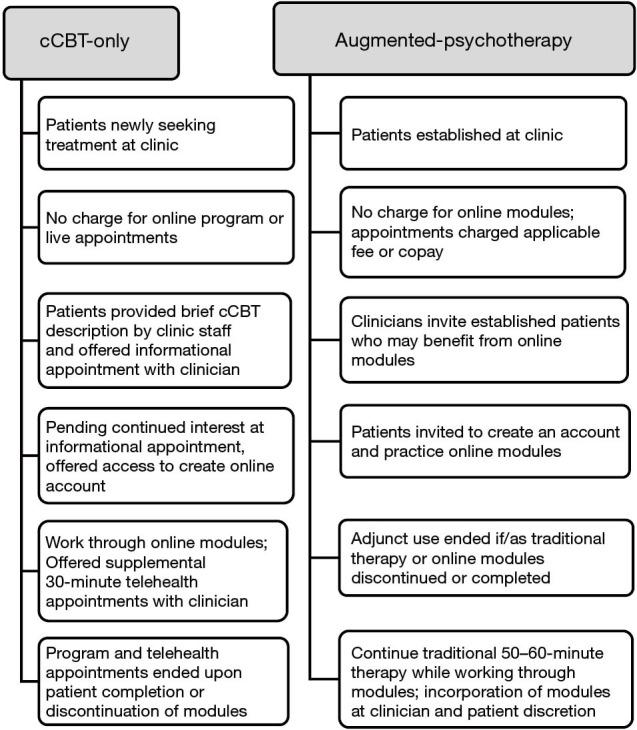
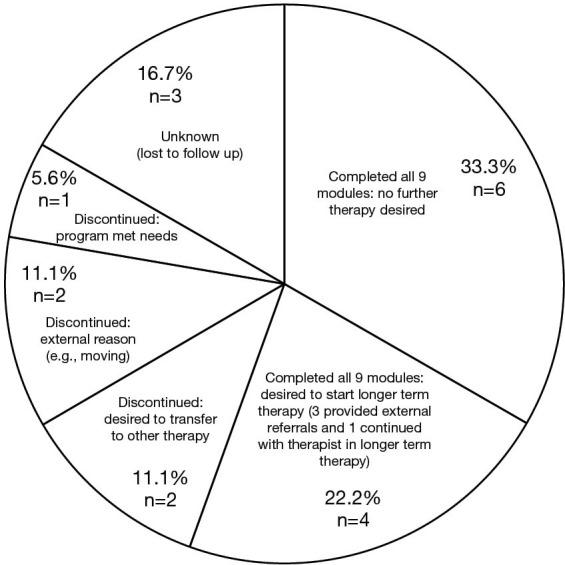
Computer-assisted psychotherapy programs have demonstrated efficacy and potential for improving access to mental health services. However, little is known about their implementation, uptake and acceptability in real-world settings. As a quality improvement effort, we designed and implemented a computer-assisted cognitive-behavioral therapy (cCBT) program for adults in an outpatient specialty mental health clinic. We sought to increase access to psychotherapy services while maintaining good patient uptake and acceptability. The program included two pathways: (I) a cCBT-only pathway in which new clinic patients had access to online modules and up to ten 30-min telehealth appointments with a mental health clinician; and (II) an augmented-psychotherapy pathway in which clinicians recommended and incorporated online modules to patients already established in the clinic. The online content for the program was a vendor website that included 9 modules with written content, videos and interactive exercises to teach cognitive-behavioral skills. Twenty-seven patients started the program over 12 months (18 in the cCBT-only pathway and 9 in the augmented-psychotherapy pathway). Twelve patients (44.4%) completed all 9 modules of the program and 18 (66.7%) completed at least half the program. Engagement was higher in the cCBT-only pathway than in the augmented-psychotherapy pathway. Twelve of 18 cCBT-only patients responded to an acceptability survey with 83.3% indicating they were satisfied and 41.7% indicating the program met their needs. Clinician satisfaction was good among all three participating clinicians. The cCBT-only program provided timely access to psychotherapy services for new patients but uptake was very low with just 2.4% of new patients contacting the clinic for psychotherapy starting in the cCBT-only pathway. Many new callers elected to receive external referrals for more traditional forms of psychotherapy. Based on this low uptake, computer-assisted psychotherapies may fit best in settings where patients have not yet identified the specific type of care they wish to seek. Systems looking to adopt similar programs may also benefit from allowing ample time to develop industry partnerships, carefully considering the customizability and technical support available for online products, and introducing the programs to patients early in treatment.
计算机辅助心理治疗项目已证明在改善心理健康服务可及性方面具有疗效和潜力。然而,对于它们在现实环境中的实施、采用情况和可接受性,我们却知之甚少。作为一项质量改进举措,我们为一家门诊专科心理健康诊所的成年患者设计并实施了一个计算机辅助认知行为疗法(cCBT)项目。我们试图在保持患者高接受度和可接受性的同时,增加心理治疗服务的可及性。该项目包括两条途径:(I)仅cCBT途径,新的诊所患者可以访问在线模块,并与心理健康临床医生进行最多十次30分钟的远程医疗预约;(II)强化心理治疗途径,临床医生向诊所中已就诊的患者推荐并纳入在线模块。该项目的在线内容是一个供应商网站,其中包括9个模块,有书面内容、视频和互动练习,用于教授认知行为技能。27名患者在12个月内开始了该项目(仅cCBT途径中有18名,强化心理治疗途径中有9名)。12名患者(44.4%)完成了该项目的所有9个模块,18名患者(66.7%)完成了至少一半的项目。仅cCBT途径中的参与度高于强化心理治疗途径。18名仅接受cCBT治疗的患者中有12名对一项可接受性调查做出了回应,83.3%的患者表示满意,41.7%的患者表示该项目满足了他们的需求。在所有三位参与的临床医生中,对该项目的满意度都很高。仅cCBT项目为新患者提供了及时的心理治疗服务,但采用率非常低,仅2.4%的新患者通过仅cCBT途径联系诊所寻求心理治疗。许多新来电者选择接受外部转介,以获得更传统形式的心理治疗。基于这种低采用率,计算机辅助心理治疗可能最适合那些尚未确定他们希望寻求的具体护理类型的患者。希望采用类似项目的系统也可能受益于留出充足的时间来发展行业伙伴关系,仔细考虑在线产品的可定制性和可用的技术支持,并在治疗早期就向患者介绍这些项目。



 Zotero 插件