
FMS样酪氨酸激酶3抑制剂吉列替尼用于FMS样酪氨酸激酶3内部串联重复急性髓系白血病患者的维持治疗:一项2期研究。
Maintenance therapy with the FMS-like tyrosine kinase 3 inhibitor gilteritinib in patients with FMS-like tyrosine kinase 3-internal tandem duplication acute myeloid leukemia: A phase 2 study.
作者信息
Gyan Emmanuel, Minden Mark D, Kubo Kohmei, Rambaldi Alessandro, Juliusson Gunnar, Jädersten Martin, Kelly Richard J, Szerafin László, He Wensheng, Gill Stanley C, Hill Jason E, Chen Caroline, Delgado David, Hasabou Nahla
机构信息
Department of Hematology and Cell Therapy, University Hospital of Tours, UMR Institut National de la Santé et de la Recherche Médicale (INSERM) 1079 N2COx, CIC INSERM U1415, Tours, France.
Department of Medical Oncology and Hematology, Princess Margaret Hospital, Toronto, Ontario, Canada.
出版信息
Cancer. 2025 Feb 15;131(4):e35746. doi: 10.1002/cncr.35746.
BACKGROUND
The GOSSAMER phase 2 study assessed the FMS-like tyrosine kinase 3 (FLT3) inhibitor gilteritinib as maintenance therapy in patients with FLT3-internal tandem duplication (FLT3-ITD) acute myeloid leukemia (AML) in first complete remission without previous hematopoietic stem cell transplantation (HSCT).
METHODS
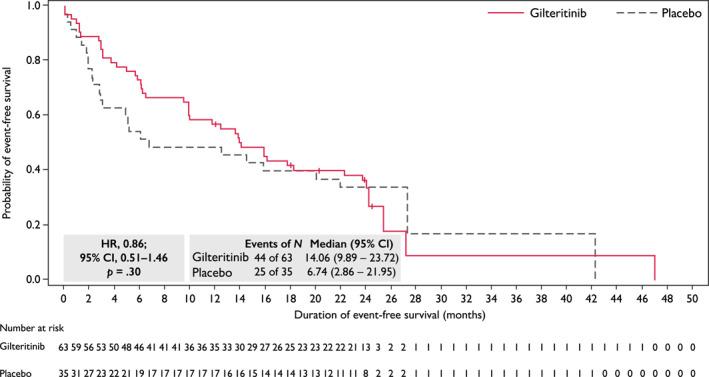
Patients had to be within 2 months of their last consolidation cycle and have completed the recommended number of cycles per local practice. FLT3 inhibitors were allowed only during induction and/or consolidation. The primary end point was relapse-free survival (RFS). Secondary end points included overall survival (OS), event-free survival, and measurable residual disease (MRD).
RESULTS
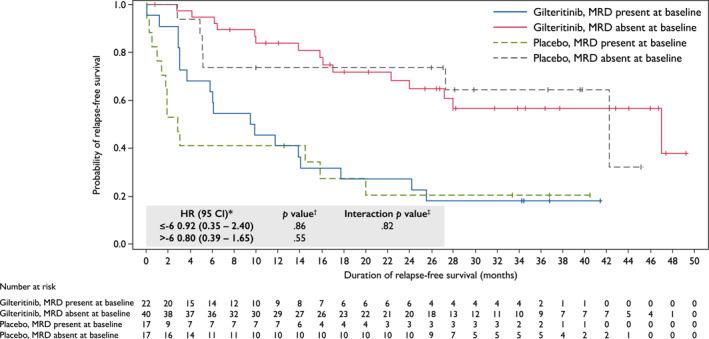
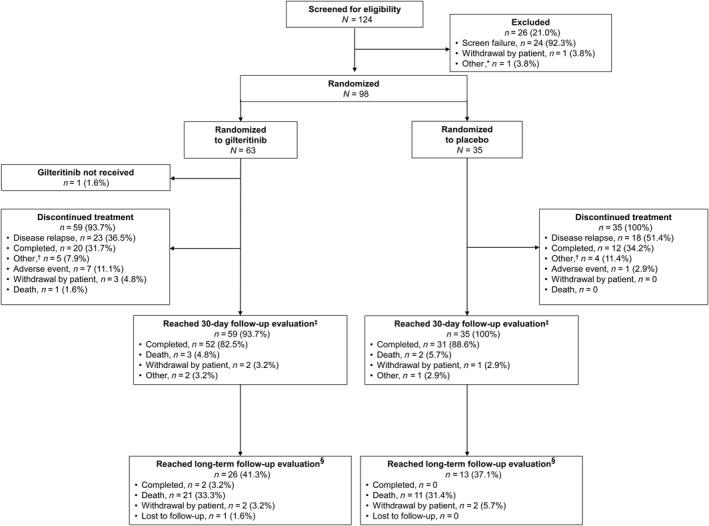
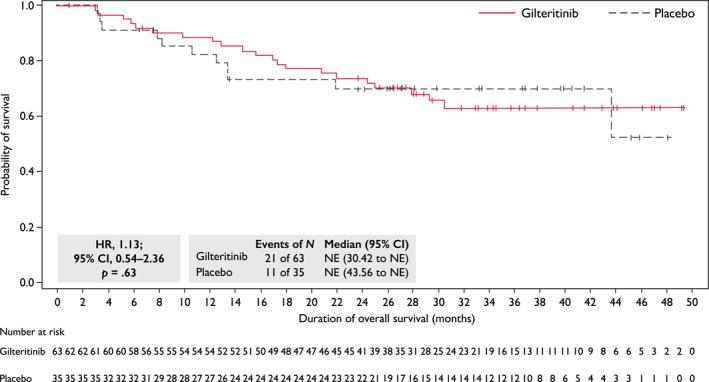
In total, 98 patients were randomized (gilteritinib, n = 63; placebo, n = 35). RFS was not significantly different between the arms (hazard ratio, 0.74; 95% confidence interval, 0.41-1.34; p = .16). RFS rates for the gilteritinib and placebo arms were 68.5% and 55.3% at 1 year, 51.8% and 44.9% at 2 years, and 41.2% and 40.8% at 3 years, respectively. OS was not significantly different between the arms but may have been affected by subsequent AML therapies after discontinuation. In patients who received subsequent therapy (gilteritinib, 46.8%; placebo, 60.0%), a higher percentage of placebo-treated (57.1%) versus gilteritinib-treated patients (27.6%) underwent HSCT. At the end of treatment, 96.4% of gilteritinib-treated and 85.7% of placebo-treated patients had undetectable MRD. Relapsed placebo-treated (86.7%) versus gilteritinib-treated patients (34.8%) had a greater FLT3 mutational burden. No new significant safety concerns were noted.
CONCLUSIONS
The primary end point was not achieved; however, an observed trend toward potential benefit was noted in patients with FLT3-ITD AML who had not undergone prior HSCT.
背景
GOSSAMER 2期研究评估了FMS样酪氨酸激酶3(FLT3)抑制剂吉列替尼作为初治完全缓解且未接受过造血干细胞移植(HSCT)的FLT3内部串联重复(FLT3-ITD)急性髓系白血病(AML)患者的维持治疗。
方法
患者必须在末次巩固周期的2个月内,且已按照当地治疗方案完成推荐的周期数。仅在诱导和/或巩固治疗期间允许使用FLT3抑制剂。主要终点为无复发生存期(RFS)。次要终点包括总生存期(OS)、无事件生存期和可测量残留病(MRD)。
结果
总共98例患者被随机分组(吉列替尼组,n = 63;安慰剂组,n = 35)。两组间RFS无显著差异(风险比,0.74;95%置信区间,0.41 - 1.34;p = 0.16)。吉列替尼组和安慰剂组1年时的RFS率分别为68.5%和55.3%,2年时分别为51.8%和44.9%,3年时分别为41.2%和40.8%。两组间OS无显著差异,但可能受到停药后后续AML治疗的影响。在接受后续治疗的患者中(吉列替尼组,46.8%;安慰剂组,60.0%),接受安慰剂治疗的患者(57.1%)接受HSCT的比例高于接受吉列替尼治疗的患者(27.6%)。治疗结束时,96.4%接受吉列替尼治疗的患者和85.7%接受安慰剂治疗的患者MRD检测不到。复发的接受安慰剂治疗的患者(86.7%)与接受吉列替尼治疗的患者(34.8%)相比,FLT3突变负担更高。未发现新的重大安全问题。
结论
未达到主要终点;然而,在未接受过HSCT的FLT3-ITD AML患者中观察到了潜在获益的趋势。


 Zotero 插件