
对模糊反馈的负面评价可能预示着自杀高风险退伍军人近期的自杀未遂风险。
Negative valuation of ambiguous feedback may predict near-term risk for suicide attempt in Veterans at high risk for suicide.
作者信息
Myers Catherine E, Perskaudas Rokas, Reddy Vibha, Dave Chintan V, Keilp John G, King Arlene, Rodriguez Kailyn, Hill Lauren St, Miller Rachael, Interian Alejandro
机构信息
Research Service, VA New Jersey Health Care System, Department of Veterans Affairs, East Orange, NJ, United States.
Department of Pharmacology, Physiology and Neuroscience, New Jersey Medical School, Rutgers University, Newark, NJ, United States.
出版信息
Front Psychiatry. 2025 Jan 30;15:1492332. doi: 10.3389/fpsyt.2024.1492332. eCollection 2024.
BACKGROUND
Learning from feedback - adapting behavior based on reinforcing and punishing outcomes - has been implicated in numerous psychiatric disorders, including substance misuse, post-traumatic stress disorder, and depression; an emerging literature suggests it may also play a role in suicidality. This study examined whether a feedback-based learning task with rewarding, punishing and ambiguous outcomes, followed by computational modeling, could improve near-term prospective prediction of suicide attempt in a high-risk sample.
METHOD
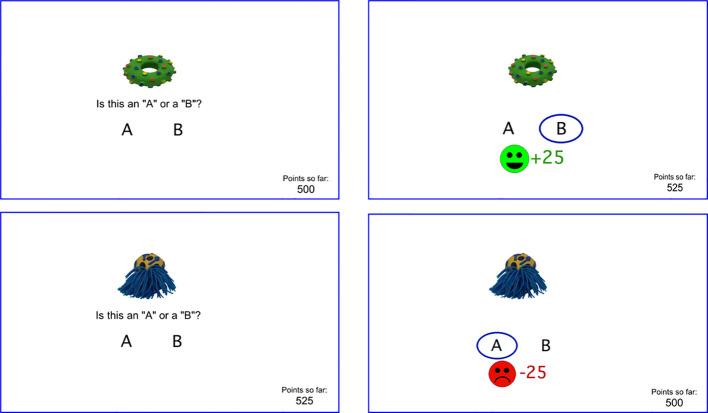
Veterans (N=60) at high-risk for suicide were tested on a task of reward- and punishment-based learning, at multiple sessions across a one-year period. Each session was coded according to whether the participant had (1) an actual suicide attempt (ASA); (2) another suicide-related event (OtherSE) such as suicidal behavior or suicidal ideation-related hospital admission (but not an ASA); or (3) neither (noSE) in the next 90 days. Computational modeling was used to estimate latent cognitive variables including learning rates from positive and negative outcomes, and the subjective value of ambiguous feedback.
RESULTS
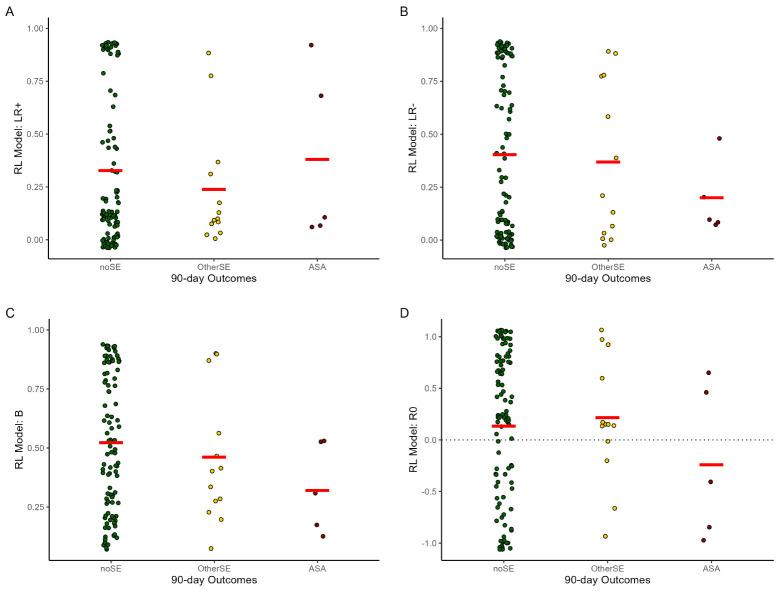
Optimal responding on the reward-based trials was positively associated with upcoming ASA, and remained predictive even after controlling for other standard clinical variables such as current suicidal ideation severity and prior suicide attempts. Computational modeling revealed that patients with upcoming ASA tended to view ambiguous outcomes as similar to weak punishment, while OtherSE and noSE both tended to view the ambiguous outcome as similar to weak reward. Differences in the reinforcement value of the neutral outcome remained predictive for ASA even after controlling for current suicidal ideation and prior suicide attempts.
CONCLUSION
A reinforcement learning task with ambiguous neutral outcomes may provide a useful tool to help predict near-term risk of ASA in at-risk patients. While most individuals interpret ambiguous feedback as mildly reinforcing (a "glass half full" interpretation), those with upcoming ASA tend to view it as mildly punishing (a "glass half empty" interpretation). While the current results are based on a very small sample with relatively few ASA events, and require replication in a larger sample, they provide support for the role of negative biases in feedback-based learning in the cognitive profile of suicide risk.
背景
从反馈中学习——根据强化和惩罚结果调整行为——与多种精神疾病有关,包括物质滥用、创伤后应激障碍和抑郁症;新出现的文献表明,它可能在自杀行为中也起作用。本研究探讨了一项基于反馈的学习任务,该任务具有奖励、惩罚和模糊结果,并随后进行计算建模,是否能改善对高风险样本中自杀未遂的近期前瞻性预测。
方法
对有自杀高风险的退伍军人(N = 60)在为期一年的多个阶段进行基于奖励和惩罚的学习任务测试。每个阶段根据参与者在接下来90天内是否有(1)实际自杀未遂(ASA);(2)另一个与自杀相关的事件(其他自杀相关事件,OtherSE),如自杀行为或与自杀意念相关的住院(但不是ASA);或(3)两者都没有(无自杀相关事件,noSE)进行编码。计算建模用于估计潜在的认知变量,包括从积极和消极结果中学习的速率,以及模糊反馈的主观价值。
结果
在基于奖励的试验中最佳反应与即将发生的ASA呈正相关,即使在控制了其他标准临床变量,如当前自杀意念严重程度和既往自杀未遂后,仍具有预测性。计算建模显示,即将发生ASA的患者倾向于将模糊结果视为类似于轻微惩罚,而其他自杀相关事件组和无自杀相关事件组都倾向于将模糊结果视为类似于轻微奖励。即使在控制了当前自杀意念和既往自杀未遂后,中性结果的强化价值差异仍对ASA具有预测性。
结论
具有模糊中性结果的强化学习任务可能是一种有用的工具,有助于预测高危患者近期的ASA风险。虽然大多数人将模糊反馈解释为轻微强化(“半杯水满”的解释),但即将发生ASA的人倾向于将其视为轻微惩罚(“半杯水空”的解释)。虽然目前的结果基于一个非常小的样本,且ASA事件相对较少,需要在更大样本中进行重复验证,但它们为基于反馈的学习中的负性偏差在自杀风险认知特征中的作用提供了支持。

 Zotero 插件