
饮茶习惯与血清尿酸水平升高风险的双向孟德尔随机化研究
A Bidirectional Mendelian Randomization Study of Tea-Drinking Habits and Risk of Elevated Serum Uric Acid Levels.
作者信息
Yan Weitian, Wang Xingqiang, Peng Zining, Deng Qian, Zhu Mengyuan, Meng Fanyu, Zhao Weiqing, Zhou Weijian, Liu Nian, Wu Jingjin, Peng Jiangyun
机构信息
Department of Rheumatology, The No. 1 Affiliated Hospital of Yunnan University of Traditional Chinese Medicine, Kunming, China.
Yunnan Provincial Clinical Medicine Research Center of Rheumatism in TCM, Yunnan Provincial Hospital of Traditional Chinese Medicine, Kunming, China.
出版信息
Int J Rheum Dis. 2025 Feb;28(2):e70128. doi: 10.1111/1756-185X.70128.
BACKGROUND
Although recent animal experiments have revealed that tea intake improves elevated serum uric acid (SUA) levels, a causal link between the consumption of different types of tea and SUA levels remains undetermined.
METHODS
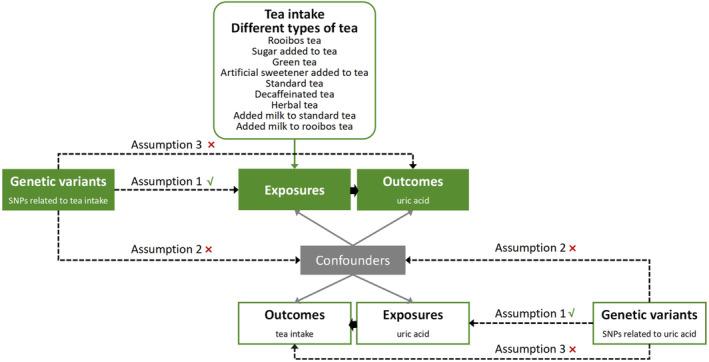
Bidirectional Mendelian randomization (MR) analysis based on genome-wide association studies was used to assess the causal relationship between consumption of different types of tea and the risk of elevated SUA levels in European and Asian populations.
RESULTS
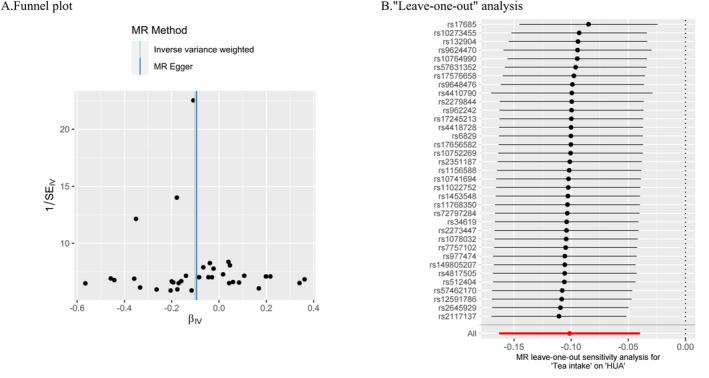
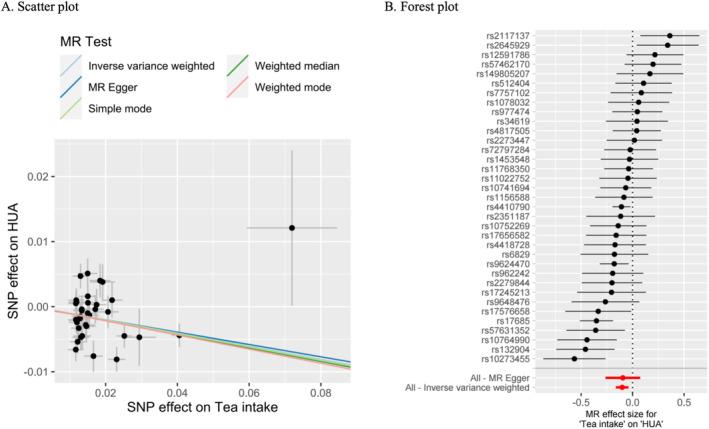
Forward MR analysis showed that tea intake was significantly associated with lower SUA levels (p = 0.0013). The estimated effect value ( -0.0440) suggests that for every 1-unit increase in tea intake, there is a 0.044-unit decrease in SUA levels. However, there is no reverse causality between SUA and tea intake (p = 0.2824). No causal relationship was found between the consumption of different types of tea and risk of elevated SUA levels (p > 0.05).
CONCLUSION
Although this bidirectional MR study provided evidence of a causal relationship between tea intake and SUA levels, however, due to limitations associated with the sample size and strength of instrumental variables, a definite conclusion was not possible.
背景
尽管最近的动物实验表明,饮茶可降低升高的血清尿酸(SUA)水平,但不同类型茶的摄入量与SUA水平之间的因果关系仍未确定。
方法
基于全基因组关联研究的双向孟德尔随机化(MR)分析,用于评估欧洲和亚洲人群中不同类型茶的摄入量与SUA水平升高风险之间的因果关系。
结果
正向MR分析表明,饮茶与较低的SUA水平显著相关(p = 0.0013)。估计效应值(-0.0440)表明,茶摄入量每增加1个单位,SUA水平就会降低0.044个单位。然而,SUA与茶摄入量之间不存在反向因果关系(p = 0.2824)。未发现不同类型茶的摄入量与SUA水平升高风险之间存在因果关系(p>0.05)。
结论
尽管这项双向MR研究提供了茶摄入量与SUA水平之间因果关系的证据,但是,由于样本量和工具变量强度的限制,无法得出明确的结论。
 Zotero 插件