
侵袭性大B细胞淋巴瘤患者在嵌合抗原受体T细胞治疗前进行桥接放疗的疗效。
Outcomes with bridging radiation therapy prior to chimeric antigen receptor T-cell therapy in patients with aggressive large B-cell lymphomas.
作者信息
Manzar Gohar S, Pinnix Chelsea C, Dudzinski Stephanie O, Marqueen Kathryn E, Cha Elaine E, Nasr Lewis F, Yoder Alison K, Rooney Michael K, Strati Paolo, Ahmed Sairah, Nze Chijioke, Nair Ranjit, Fayad Luis E, Wang Michael, Nastoupil Loretta J, Westin Jason R, Flowers Christopher R, Neelapu Sattva S, Gunther Jillian R, Dabaja Bouthaina S, Wu Susan Y, Fang Penny Q
机构信息
Department of Radiation Oncology, The University of Texas MD Anderson Cancer Center, Houston, TX, United States.
Department of Lymphoma/Myeloma, The University of Texas MD Anderson Cancer Center, Houston, TX, United States.
出版信息
Front Immunol. 2025 Jan 31;16:1517348. doi: 10.3389/fimmu.2025.1517348. eCollection 2025.
BACKGROUND
Select patients with relapsed/refractory aggressive B cell lymphoma may benefit from bridging radiation (bRT) prior to anti-CD19-directed chimeric antigen receptor T cell therapy (CAR-T). Here, we examined patient and treatment factors associated with outcomes and patterns of failure after bRT and CAR-T.
METHODS
We retrospectively reviewed adults with diffuse large B-cell lymphoma (DLBCL) who received bRT prior to axicabtagene ciloleucel, tisagenlecleucel, or lisocabtagene maraleucel between 11/2017-4/2023. Clinical/treatment characteristics, response, and toxicity were extracted. Survival was modeled using Kaplan-Meier or Cox regression models for events distributed over time, or binary logistic regression for disease response. Fisher's Exact Test or Mann-Whitney U methods were used.
RESULTS
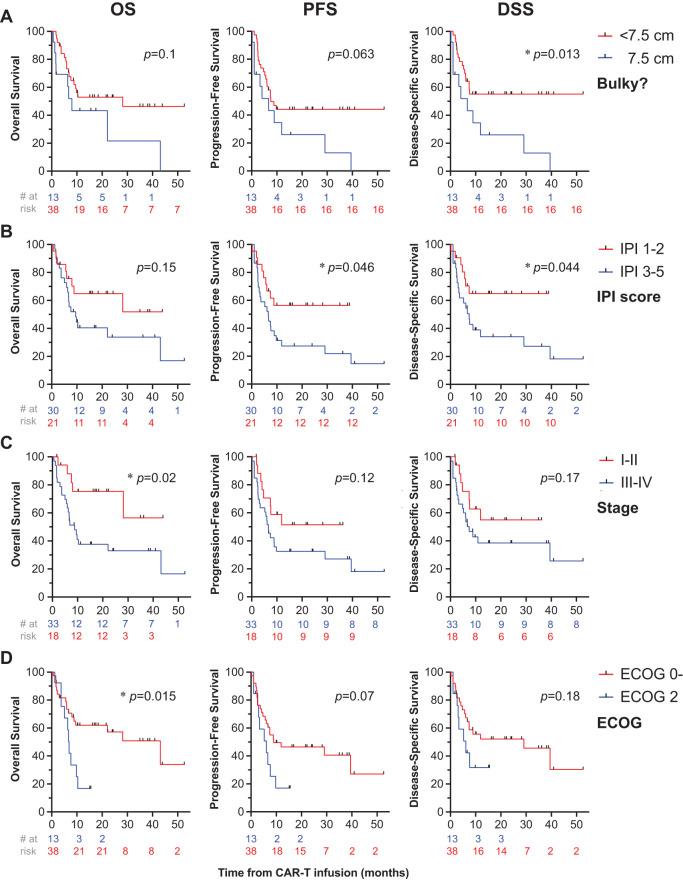
Of 51 patients, 25.5% had bulky disease and 64.7% had Stage III/IV disease at the time of RT. Comprehensive bRT alone to all disease sites was delivered to 51% of patients, and 29.4% were additionally bridged with systemic therapy. Median follow-up was 10.3 months (95% CI: 7.7-16.4). Overall response rate (ORR) was 82.4% at 30 days post-CAR-T infusion. Median overall survival (OS) was 22.1 months (6.6-not reached) and the median progression-free survival (PFS) was 7.4 months (5.5-30). OS/PFS were 80% (66-99)/78% (64-87) at 1-year, and 59% (44-71)/54% (40-67) at 2-years, respectively. Comprehensive RT to all sites of disease correlated with improved PFS and OS, 0.04. Additionally, ECOG ≥2 and Stage III/IV disease predicted poor OS ( 0.02). Disease bulk, IPI ≥3, and non-GCB histology were poor predictors for disease-specific survival (DSS), <0.05. The latter two, as well as bRT dose of ≤30 Gy predicted worse PFS (<0.05). Among patients with advanced stage disease, comprehensive bRT to all sites of disease (=10) was not associated with improved OS and PFS compared to focal bRT (=23), >0.17. No difference was seen in bridging RT vs. chemoRT. Twenty-six patients developed relapse (50.9%), of which 46% was in-field. Risk of in-field relapse correlated with bulky disease (OR=7, 95% CI: 1.2-41, =0.03) and lack of response at 30 day post-CAR-T evaluation (OR=16.8, 95% CI: 1.6-176, =0.02), but not with bRT dose (=0.27).
CONCLUSION
bRT and CART is a good treatment strategy for select patients with aggressive B cell lymphoma. Comprehensive bRT including all sites of disease is associated with improved outcomes.
背景
复发/难治性侵袭性B细胞淋巴瘤患者在接受抗CD19嵌合抗原受体T细胞疗法(CAR-T)之前,部分患者可能从桥接放疗(bRT)中获益。在此,我们研究了与bRT和CAR-T治疗后的结局及失败模式相关的患者和治疗因素。
方法
我们回顾性分析了2017年11月至2023年4月期间接受阿基仑赛、替雷利珠单抗或利基奥仑赛治疗前接受bRT的弥漫性大B细胞淋巴瘤(DLBCL)成人患者。提取临床/治疗特征、缓解情况和毒性反应。对于随时间分布的事件,使用Kaplan-Meier或Cox回归模型进行生存建模;对于疾病缓解情况,使用二元逻辑回归模型。采用Fisher精确检验或Mann-Whitney U检验方法。
结果
51例患者中,25.5%有大包块疾病,放疗时64.7%为Ⅲ/Ⅳ期疾病。51%的患者接受了针对所有疾病部位的全面bRT,29.4%的患者还接受了全身治疗桥接。中位随访时间为10.3个月(95%CI:7.7-16.4)。CAR-T输注后30天的总体缓解率(ORR)为82.4%。中位总生存期(OS)为22.1个月(6.6-未达到),中位无进展生存期(PFS)为7.4个月(5.5-30)。1年时的OS/PFS分别为80%(66-99)/78%(64-87),2年时分别为59%(44-71)/54%(40-67)。针对所有疾病部位的全面放疗与PFS和OS的改善相关,P = 0.04。此外,东部肿瘤协作组(ECOG)评分≥2以及Ⅲ/Ⅳ期疾病预示OS较差,P = 0.02。疾病大包块、国际预后指数(IPI)≥3和非生发中心B细胞(GCB)组织学是疾病特异性生存(DSS)的不良预测因素,P<0.05。后两者以及bRT剂量≤30 Gy预示PFS更差,P<0.05。在晚期疾病患者中,与局部bRT(n = 23)相比,针对所有疾病部位的全面bRT(n = 10)与OS和PFS的改善无关,P>0.17。桥接放疗与化疗放疗之间未见差异。26例患者出现复发(50.9%),其中46%为野内复发。野内复发风险与大包块疾病相关(比值比[OR]=7,95%CI:1.2-41,P = 0.03)以及CAR-T评估后30天无缓解相关(OR = 16.8,95%CI:1.6-176,P = 0.02),但与bRT剂量无关(P = 0.27)。
结论
bRT和CART是部分侵袭性B细胞淋巴瘤患者的良好治疗策略。包括所有疾病部位的全面bRT与更好的结局相关。



 Zotero 插件