
F-氟脱氧葡萄糖正电子发射断层扫描-计算机断层扫描用于预测乳腺癌患者新辅助化疗的病理完全缓解情况。
F-fluorodeoxyglucose positron emission tomography-computed tomography for predicting pathological complete response to neoadjuvant chemotherapeutic in breast cancer patients.
作者信息
Ge Chengchun, Shi Lukai, Tan Zhonghua
机构信息
Department of Nuclear Medicine, Affiliated Hospital of Nantong University, Nantong, China.
出版信息
Gland Surg. 2025 Jan 24;14(1):48-59. doi: 10.21037/gs-2024-568. Epub 2025 Jan 20.
BACKGROUND
Accurately predicting pathological complete response (pCR) to neoadjuvant chemotherapy (NACT) in breast cancer remains a clinical challenge. Current imaging-based models are limited in their ability to integrate key metabolic parameters to enhance prediction accuracy. This study aimed to develop and validate a nomogram using F-fluorodeoxyglucose (FDG) positron emission tomography/computed tomography (PET/CT) parameters, including maximum standardized uptake value (SUV), metabolic tumor volume (MTV), and total lesion glycolysis (TLG), to improve pCR prediction. These parameters, representing both tumor metabolic burden and activity, were hypothesized to collectively provide a robust means of predicting pCR.
METHODS
This retrospective cohort study enrolled 95 breast cancer (BC) patients who underwent F-FDG PET/CT before and after NACT. Patients were categorized into pCR (n=46) and non-pCR (n=49) groups based on postoperative pathological outcomes. Clinical and pathological characteristics, as well as changes in SUV, MTV, and TLG, were compared between the two cohorts. Logistic regression identified independent predictors of non-pCR. The dataset was then randomly divided into training (n=66) and validation (n=29) cohorts for nomogram construction and validation. The model's performance was evaluated using the area under the receiver operating characteristic (ROC) curve, calibration curves, and decision curve analysis.
RESULTS
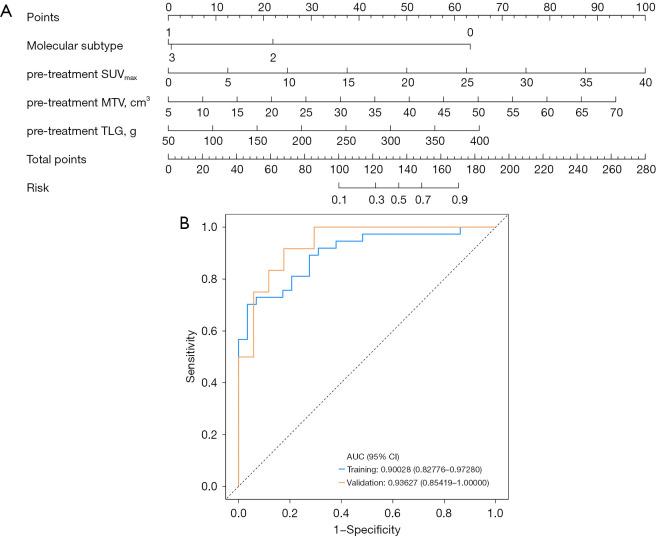
Relative to the non-pCR cohort, the pCR group exhibited smaller tumor diameters, lower Ki-67 expression, fewer lymph node metastases, and higher proportions of HER2+ molecular subtype (P<0.05). Pretreatment SUV, MTV, and TLG levels in the pCR group were significantly lower than those in the non-pCR group, and showed a marked decrease after treatment (P<0.05), whereas no significant changes were observed in the non-pCR group (P>0.05). SUV, MTV, TLG, and molecular subtype were identified as independent predictors of non-pCR through logistic regression analysis. A nomogram constructed using these predictors achieved area under the ROC curve (AUC) of 0.9003 and 0.9363 in the training and validation cohorts, respectively. The model demonstrated good calibration (Hosmer-Lemeshow test, χ=6.412, P=0.60) and clinical utility through decision curve analysis, effectively stratifying patients at high risk of non-pCR based on a cutoff value of 0.8230.
CONCLUSIONS
F-FDG PET/CT demonstrates significant clinical value in predicting pCR to NACT in BC patients. By integrating metabolic parameters such as SUV, MTV, and TLG into a nomogram, this approach enables accurate prediction of treatment efficacy, aiding in the early identification of patients unlikely to benefit from NACT. This facilitates timely adjustments to personalized treatment plans, optimizing clinical outcomes and resource allocation.
背景
准确预测乳腺癌新辅助化疗(NACT)后的病理完全缓解(pCR)仍然是一项临床挑战。当前基于影像学的模型在整合关键代谢参数以提高预测准确性方面存在局限性。本研究旨在开发并验证一种列线图,该列线图使用氟脱氧葡萄糖(FDG)正电子发射断层扫描/计算机断层扫描(PET/CT)参数,包括最大标准化摄取值(SUV)、代谢肿瘤体积(MTV)和总病灶糖酵解(TLG),以改善pCR预测。这些代表肿瘤代谢负担和活性的参数被认为共同提供了一种强大的预测pCR的方法。
方法
这项回顾性队列研究纳入了95例在NACT前后接受F-FDG PET/CT检查的乳腺癌(BC)患者。根据术后病理结果将患者分为pCR组(n = 46)和非pCR组(n = 49)。比较了两组患者的临床和病理特征,以及SUV、MTV和TLG的变化。逻辑回归确定了非pCR的独立预测因素。然后将数据集随机分为训练组(n = 66)和验证组(n = 29),用于列线图的构建和验证。使用受试者工作特征(ROC)曲线下面积、校准曲线和决策曲线分析评估模型的性能。
结果
与非pCR队列相比,pCR组肿瘤直径更小、Ki-67表达更低、淋巴结转移更少,且HER2+分子亚型比例更高(P < 0.05)。pCR组治疗前的SUV、MTV和TLG水平显著低于非pCR组,且治疗后显著降低(P < 0.05),而非pCR组未观察到显著变化(P > 0.05)。通过逻辑回归分析,SUV、MTV、TLG和分子亚型被确定为非pCR的独立预测因素。使用这些预测因素构建的列线图在训练组和验证组中的ROC曲线下面积(AUC)分别为0.9003和0.9363。该模型通过校准曲线(Hosmer-Lemeshow检验,χ = 6.412,P = 0.60)和决策曲线分析显示出良好的校准和临床实用性,根据截断值0.8230有效地对非pCR高风险患者进行分层。
结论
F-FDG PET/CT在预测BC患者对NACT的pCR方面具有显著的临床价值。通过将SUV、MTV和TLG等代谢参数整合到列线图中,这种方法能够准确预测治疗效果,有助于早期识别不太可能从NACT中获益的患者。这有助于及时调整个性化治疗方案,优化临床结果和资源分配。


 Zotero 插件