
在新加坡总医院实施由护士主导的术中血液回收服务对减少异体红细胞输注的影响。
Impact of implementing a nurse-led intraoperative cell saver service in reducing allogeneic red blood cell transfusions in Singapore General Hospital.
作者信息
He Yingke, Tan Yan Ru, Fu Jing, Gan Yu, Ang Ai Leen, Elisabeth Angelina, Abdullah Hairil Rizal
机构信息
Singapore General Hospital, Singapore.
Duke-NUS Medical School, Singapore.
出版信息
BMJ Open Qual. 2025 Feb 17;14(1):e003045. doi: 10.1136/bmjoq-2024-003045.
INTRODUCTION
Major perioperative blood loss often necessitates allogeneic blood transfusions, leading to adverse outcomes and straining healthcare resources. Intraoperative cell salvage (ICS) offers benefits like reduced adverse reactions, optimised blood resource allocation, and cost-effectiveness. Yet, ICS adoption remains limited. Our aim is to formalise and expand ICS as a routine service to promote wider adoption and improve patient outcomes.
METHODS
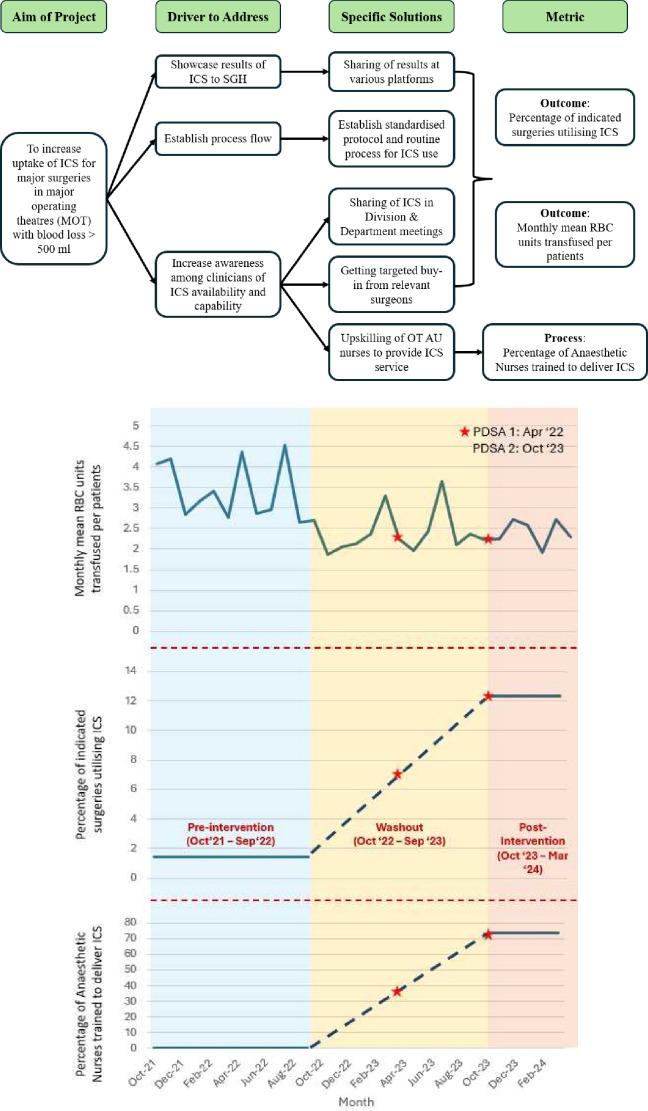
The model for improvement was adopted for an ICS quality improvement initiative across two Plan-Do-Study-Act cycles. Interventions followed the '4E' framework: education, empowerment, enforcement and embedding reminders. The primary outcome was the number of allogeneic red blood cell (RBC) units transfused per surgery with predicted blood loss >500 mL; the secondary outcome was the percentage of indicated surgeries using ICS. Process measure was percentage of anaesthetic unit nurses trained in ICS. Balancing measures included the number of ICS activations with no blood return and complications during and after ICS.
RESULTS
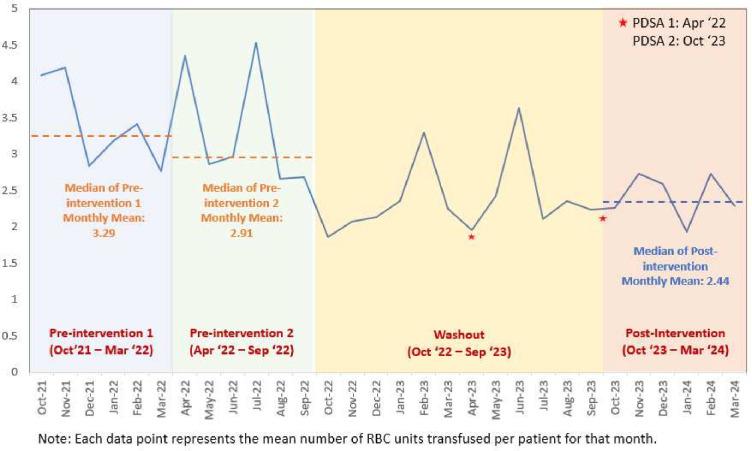
A total of 152 surgeries used ICS postintervention (January 2023 to April 2024), marking an increase from preintervention levels. The median number of monthly mean allogeneic RBC units transfused per patient demonstrated a significant reduction from 3.10 (preintervention) to 2.44 (postintervention). The percentage of indicated surgeries utilising ICS increased from 1.4% to 12.3%. Cost savings were observed, with potential annual savings close to SGD 500 000. No complications related to the use of ICS were recorded.
CONCLUSION
The formalisation and expansion of the ICS service within our institution resulted in notable improvements, including increased ICS adoption rates, reduced reliance on allogeneic blood transfusions and potential cost savings. Future quality improvement efforts should concentrate on further promoting ICS adoption, particularly for surgeries with clinical indications.
引言
围手术期大量失血常常需要输注异体血,这会导致不良后果并给医疗资源带来压力。术中血液回收(ICS)具有减少不良反应、优化血液资源分配和成本效益等益处。然而,ICS的应用仍然有限。我们的目标是将ICS规范化并扩大为常规服务,以促进更广泛的应用并改善患者预后。
方法
在两个“计划-实施-研究-改进”循环中,采用改进模型开展ICS质量改进项目。干预措施遵循“4E”框架:教育、授权、执行和嵌入提醒。主要结局是预计失血量>500 mL的手术中输注的异体红细胞(RBC)单位数量;次要结局是使用ICS的指定手术的百分比。过程指标是接受ICS培训的麻醉科护士的百分比。平衡指标包括ICS激活后无回血的次数以及ICS期间及之后的并发症。
结果
干预后(2023年1月至2024年4月)共有152例手术使用了ICS,较干预前有所增加。每位患者每月平均输注的异体RBC单位中位数从干预前的3.10显著降至干预后的2.44。使用ICS的指定手术的百分比从1.4%增至12.3%。观察到成本节约,潜在年度节约近50万新元。未记录到与使用ICS相关的并发症。
结论
在我们机构内将ICS服务规范化并扩大带来了显著改善,包括ICS采用率提高、对异体输血的依赖减少以及潜在的成本节约。未来的质量改进工作应集中于进一步促进ICS的应用,特别是对于有临床指征的手术。
 Zotero 插件