
基于人工智能的产程第二阶段持续时间预测:一项多中心回顾性队列分析
Artificial intelligence-based prediction of second stage duration in labor: a multicenter retrospective cohort analysis.
作者信息
Huang Xiaoqing, Di Xiaodan, Lin Suiwen, Yao Minrong, Zheng Suijin, Liu Shuyi, Lau Wayan, Ye Zhixin, Wang Zilian, Liu Bin
机构信息
Department of Obstetrics and Gynecology, The First Affiliated Hospital of Sun Yat-sen University, Guangzhou, China.
Guangdong Provincial Clinical Research Center for Obstetrical and Gynecological Diseases, Guangzhou, China.
出版信息
EClinicalMedicine. 2025 Jan 20;80:103072. doi: 10.1016/j.eclinm.2025.103072. eCollection 2025 Feb.
BACKGROUND
Duration of second stage of labor is crucial for fetal delivery, but the optimal length of this stage remains controversial. While extending the duration of second stage can reduce primary cesarean delivery rates, it may increase maternal and neonatal morbidities as the duration progresses. We aimed to develop a personalized machine learning (ML) model to predict the possible second-stage duration.
METHODS
This multicenter, retrospective study was conducted at four tertiary hospitals in China from September 2013 to October 2022. Data from three hospitals in Guangdong Province was selected as derivation set, and a geographically independent dataset from Fujian Province as the external validation set. Singleton vaginal deliveries with term live birth in a cephalic position were included. The primary outcome was the duration of the second stage of labor. Since durations beyond 3 h were rare, we developed binary classification models with thresholds at 1 h and 2 h. After the optimal features selected by recursive feature elimination (RFE) method, four ML algorithms were employed to build the models. The best model would be selected with the predictive performance and interpreted with Shapley Additive exPlanations method. The study is registered in Clinical Trial (ChiCTR2400085338).
FINDINGS
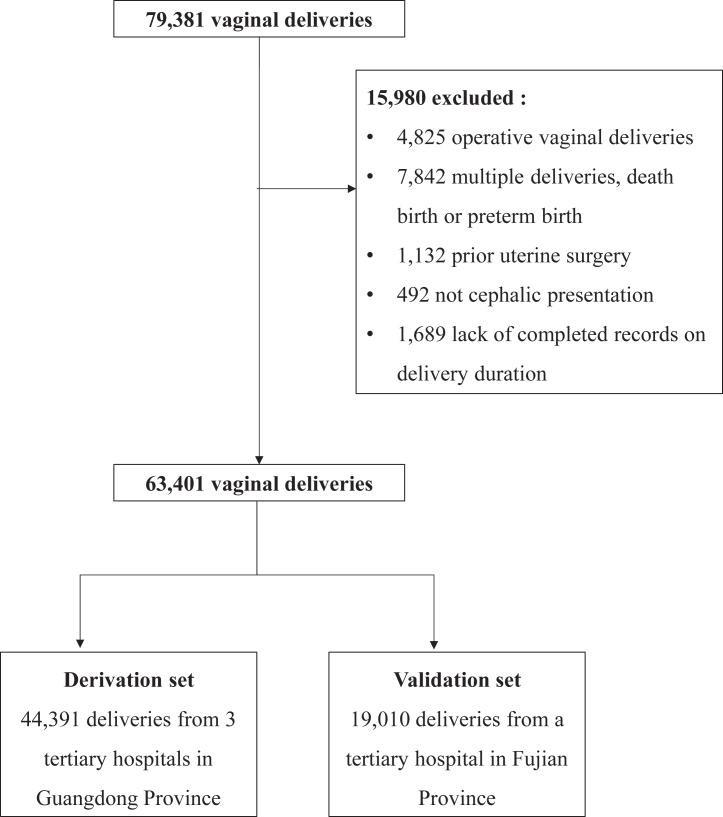
Electronic medical records of 79,381 vaginal deliveries were obtained, and 63,401 deliveries meeting the inclusion criteria were included in the final analysis. Eight risk features were selected through the RFE process. Gradient boosting machine implemented by decision tree models achieved the best performance, yielding areas under the curve for 1-h and 2-h models of 0.808 (95% confidence interval [CI] 0.797-0.819) and 0.824 (95% CI 0.804-0.843) in the testing set, and 0.862 (95% CI 0.854-0.870) and 0.859 (95% CI 0.843-0.875) in the external validation set, respectively.
INTERPRETATION
An explainable and reliable ML model was developed to predict the probable second-stage duration, which could assist in individualized labor management. Factors such as first-stage duration and maternal age are potential predictors for the second stage.
FUNDING
National Natural Science Foundation of China (No.82371689, N0.81771602), and National Key Research and Development Program of China (No.2021YFC2700703).
背景
第二产程的时长对胎儿娩出至关重要,但该阶段的最佳时长仍存在争议。虽然延长第二产程的时长可降低首次剖宫产率,但随着时长的增加,可能会增加孕产妇和新生儿的发病率。我们旨在开发一种个性化的机器学习(ML)模型来预测第二产程可能的时长。
方法
本多中心回顾性研究于2013年9月至2022年10月在中国的四家三级医院进行。来自广东省三家医院的数据被选作衍生集,来自福建省的一个地理上独立的数据集作为外部验证集。纳入单胎头位足月活产的阴道分娩。主要结局是第二产程的时长。由于超过3小时的时长很少见,我们开发了阈值分别为1小时和2小时的二元分类模型。在通过递归特征消除(RFE)方法选择最佳特征后,采用四种ML算法构建模型。将根据预测性能选择最佳模型,并采用夏普利加法解释法进行解释。该研究已在临床试验注册(ChiCTR2400085338)。
结果
获得了79381例阴道分娩的电子病历,最终分析纳入了63401例符合纳入标准的分娩。通过RFE过程选择了八个风险特征。由决策树模型实现的梯度提升机表现最佳,测试集中1小时和2小时模型的曲线下面积分别为0.808(95%置信区间[CI]0.797 - 0.819)和0.824(95%CI 0.804 - 0.843),外部验证集中分别为0.862(95%CI 0.854 - 0.870)和0.859(95%CI 0.843 - 0.875)。
解读
开发了一种可解释且可靠的ML模型来预测可能的第二产程时长,这有助于个体化的产程管理。第一产程时长和产妇年龄等因素是第二产程的潜在预测因素。
资助
中国国家自然科学基金(编号82371689、81771602),以及中国国家重点研发计划(编号2021YFC2700703)。



 Zotero 插件