
1990年至2021年期间,全球、区域和国家层面归因于高体重指数和低体力活动的缺血性心脏病负担。
Global, regional and national burden of ischaemic heart disease attributable to high body mass index and low physical activity from 1990 to 2021.
作者信息
Lin Wenwen, Jiang Xinye, Chen Jingyi, Yuan Yin, Li Qiaowei, Wu Hongkun, Huang Feng, Zhu Pengli
机构信息
Fuzhou University Affiliated Provincial Hospital, Fujian Provincial Hospital, Fuzhou, China.
Shengli Clinical Medical College of Fujian Medical University, Fuzhou, China.
出版信息
Diabetes Obes Metab. 2025 May;27(5):2561-2572. doi: 10.1111/dom.16256. Epub 2025 Feb 18.
AIM
This study aimed to estimate the distribution of and changes in the global burden of ischaemic heart disease (IHD) attributable to high body mass index (BMI) and low physical activity (PA) from 1990 to 2021.
METHODS
Data on deaths, disability-adjusted life years (DALYs) and age-standardized rates for IHD attributable to high BMI and low PA were extracted from the Global Burden of Disease 2021 study. Temporal trends by gender, region and Socio-Demographic Index (SDI) were analysed using joinpoint regression. Decomposition, health inequality analysis and Bayesian model were utilized.
RESULTS
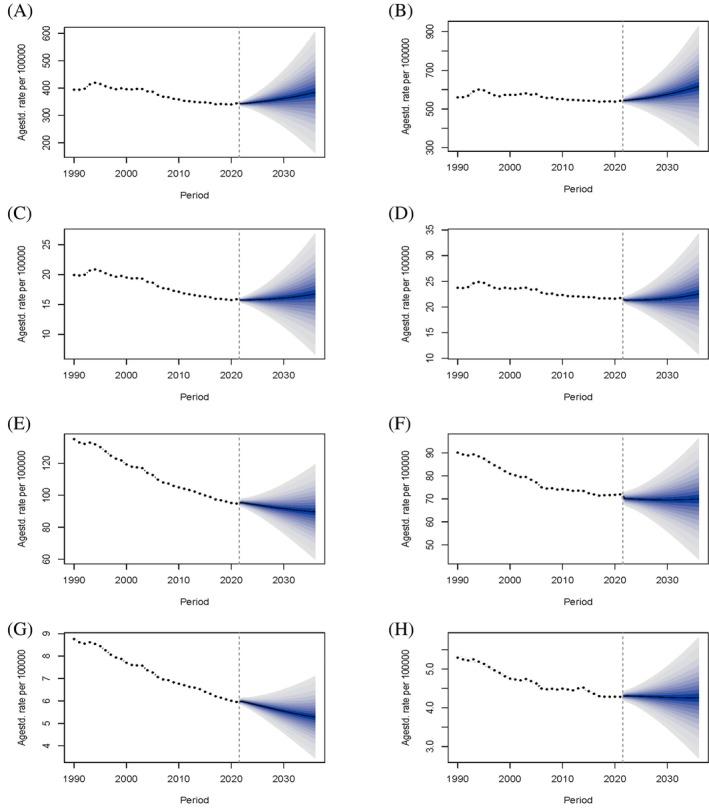
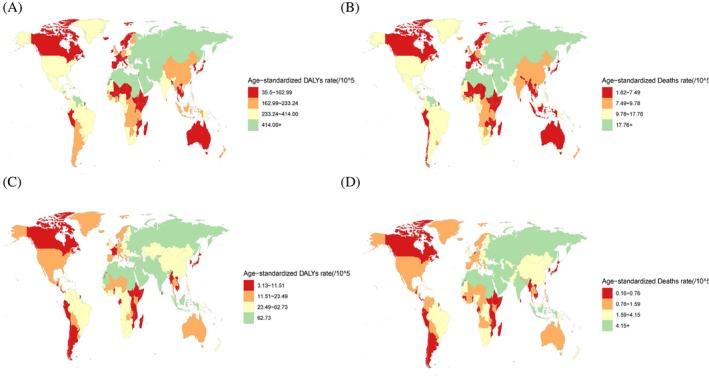
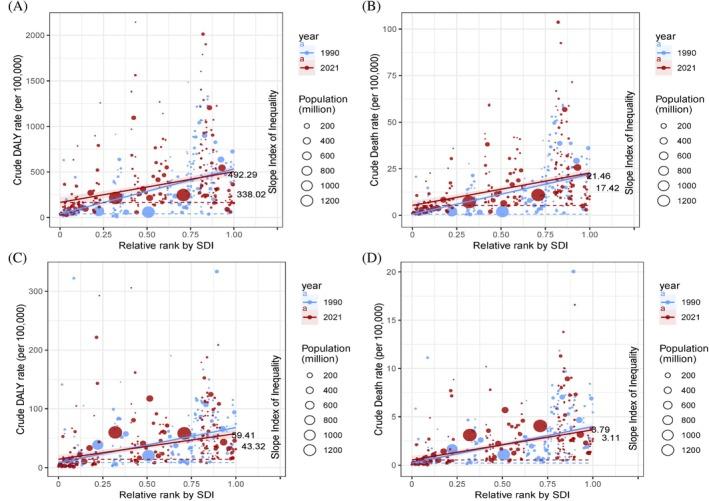
From 1990 to 2021, global DALYs and deaths for IHD attributable to high BMI and low PA nearly doubled, despite a decline in age-standardized DALYs ([average annual percent change (AAPC) = -0.26, 95% uncertainty interval (95% UI): -0.45, -0.07), (AAPC = -1.03, 95% UI:-1.18, -0.88]) and deaths rates ([AAPC = -0.53, 95% UI: -0.72, -0.33], [AAPC = -1.13,95% UI: -1.34, -0.92]), respectively. The burden of IHD due to high BMI was predominantly seen in males, while low PA was more prevalent in females. Significant regional and national variation was observed, with the burden shifting from high SDI regions to middle or low SDI regions. Population growth and aging have exacerbated this burden. Health inequities have shown improvement between 1990 and 2021. Projections for the next 15 years suggest rising global age-standardized DALYs and death rates of IHD attributable to high BMI, while those attributable to low PA may decrease.
CONCLUSIONS
Since 1990, the global and regional impact of IHD attributable to high BMI and low PA remains significant, with disparities by gender, age, region and SDI. Countries should implement effective measures to control BMI and promote PA to reduce the IHD burden.
目的
本研究旨在估计1990年至2021年期间,归因于高体重指数(BMI)和低体力活动(PA)的缺血性心脏病(IHD)全球负担的分布及变化情况。
方法
从《2021年全球疾病负担研究》中提取归因于高BMI和低PA的IHD的死亡数据、伤残调整生命年(DALYs)和年龄标准化率。使用连接点回归分析按性别、地区和社会人口指数(SDI)划分的时间趋势。采用分解法、健康不平等分析和贝叶斯模型。
结果
1990年至2021年期间,尽管年龄标准化DALYs有所下降([平均年变化百分比(AAPC)=-0.26,95%不确定区间(95%UI):-0.45,-0.07])以及死亡率([AAPC=-0.53,95%UI:-0.72,-0.33]),但归因于高BMI和低PA的IHD全球DALYs和死亡人数几乎翻了一番,([AAPC=-1.03,95%UI:-1.18,-0.88]),([AAPC=-1.13,95%UI:-1.34,-0.92])。归因于高BMI的IHD负担主要见于男性,而低PA在女性中更为普遍。观察到显著的地区和国家差异,负担从高SDI地区转移到中低SDI地区。人口增长和老龄化加剧了这一负担。1990年至2021年期间健康不平等情况有所改善。未来15年的预测表明,归因于高BMI的IHD全球年龄标准化DALYs和死亡率将上升,而归因于低PA的可能会下降。
结论
自1990年以来,归因于高BMI和低PA的IHD的全球和地区影响仍然很大,在性别、年龄、地区和SDI方面存在差异。各国应采取有效措施控制BMI并促进PA,以减轻IHD负担。


 Zotero 插件