
基于双时相F-FDG PET/CT,使用卷积神经网络预测磨玻璃结节的恶性风险。
Predicting malignant risk of ground-glass nodules using convolutional neural networks based on dual-time-point F-FDG PET/CT.
作者信息
Liu Yuhang, Wang Jian, Du Bulin, Li Yaming, Li Xuena
机构信息
Department of Nuclear Medicine, The First Hospital of China Medical University, No. 155 Nanjing St, Shenyang, 110001, China.
出版信息
Cancer Imaging. 2025 Feb 18;25(1):17. doi: 10.1186/s40644-025-00834-8.
BACKGROUND
Accurately predicting the malignant risk of ground-glass nodules (GGOs) is crucial for precise treatment planning. This study aims to utilize convolutional neural networks based on dual-time-point F-FDG PET/CT to predict the malignant risk of GGOs.
METHODS
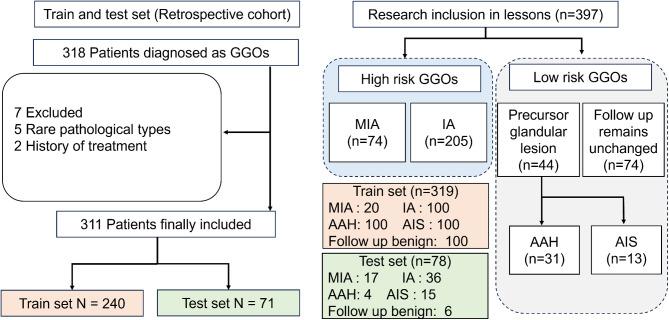
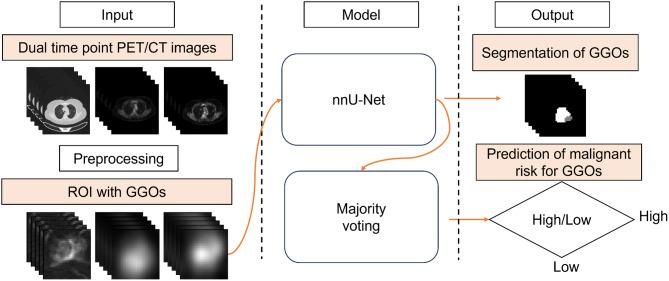
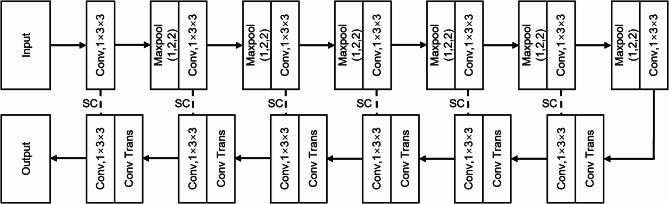
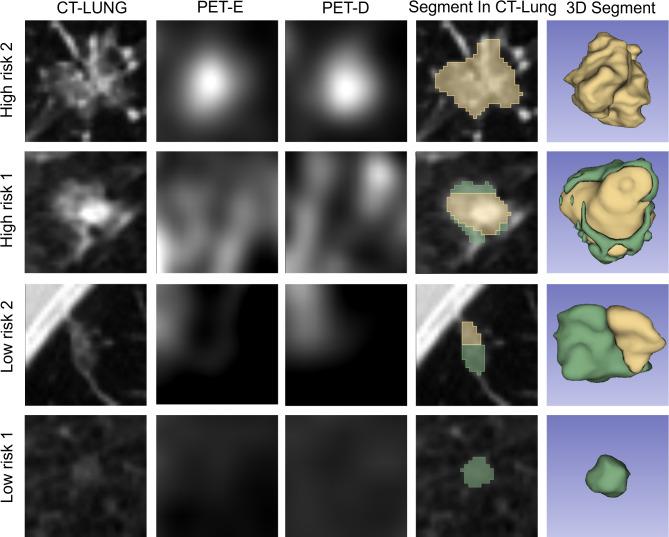
Retrospectively analyzing 311 patients with 397 GGOs, this study identified 118 low-risk GGOs and 279 high-risk GGOs through pathology and follow-up according to the new WHO classification. The dataset was randomly divided into a training set comprising 239 patients (318 lesions) and a testing set comprising 72 patients (79 lesions), we employed a self-configuring 3D nnU-net convolutional neural network with majority voting method to segment GGOs and predict malignant risk of GGOs. Three independent segmentation prediction models were developed based on thin-section lung CT, early-phase F-FDG PET/CT, and dual-time-point F-FDG PET/CT, respectively. Simultaneously, the results of the dual-time-point F-FDG PET/CT model on the testing set were compared with the diagnostic of nuclear medicine physicians.
RESULTS
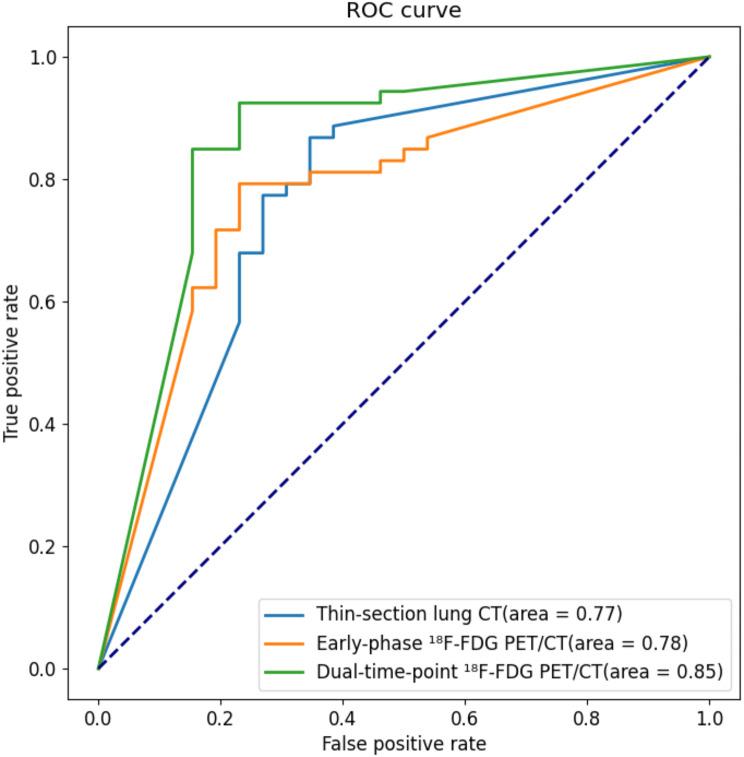
The dual-time-point F-FDG PET/CT model achieving a Dice coefficient of 0.84 ± 0.02 for GGOs segmentation and demonstrating high accuracy (84.81%), specificity (84.62%), sensitivity (84.91%), and AUC (0.85) in predicting malignant risk. The accuracy of the thin-section CT model is 73.42%, and the accuracy of the early-phase F-FDG PET/CT model is 78.48%, both of which are lower than the accuracy of the dual-time-point F-FDG PET/CT model. The diagnostic accuracy for resident, junior and expert physicians were 67.09%, 74.68%, and 78.48%, respectively. The accuracy (84.81%) of the dual-time-point F-FDG PET/CT model was significantly higher than that of nuclear medicine physicians.
CONCLUSIONS
Based on dual-time-point F-FDG PET/CT images, the 3D nnU-net with a majority voting method, demonstrates excellent performance in predicting the malignant risk of GGOs. This methodology serves as a valuable adjunct for physicians in the risk prediction and assessment of GGOs.
背景
准确预测磨玻璃结节(GGO)的恶性风险对于精确的治疗规划至关重要。本研究旨在利用基于双时相F-FDG PET/CT的卷积神经网络来预测GGO的恶性风险。
方法
本研究回顾性分析了311例患有397个GGO的患者,根据世界卫生组织新分类法,通过病理检查和随访确定了118个低风险GGO和279个高风险GGO。将数据集随机分为包含239例患者(318个病灶)的训练集和包含72例患者(79个病灶)的测试集,我们采用自配置的3D nnU-net卷积神经网络结合多数投票法对GGO进行分割并预测其恶性风险。分别基于薄层胸部CT、早期F-FDG PET/CT和双时相F-FDG PET/CT开发了三个独立的分割预测模型。同时,将双时相F-FDG PET/CT模型在测试集上的结果与核医学医师的诊断结果进行比较。
结果
双时相F-FDG PET/CT模型在GGO分割方面的Dice系数为0.84±0.02,在预测恶性风险方面表现出高准确率(84.81%)、特异性(84.62%)、敏感性(84.91%)和AUC(0.85)。薄层CT模型的准确率为73.42%,早期F-FDG PET/CT模型的准确率为78.48%,两者均低于双时相F-FDG PET/CT模型的准确率。住院医师、初级医师和专家医师的诊断准确率分别为67.09%、74.68%和78.48%。双时相F-FDG PET/CT模型的准确率(84.81%)显著高于核医学医师的准确率。
结论
基于双时相F-FDG PET/CT图像,采用多数投票法的3D nnU-net在预测GGO的恶性风险方面表现出色。该方法为医生在GGO的风险预测和评估中提供了有价值的辅助手段。
 Zotero 插件