
英格兰成年结肠癌患者中与虚弱相关的分期、治疗及净生存率的年龄差异:来自结直肠癌数据储存库(CORECT-R)资源的分析
Age-related differences in staging, treatment and net survival in relation to frailty in adults with colon cancer in England: an analysis of the COloRECTal cancer data repository (CORECT-R) resource.
作者信息
Pilleron Sophie, Birch Rebecca J, Taylor John, O'Hanlon Shane, Morris Eva J A
机构信息
Nuffield Department of Population Health, University of Oxford, Old Road Campus, Oxford OX1 2JD, UK.
Department of Precision Health, Luxembourg Institute of Health - Ageing, Cancer, and Disparities Research Unit, Department of Precision Health, Luxembourg Institute of Health, 1A-B, rue Thomas Edison, Strassen, L1445, Luxembourg.
出版信息
Age Ageing. 2025 Feb 2;54(2). doi: 10.1093/ageing/afaf025.
OBJECTIVE
To describe the distribution of disease stages, receipt of major surgery, 1-year net survival (NS) and 1-year conditional NS in relation to age and frailty in adults aged ≥50 diagnosed with colon cancer in England.
METHODS
We obtained data on adults aged 50-99 diagnosed with colon cancer between 2014 and 2019, followed up through December 2021, from the national population-based COloRECTal cancer Repository. Frailty was assessed using the Secondary Care Administrative Records Frailty (SCARF) index categorised into fit, mild, moderate and severe frailty. Data on major resection were obtained through linkage with Hospital Episode Statistics dataset. Major resection rates were calculated in adults with stage I-III cancer. Descriptive statistics were used as appropriate. One-year NS from cancer diagnosis and 1-year conditional NS were estimated using the Pohar-Perme estimator.
RESULTS
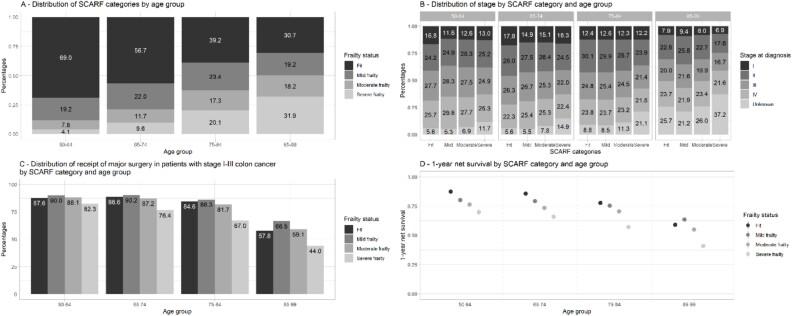
Out of 130 360 individuals (48% females-50% over 75), 48.9% were fit, ranging from 69% in the 50-64 age group to 31% in the 85-99 age group. Over 80% of adults with stage I-III cancer underwent a major resection. This percentage was 58% amongst fit adults aged over 85. One-year NS decreased as age increased across all frailty levels. Differences in NS between the 50-64 age group and the 85-99 age group were reduced in adults who survived beyond 1 year from diagnosis except for severely frail adults.
CONCLUSION
This population-based study shows that a non-negligible proportion of older adults diagnosed with colon cancer and deemed 'fit' through the SCARF did not receive surgery that may impact their survival.
目的
描述在英格兰≥50岁的成年结肠癌患者中,疾病分期、大手术接受情况、1年净生存率(NS)和1年条件性NS与年龄和虚弱程度的关系。
方法
我们从基于全国人口的结直肠癌数据库中获取了2014年至2019年间诊断为结肠癌、随访至2021年12月的50 - 99岁成年人的数据。使用二级医疗行政记录虚弱(SCARF)指数评估虚弱程度,分为健康、轻度、中度和重度虚弱。通过与医院事件统计数据集链接获取大切除的数据。计算I - III期癌症成年患者的大切除率。酌情使用描述性统计。使用波哈尔 - 珀尔梅估计器估计从癌症诊断起的1年NS和1年条件性NS。
结果
在130360名个体中(48%为女性,50%年龄超过75岁),48.9%为健康状态,在50 - 64岁年龄组中占69%,在85 - 99岁年龄组中占31%。超过80%的I - III期癌症成年患者接受了大切除。在85岁以上的健康成年患者中,这一比例为58%。在所有虚弱程度水平上,1年NS均随年龄增加而降低。除重度虚弱的成年人外,从诊断起存活超过1年的成年人中,50 - 64岁年龄组和85 - 99岁年龄组之间的NS差异有所减小。
结论
这项基于人群的研究表明,在通过SCARF被判定为“健康”的老年结肠癌患者中,有不可忽视的一部分没有接受可能影响其生存的手术。
 Zotero 插件