
免疫检查点抑制剂联合碘-125粒子植入治疗驱动基因阴性非小细胞肺癌的疗效与安全性:一项回顾性队列研究
Efficacy and safety of immune checkpoint inhibitors combined with iodine-125 seed implantation in driver gene-negative non-small cell lung cancer: a retrospective cohort study.
作者信息
Tao Xipeng, Liang Lan, Xu Junjie, Xie Lici, Wen Qing, Zhou Xiangdong, Luo Hu
机构信息
Department of Respiratory and Critical Care Medicine, First Affiliated Hospital of Army Medical University, Chongqing, China.
出版信息
J Thorac Dis. 2025 Jan 24;17(1):278-288. doi: 10.21037/jtd-24-1403. Epub 2025 Jan 22.
BACKGROUND
Non-small cell lung cancer (NSCLC) presents the most common type of lung cancer, accounting for 80-85% of cases. Combining immunotherapy with radiotherapy (RT) has emerged as a significant research area in recent years. However, the risk of radiation pneumonitis, especially in lung cancer patients, poses a significant concern. Iodine-125 (I) seed implantation offers a precise, less invasive alternative, minimizing damage to surrounding lung tissues and reducing side effects. This study aims to evaluate the safety and efficacy of I seed implantation combined with immune checkpoint inhibitors (ICIs) and chemotherapy (CT) in treating driver gene-negative NSCLC patients.
METHODS
Retrospective analysis of 95 patients with driver gene-negative NSCLC who presented to the First Affiliated Hospital of Army Medical University was conducted. Among them, 33 cases in the observation group were treated with I seed implantation combined with CT and ICIs (ICIs + CT + I), and 62 cases in the control group were treated with extracorporeal RT combined with CT and ICIs (ICIs + CT + RT). The primary observational endpoint was median progression-free survival (mPFS), while the secondary observational endpoints included the 1- and 2-year PFS rate and the incidence of adverse events.
RESULTS
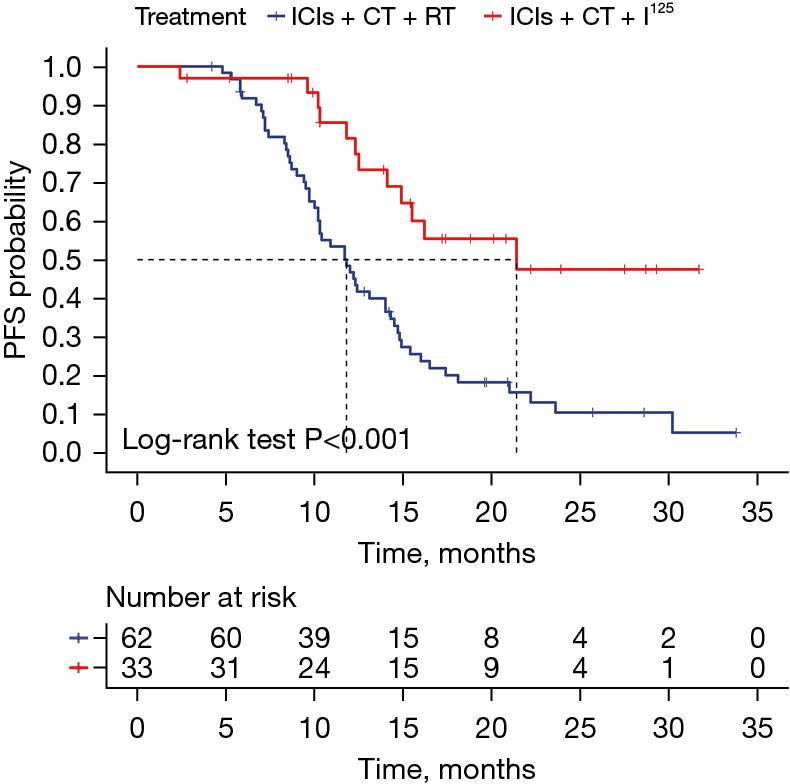
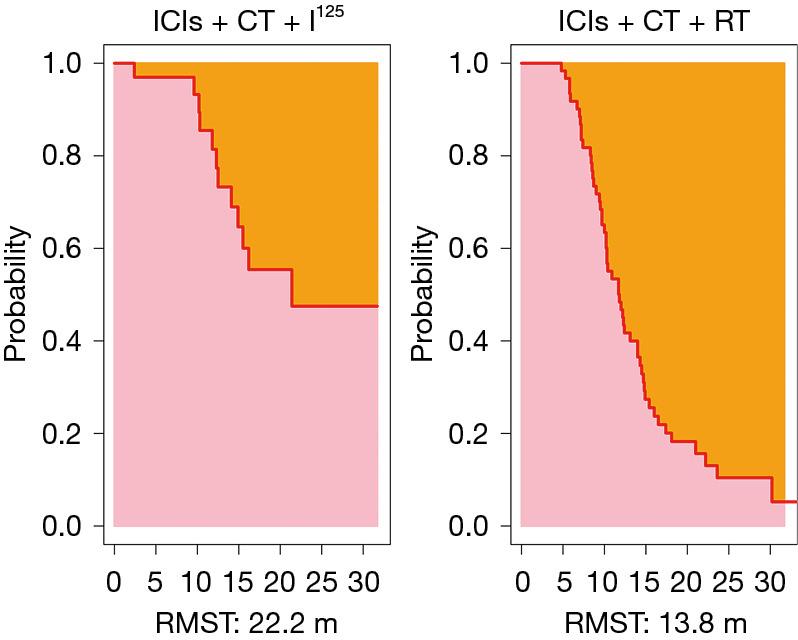
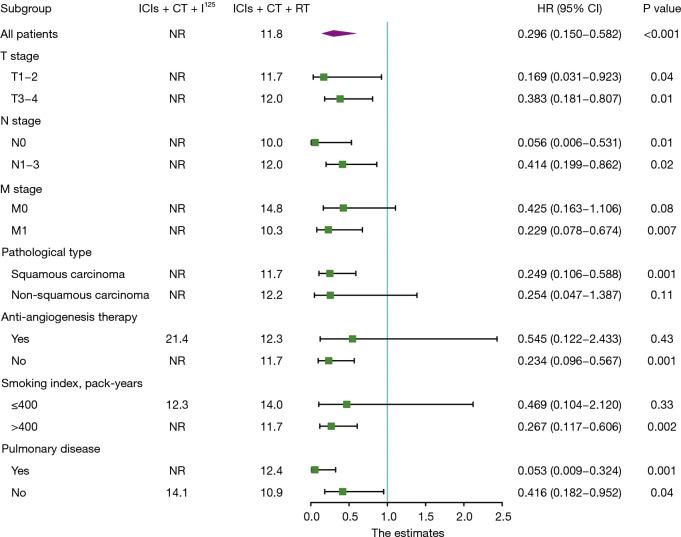
mPFS was not reached in the observation group but 11.8 months [95% confidence interval (CI): 9.743-13.857] in the control group, a statistically significant difference (P<0.001). The restricted mean survival time (RMST) was 22.2 (95% CI: 18.257-26.101) and 13.8 (95% CI: 11.912-15.718) months in both groups at 31.7 months, PFS was better in the observation group than in the control group. In the observation group, two cases (6.1%) developed grade 3 pneumothorax or hemorrhage, and in the control group, 16 cases (25.8%) developed grade 3 radiation pneumonitis, which was higher in the control group than in the observation group (P=0.02).
CONCLUSIONS
Compared to RT in combination with CT and immunotherapy, patients with driver gene-negative NSCLC who received I seed implantation had greater advantages with longer survival and fewer adverse effects.
背景
非小细胞肺癌(NSCLC)是最常见的肺癌类型,占病例的80 - 85%。近年来,免疫疗法与放射治疗(RT)相结合已成为一个重要的研究领域。然而,放射性肺炎的风险,尤其是在肺癌患者中,是一个重大问题。碘 - 125(I)粒子植入提供了一种精确、侵入性较小的替代方法,可将对周围肺组织的损伤降至最低并减少副作用。本研究旨在评估I粒子植入联合免疫检查点抑制剂(ICIs)和化疗(CT)治疗驱动基因阴性NSCLC患者的安全性和疗效。
方法
对陆军军医大学第一附属医院收治的95例驱动基因阴性NSCLC患者进行回顾性分析。其中,观察组33例采用I粒子植入联合CT和ICIs治疗(ICIs + CT + I),对照组62例采用体外RT联合CT和ICIs治疗(ICIs + CT + RT)。主要观察终点是中位无进展生存期(mPFS),次要观察终点包括1年和2年PFS率以及不良事件发生率。
结果
观察组未达到mPFS,而对照组为11.8个月[95%置信区间(CI):9.743 - 13.857],差异有统计学意义(P<0.001)。两组在31.7个月时的受限平均生存时间(RMST)分别为22.2(95%CI:18.257 - 26.101)和13.8(95%CI:11.912 - 15.718)个月,观察组的PFS优于对照组。观察组有2例(6.1%)发生3级气胸或出血,对照组有16例(25.8%)发生3级放射性肺炎,对照组高于观察组(P = 0.02)。
结论
与RT联合CT和免疫治疗相比,接受I粒子植入的驱动基因阴性NSCLC患者具有更大优势,生存期更长且不良反应更少。
 Zotero 插件