
2016 - 2017年至2022 - 2023年期间,意大利罗马一家大型医院实验室对除SARS-CoV-2之外的呼吸道病毒的检测
Detection of Respiratory Viruses Other Than SARS-CoV-2 in a Large Hospital Laboratory in Rome, Italy, During the Seasons 2016-2017 to 2022-2023.
作者信息
Liotti Flora Marzia, Marchetti Simona, D'Onghia Sara, Sanguinetti Maurizio, Santangelo Rosaria, Posteraro Brunella
机构信息
Dipartimento di Scienze di Laboratorio ed Ematologiche, Fondazione Policlinico Universitario A. Gemelli IRCCS, Rome, Italy.
Dipartimento di Scienze Biotecnologiche di Base, Cliniche Intensivologiche e Perioperatorie, Università Cattolica del Sacro Cuore, Rome, Italy.
出版信息
Influenza Other Respir Viruses. 2025 Feb;19(2):e70079. doi: 10.1111/irv.70079.
BACKGROUND AND OBJECTIVE
Respiratory viruses are major contributors to morbidity and mortality worldwide, with their circulation influenced by seasonal patterns and pandemic-related interventions. This study analyzed detection trends of non-SARS-CoV-2 respiratory viruses in a large Italian hospital over a 7-year period, focusing on variations across COVID-19-related periods and patient age groups.
METHODS
We retrospectively analyzed multiplex PCR-based laboratory results of 8836 nasopharyngeal samples collected between September 2016 and August 2023. Viral detection rates were stratified by season, COVID-19-related periods (pre-pandemic, pandemic, post-pandemic), and age groups.
RESULTS
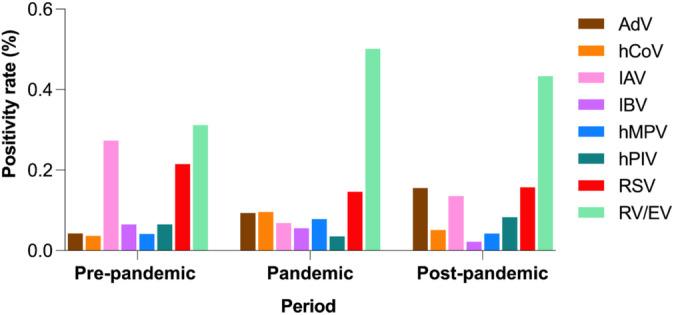
Of the 8836 nasopharyngeal samples analyzed, 2795 (31.6%) tested positive for at least one respiratory virus. Rhinovirus/enterovirus (RV/EV) was the most frequently detected virus (37.6%), followed by influenza A virus (IAV, 17.9%) and respiratory syncytial virus (RSV, 17.2%). The 2020-2021 season had the lowest positivity rate (p < 0.001), with marked declines in IAV and RSV detections, likely because of COVID-19 mitigation measures. Conversely, detections of RV/EV and human coronaviruses increased. Postpandemic data suggested a return to prepandemic patterns, though overall positivity rates remained altered. Age-stratified analysis revealed RSV predominance in infants (p < 0.001), emphasizing its clinical relevance in pediatric populations.
CONCLUSIONS
Our findings highlight the dynamic nature of respiratory virus epidemiology and the persistent impact of the COVID-19 pandemic on viral circulation. Continuous surveillance and adaptive public health strategies are essential for managing future outbreaks and mitigating the burden of respiratory viral infections.
背景与目的
呼吸道病毒是全球发病和死亡的主要原因,其传播受季节模式和与大流行相关的干预措施影响。本研究分析了一家大型意大利医院7年间非SARS-CoV-2呼吸道病毒的检测趋势,重点关注与COVID-19相关时期和患者年龄组的差异。
方法
我们回顾性分析了2016年9月至2023年8月期间收集的8836份鼻咽样本基于多重PCR的实验室结果。病毒检测率按季节、与COVID-19相关的时期(大流行前、大流行期间、大流行后)和年龄组进行分层。
结果
在分析的8836份鼻咽样本中,2795份(31.6%)至少一种呼吸道病毒检测呈阳性。鼻病毒/肠道病毒(RV/EV)是最常检测到的病毒(37.6%),其次是甲型流感病毒(IAV,17.9%)和呼吸道合胞病毒(RSV,17.2%)。2020 - 2021年季节阳性率最低(p < 0.001),IAV和RSV检测显著下降,可能是由于COVID-19缓解措施。相反,RV/EV和人冠状病毒的检测增加。大流行后的数据表明虽总体阳性率仍有变化,但已恢复到大流行前模式。年龄分层分析显示RSV在婴儿中占主导地位(p < 0.001),强调了其在儿科人群中的临床相关性。
结论
我们的研究结果突出了呼吸道病毒流行病学的动态性质以及COVID-19大流行对病毒传播的持续影响。持续监测和适应性公共卫生策略对于管理未来疫情和减轻呼吸道病毒感染负担至关重要。


 Zotero 插件