
老年患者移位型股骨颈骨折全髋关节置换术中骨水泥型与非骨水泥型股骨柄的长期疗效比较。
Long-term outcomes of cemented compared to uncemented femoral stems in total hip arthroplasty for displaced femoral neck fractures in elderly patients.
作者信息
Axenhus Michael, Chammout Ghazi, Kelly-Pettersson Paula, Mukka Sebastian, Magnéli Martin, Sköldenberg Olof
机构信息
Department of Clinical Sciences at Danderyd Hospital, Division of Orthopaedics, Karolinska Institutet, Stockholm, Sweden.
Department of Diagnostics and Intervention (Orthopaedics), Umeå University, Umeå, Sweden.
出版信息
Eur J Trauma Emerg Surg. 2025 Jan 24;51(1):73. doi: 10.1007/s00068-024-02735-0.
BACKGROUND
Total hip replacement (THR) is commonly used for active and lucid elderly patients with displaced femoral neck fractures (FNF). Historically, cemented stems have been favoured, demonstrating superior early outcomes. Controversy still exists regarding the use of cemented or uncemented stems in the most active group of patients with FNF and there is a need for extended follow-up studies to assess long-term outcome of cemented and uncemented stem results.
METHODS
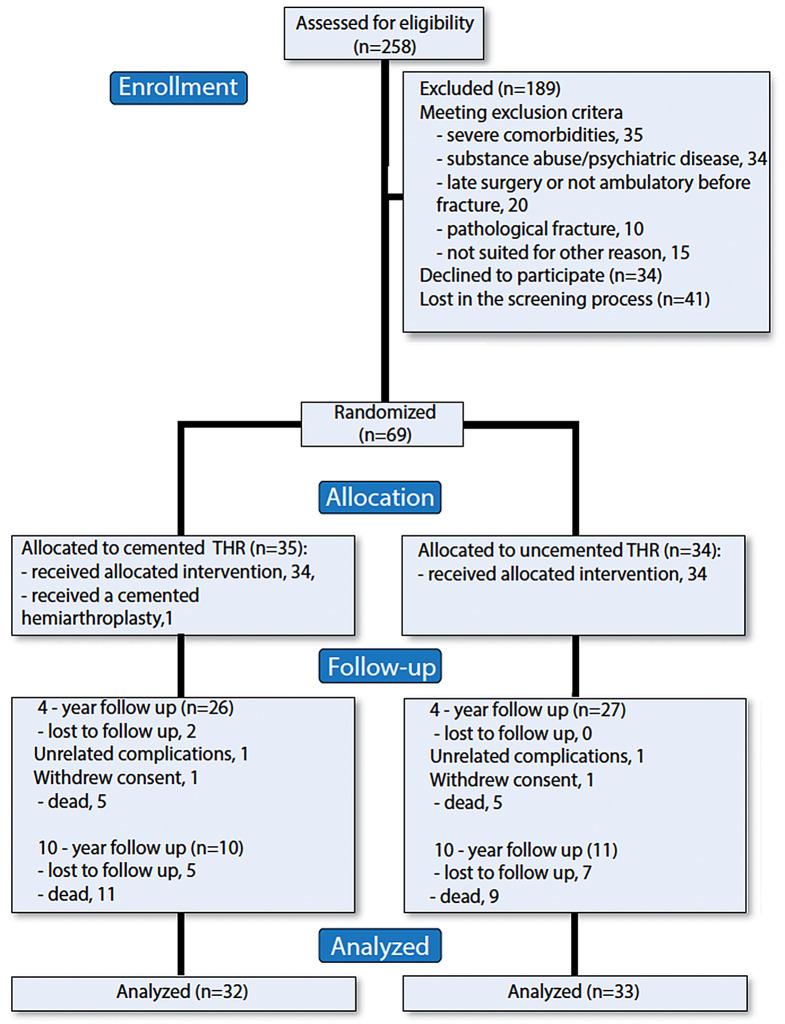
A 4 and 10-year follow-up was conducted on a single-centre, single-blinded, randomized controlled trial. Patients aged 65-79 years with an acute displaced FNF (Garden III-IV) were included, and surgeries were performed between 2009 and 2014. The study was terminated after an interim analysis indicated that the total number of early hip-related complications was substantially higher in the uncemented group. Baseline and follow-up assessments included hip-related complications, reoperations, health-related quality of life scores, Harris hip score and pain ratings.
RESULTS
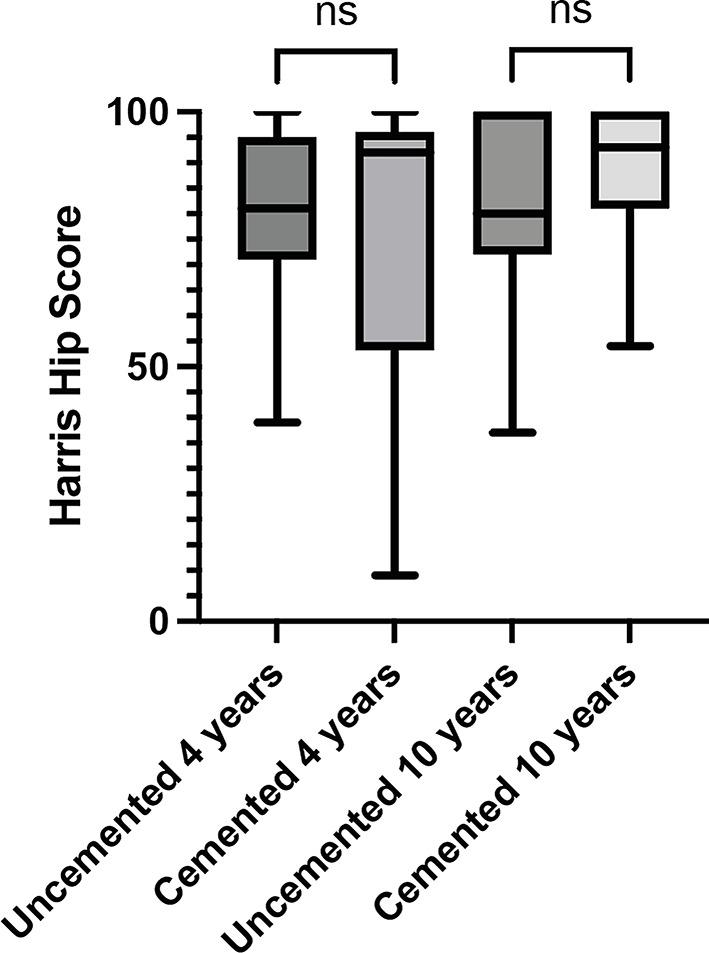
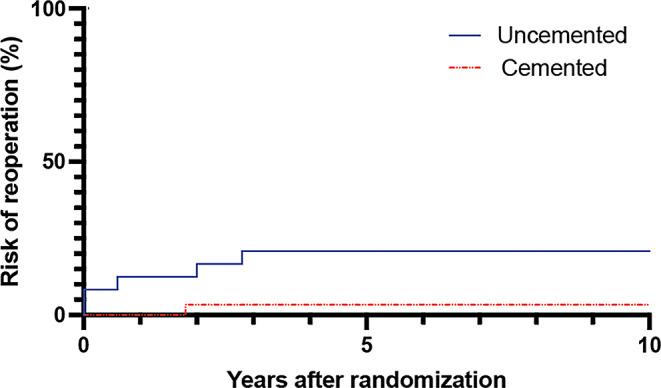
In total, 69 patients were randomized. At 4 years, there were 8 complications in the uncemented group and 2 complications in the cemented groups. The uncemented group had several periprosthetic fractures and dislocations necessitating revisions in several cases. From 4 to 10 years, the cemented group showed a single periprosthetic fracture, while none occurred in the uncemented group. The total number of complications during the study period were 8 in the uncemented group and 3 in the cemented group. The median Harris hip score for the uncemented group remained consistent at 81 for both the 4- and 10-year follow-ups. In contrast, the cemented group showed scores of 92 and 93 at the respective 4- and 10-year follow-ups, with no statistically significant difference between the two groups. Health-related quality of life and pain ratings were similar between groups throughout the study.
CONCLUSION
Our study presents a 10-year follow-up of uncemented femoral stems in THR for elderly FNF patients. Our findings not only underscore the importance of cautious decision-making in selecting patients for uncemented implants, but also highlight that most patients suitable for THR would benefit from a cemented arthroplasty to avoid an increased risk of short-term complications.
背景
全髋关节置换术(THR)常用于活跃且神志清醒的老年股骨颈移位骨折(FNF)患者。从历史上看,骨水泥型假体柄一直更受青睐,早期疗效更佳。对于最活跃的FNF患者群体,使用骨水泥型或非骨水泥型假体柄仍存在争议,因此需要进行长期随访研究以评估骨水泥型和非骨水泥型假体柄的长期效果。
方法
对一项单中心、单盲、随机对照试验进行了4年和10年的随访。纳入年龄在65 - 79岁的急性股骨颈移位骨折(Garden III - IV型)患者,手术于2009年至2014年期间进行。中期分析表明非骨水泥组早期髋关节相关并发症总数显著更高后,该研究终止。基线和随访评估包括髋关节相关并发症、再次手术、健康相关生活质量评分、Harris髋关节评分和疼痛评级。
结果
总共69例患者被随机分组。4年时,非骨水泥组有8例并发症,骨水泥组有2例并发症。非骨水泥组有几例假体周围骨折和脱位,需要进行多次翻修。从4年到10年,骨水泥组出现1例假体周围骨折,而非骨水泥组未出现。研究期间非骨水泥组并发症总数为8例,骨水泥组为3例。非骨水泥组4年和10年随访时Harris髋关节评分中位数均为81分,保持一致。相比之下,骨水泥组在4年和10年随访时分别为92分和93分,两组之间无统计学显著差异。在整个研究过程中,两组健康相关生活质量和疼痛评级相似。
结论
我们的研究对老年FNF患者THR中使用非骨水泥股骨柄进行了10年随访。我们的研究结果不仅强调了在选择非骨水泥植入物患者时谨慎决策的重要性,还突出了大多数适合THR的患者将从骨水泥关节置换术中受益,以避免短期并发症风险增加。
 Zotero 插件