
白质微观结构完整性介导了产前内分泌干扰化学物暴露与青少年智力之间的关联。
White matter microstructural integrity mediates associations between prenatal endocrine-disrupting chemicals exposure and intelligence in adolescents.
作者信息
Wang Shi-Ming, Wen Hui-Ju, Huang Fan, Sun Chien-Wen, Huang Chih-Mao, Wang Shu-Li
机构信息
Department of Biological Science and Technology, National Yang Ming Chiao Tung University, Taiwan; Center for Intelligent Drug Systems and Smart Bio-devices (IDS(2)B), National Yang Ming Chiao Tung University, Taiwan; Department of Computer Science, National Yang Ming Chiao Tung University, Taiwan.
Institute of Earth Science, Academia Sinica, Taipei, Taiwan; National Institute of Environmental Health Sciences, National Health Research Institutes, Miaoli, Taiwan.
出版信息
Neuroimage Clin. 2025;45:103758. doi: 10.1016/j.nicl.2025.103758. Epub 2025 Feb 17.
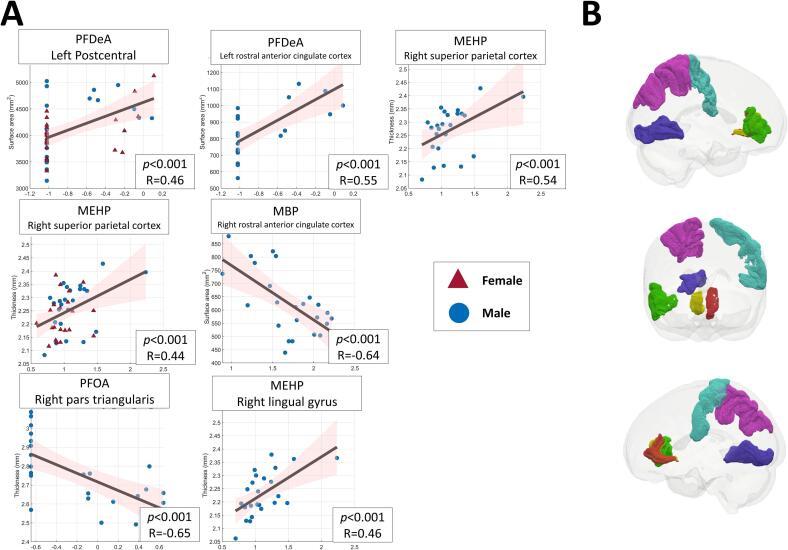
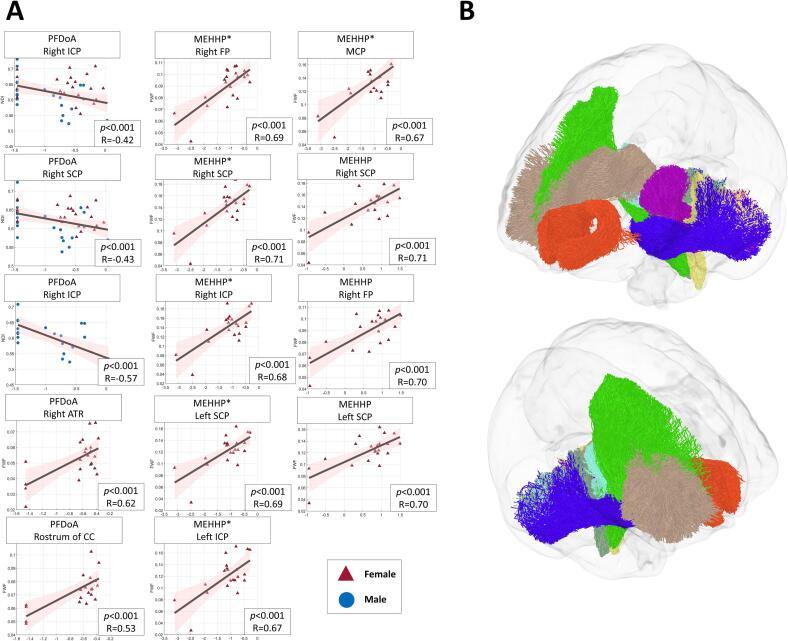
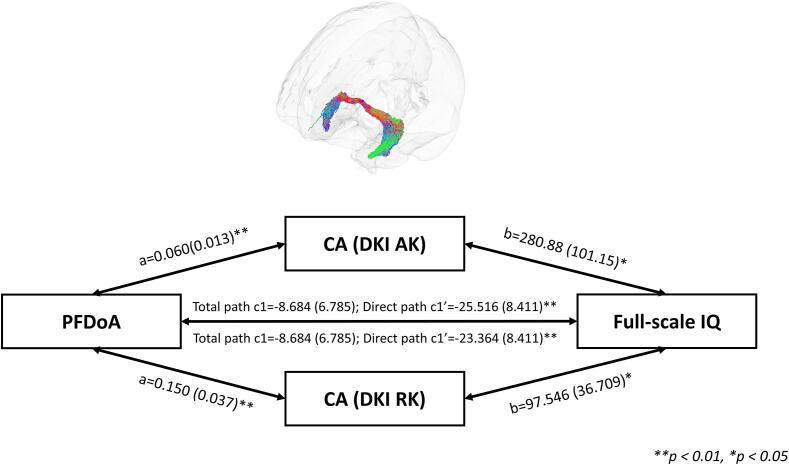
Per- and polyfluoroalkyl substances (PFAS) and phthalic acid esters (PAEs) are well-known endocrine-disrupting chemicals (EDCs) that potentially affect child neurodevelopment. We aimed to investigate the effects of prenatal exposure to PFAS and PAEs on macro- and micro-structural brain development and intelligence in adolescents using multimodal neuroimaging techniques. We employed structural magnetic resonance imaging (MRI) and various diffusion MRI techniques, including diffusion tensor imaging (DTI), diffusion kurtosis imaging (DKI), and neurite orientation dispersion and density imaging (NODDI), to assess the gray-matter macrostructure and white-matter microstructural integrity and complexity. Participants were drawn from a birth cohort of 52 mother-child pairs in central Taiwan recruited in 2001, and the adolescent intelligence quotient (IQ) scores were assessed using the Wechsler Intelligence Scale. Nine PFAS concentrations of cord blood and maternal serum samples were obtained from the children's mothers during the third trimester of pregnancy (27-40 weeks) using a liquid chromatography system coupled to a triple-quadrupole mass spectrometer, while maternal urinary phthalates were used to evaluate PAEs exposure. Our results showed significant associations between prenatal exposure to PFAS and phthalates with changes in specific fronto-parietal regions of the adolescent male brain, including reduced cortical thickness in the inferior frontal gyrus and right superior parietal cortex, which are involved in language, memory, and executive function. A dose-response association was observed, with higher levels of PFAS and PAE exposure modulating altered white-matter fiber integrity in the superior cerebellar peduncle and inferior cerebellar peduncle of the male and female adolescent brains. In addition, higher levels of prenatal exposure to EDCs were associated with lower IQ scores in adolescents. Mediation analyses further revealed that white-matter microstructure of inter-hemispheric and cerebellar fibers mediated the association between prenatal EDC exposure and adolescent IQ scores in female adolescents. Our multimodal human neuroimaging findings suggest that prenatal exposure to EDCs may have long-lasting effects on neuroanatomical development, neural fiber connectivity, and intelligence in adolescents, and highlight the importance of using advanced diffusion imaging techniques, including DKI and NODDI, to detect neurodevelopmental changes and their brain-behavioral consequences with the risks associated with these environmental exposures.
全氟和多氟烷基物质(PFAS)以及邻苯二甲酸酯(PAEs)是众所周知的内分泌干扰化学物质(EDCs),可能会影响儿童神经发育。我们旨在使用多模态神经成像技术,研究产前暴露于PFAS和PAEs对青少年大脑宏观和微观结构发育以及智力的影响。我们采用结构磁共振成像(MRI)和各种扩散MRI技术,包括扩散张量成像(DTI)、扩散峰度成像(DKI)和神经突方向离散度与密度成像(NODDI),来评估灰质宏观结构和白质微观结构的完整性与复杂性。参与者来自2001年在台湾中部招募的52对母婴的出生队列,青少年智商(IQ)分数使用韦氏智力量表进行评估。在妊娠晚期(27 - 40周),使用液相色谱系统与三重四极杆质谱仪联用,从儿童母亲处获取脐带血和母体血清样本中的9种PFAS浓度,同时使用母体尿邻苯二甲酸盐来评估PAEs暴露情况。我们的结果显示,产前暴露于PFAS和邻苯二甲酸盐与青少年男性大脑特定额顶区域的变化之间存在显著关联,包括额下回和右上顶叶皮质的皮质厚度降低,这些区域与语言、记忆和执行功能有关。观察到剂量反应关系,较高水平的PFAS和PAE暴露调节了青少年男性和女性大脑上小脑脚和下小脑脚中白质纤维完整性的改变。此外,较高水平的产前暴露于EDCs与青少年较低的IQ分数相关。中介分析进一步表明,半球间和小脑纤维的白质微观结构介导了产前EDC暴露与女性青少年IQ分数之间的关联。我们的多模态人类神经成像研究结果表明,产前暴露于EDCs可能对青少年的神经解剖发育、神经纤维连接性和智力产生长期影响,并强调使用先进的扩散成像技术(包括DKI和NODDI)来检测神经发育变化及其脑行为后果以及这些环境暴露相关风险的重要性。

 Zotero 插件